
Pineapple Drink With Nata De Coco Sees Growing Global Demand As Consumers Seek Tropical Refreshment
The combination of sweet, tangy pineapple juice with chewy nata de coco cubes has emerged as a standout product category in the ready-to-drink market, attracting attention from distributors, retailers, and private-label buyers seeking differentiated offerings. According to industry analysts, the tropical beverage segment continues to expand at a steady pace, driven by shifting consumer preferences toward authentic fruit-based drinks with playful, sensory elements.
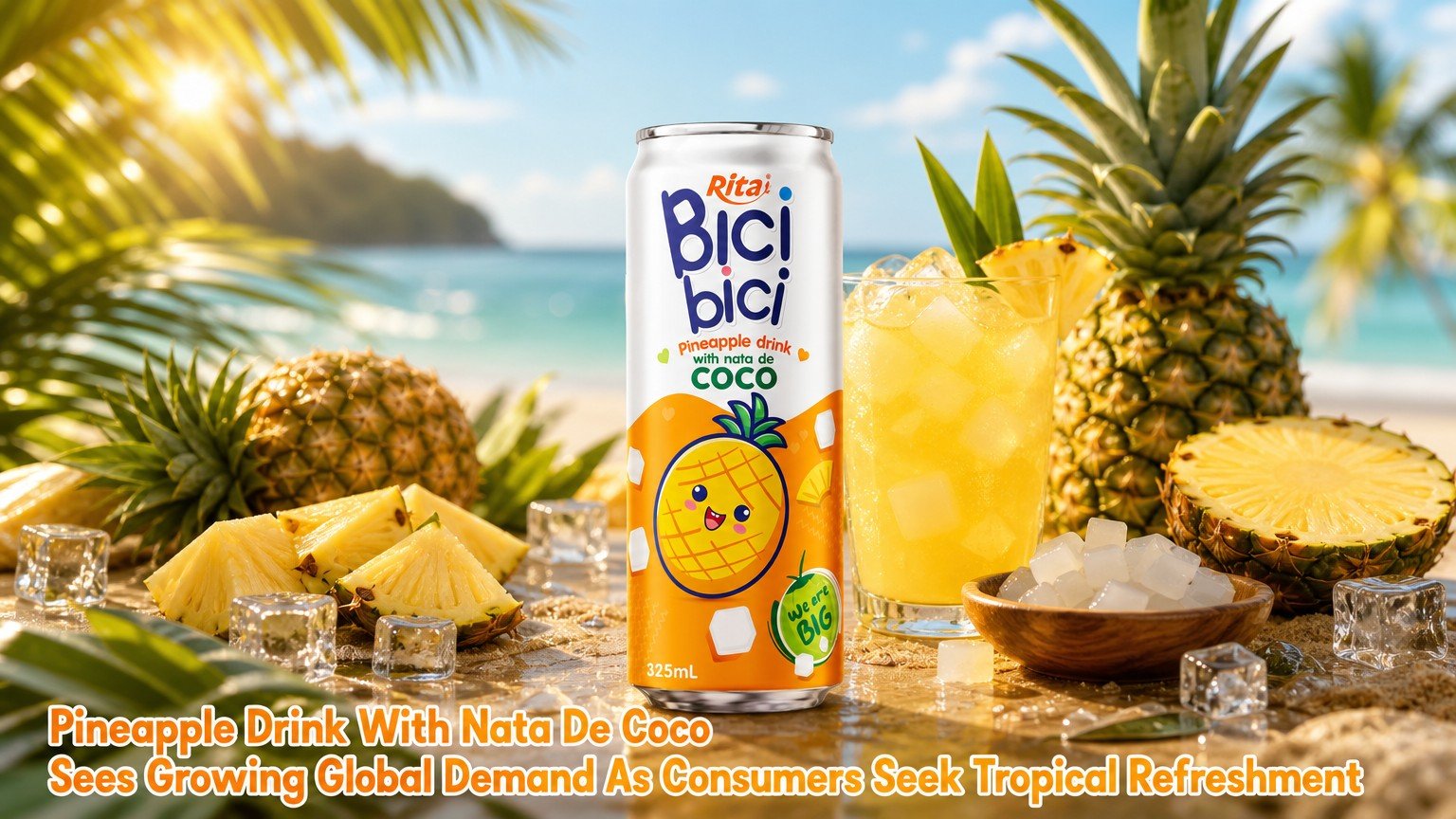
Key Takeaways
- Global pineapple drink with nata de coco demand is rising across Americas, Europe, Asia, Middle East, Africa, and Oceania
- Wide-opening cans enhance the drinking and eating experience for textured beverages
- OEM manufacturers like RITA Food and Drink Co., Ltd offer scalable production for private-label tropical beverages
- Halal, BRC, FSSC 22000, and other certifications open doors in diverse international markets
Global Market Opportunity for Pineapple Drinks With Nata De Coco
The market for pineapple drinks with nata de coco is experiencing a notable shift. While pineapple-flavored beverages have long been popular in Southeast Asia, demand is now expanding rapidly across the Americas, Europe, the Middle East, and Africa. This growth is fueled by a broader consumer movement toward fruit-based, ready-to-drink products that offer more than just flavor — they deliver an experience.
Textured beverages, including those containing nata de coco, have carved out a distinct niche. Nata de coco, a chewy, translucent gel derived from coconut water fermentation, adds a tactile dimension that appeals to younger demographics and adventurous consumers. When paired with pineapple's natural sweetness and acidity, the result is a product that stands out on retail shelves and in foodservice channels alike.
Market research firms have tracked a consistent uptick in export volumes for canned tropical beverages from Southeast Asia, particularly from Vietnam, which has become a major production hub. The country's proximity to raw material sources — including pineapple plantations in the Mekong Delta — gives manufacturers a competitive advantage in terms of cost and freshness.
Why Wide-Opening Cans Matter for Consumer Experience
One notable innovation in the category is the adoption of wide-opening cans for beverages containing solid or semi-solid ingredients. Traditional slim-opening cans, designed primarily for liquid beverages, present a practical challenge when consumers attempt to drink or consume chunky inclusions like nata de coco cubes.
Wide-opening can technology addresses this barrier directly. The wider aperture allows consumers to enjoy both the liquid and the nata de coco pieces seamlessly, enhancing the overall product experience. For brands and private-label buyers, this packaging choice signals attention to consumer needs and can serve as a meaningful differentiator in a crowded market.
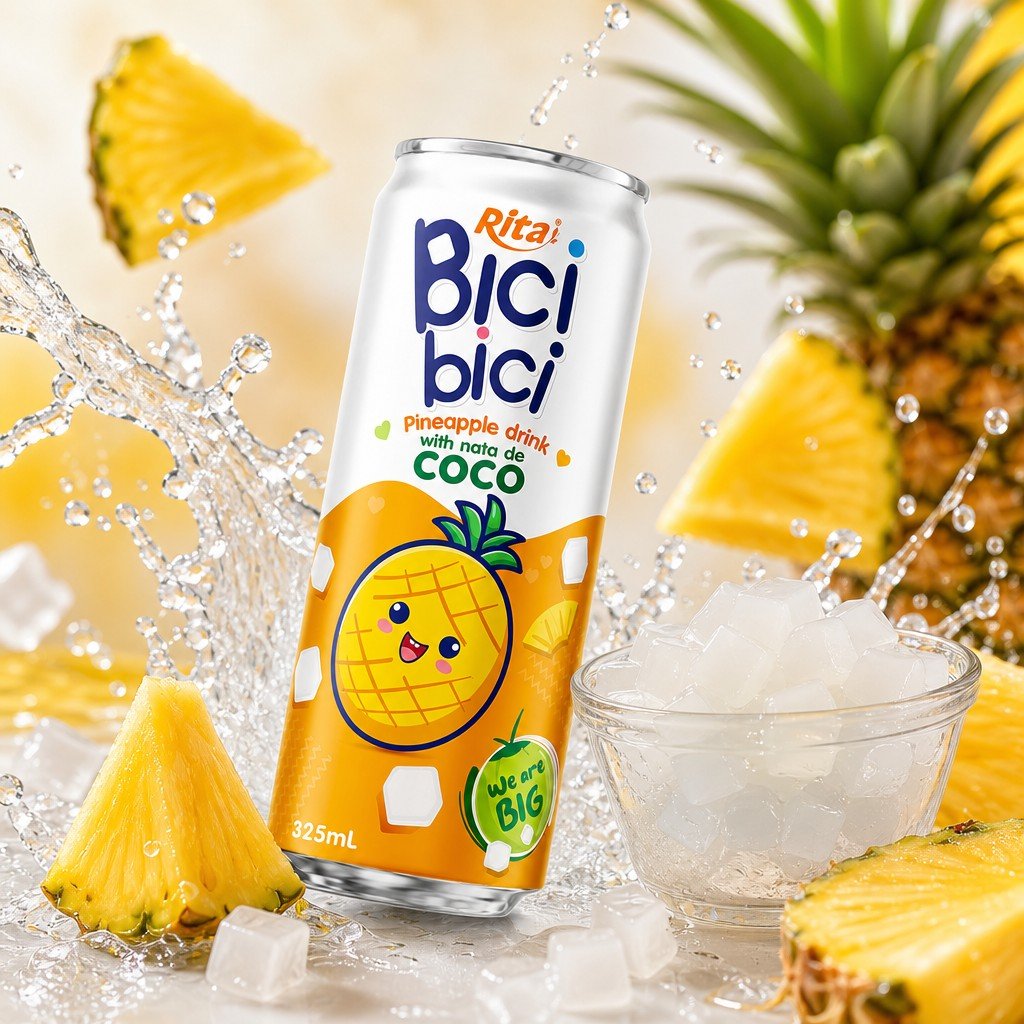
The Bici Bici 325ml Pineapple Drink With Nata De Coco exemplifies this approach. Its wide-opening aluminum can is designed to deliver the full tropical experience — the bright, refreshing pineapple liquid alongside visible nata de coco pieces — in a format that is both convenient and visually appealing. The 325ml serving size aligns with global single-serve consumption patterns, making it suitable for convenience stores, vending machines, and impulse-buy retail placements.
RITA's OEM Capabilities for Tropical Beverage Production
For businesses seeking to capitalize on the growing demand for pineapple drinks with nata de coco, partnering with an experienced OEM manufacturer is essential. RITA Food and Drink Co., Ltd, established in 2004, has built a reputation as one of Vietnam's leading beverage manufacturers and exporters. The company operates over 50 automated production lines and exports more than 1,200 containers monthly to over 200 countries and territories worldwide.
RITA's tropical beverage portfolio spans a wide range of products, from fruit juices to coconut-based drinks, and the company offers both OEM and ODM services. This flexibility allows brand owners to either bring their own formulations to production or collaborate with RITA's R&D team to develop entirely new products. The company's experience in manufacturing textured beverages — including products with nata de coco, aloe vera, and basil seeds — positions it as a capable partner for brands entering or expanding within the category.
With a minimum order quantity of just 500 cartons and a delivery timeline of 20 to 25 days after order confirmation, RITA provides an accessible entry point for small to mid-sized brands looking to test new markets without committing to large production volumes. FOB pricing is available upon request, with port of departure at Ho Chi Minh City, Vietnam.
Certifications That Open Global Doors
Entering diverse international markets requires navigating a complex web of regulatory and certification requirements. RITA's pineapple drinks with nata de coco and its broader product portfolio carry an extensive set of certifications, including Halal (Jakim and HCA-GCC), BRC, FSSC 22000, Kosher, ISO, GMP, HACCP, and SMETA. These certifications are particularly significant for exporters targeting markets in the Middle East, Southeast Asia, and parts of Africa, where Halal compliance is a prerequisite for retail distribution.
The breadth of RITA's certification portfolio also facilitates smoother entry into European and North American markets, where food safety standards such as BRC and FSSC 22000 are increasingly expected by major retail chains and foodservice operators. For private-label buyers, this eliminates the need to invest in separate certification processes, accelerating time-to-market significantly.
Explore RITA's full range of tropical beverage offerings through their fruit drinks catalog or learn more about their coconut products, which include nata de coco-based beverages.
Tropical Beverage Trends Shaping the Global Market
Several macro trends are converging to create favorable conditions for pineapple drinks with nata de coco in the global marketplace.
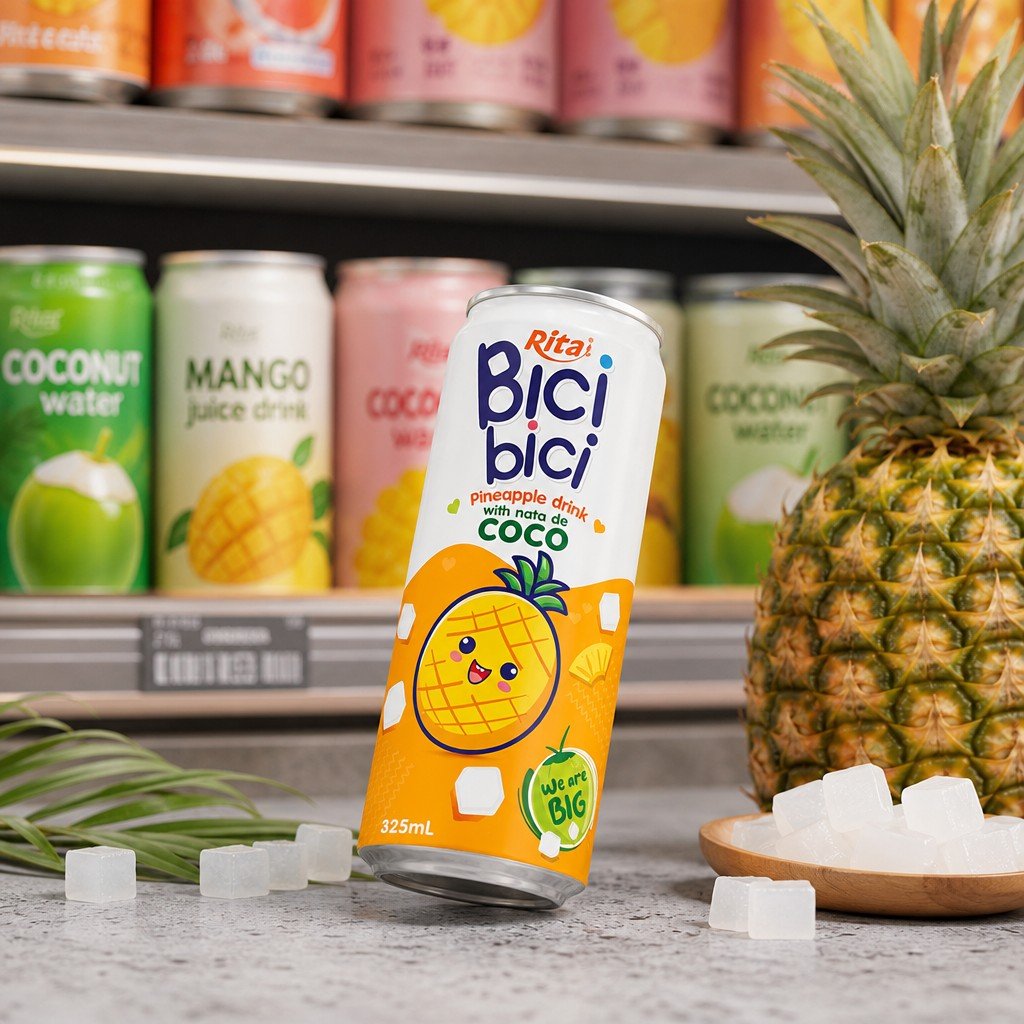
Texture as a Differentiator. The beverage industry has increasingly recognized that texture plays a critical role in product differentiation. Consumers, particularly in the 18-to-35 age bracket, are drawn to drinks that offer more than a uniform liquid experience. Nata de coco, with its unique chewy texture, transforms a simple pineapple drink into an interactive consumption moment. This sensory appeal translates directly to higher repeat purchase rates and stronger brand loyalty.
Tropical Flavor Crossover. Flavors that were once considered niche or regionally specific are now crossing borders at an accelerating pace. Pineapple, mango, passion fruit, and coconut are no longer confined to tropical markets — they are mainstream in Europe, North America, and the Middle East. This flavor migration is supported by growing diaspora communities, increased travel, social media exposure, and the expansion of Asian grocery retail channels globally.
Canned Beverage Renaissance. After years of growth in bottled and pouch formats, canned beverages are experiencing a resurgence. Aluminum cans offer superior recyclability, shelf stability, and visual branding opportunities. For textured beverages, the wide-opening can format solves a longstanding usability issue, making cans a viable and attractive packaging choice for products with solid inclusions.
Competitive Landscape and Pricing Dynamics
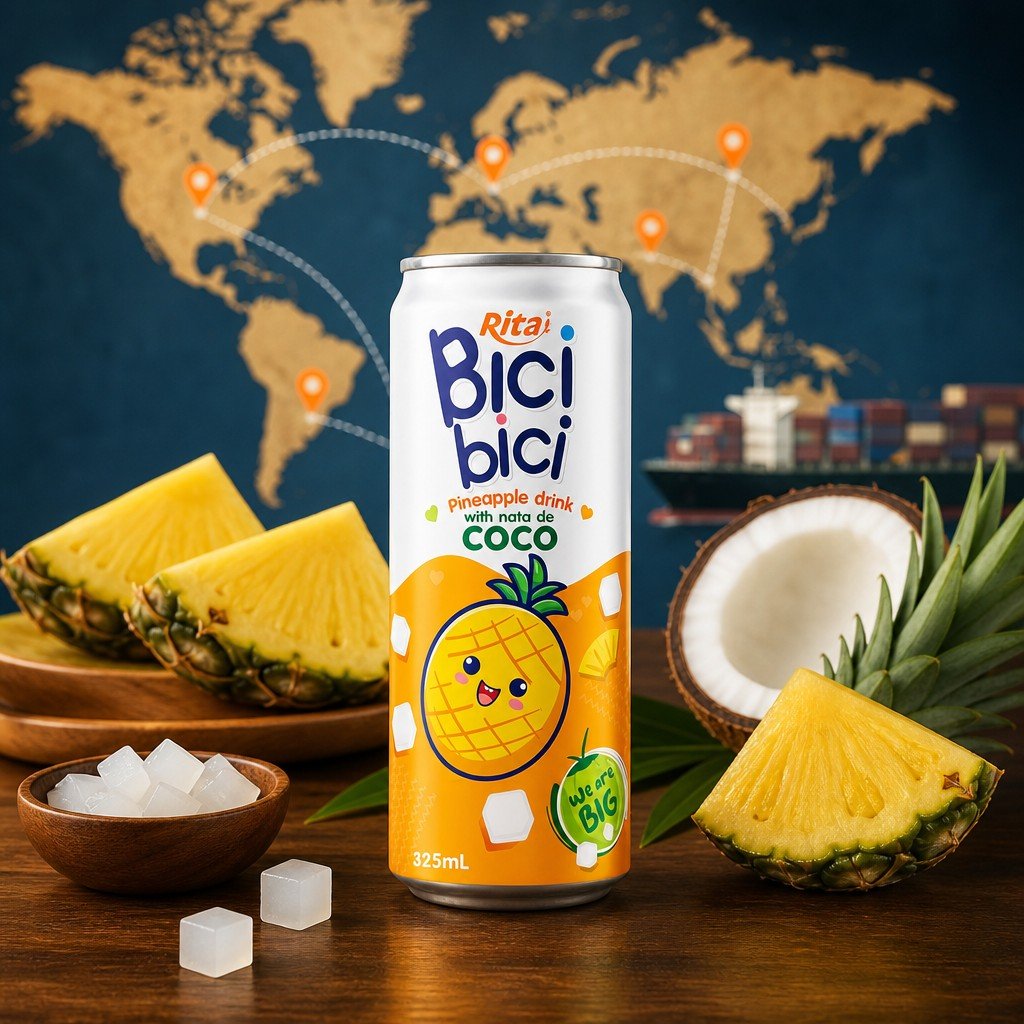
The global market for canned tropical beverages is competitive, with manufacturers from Thailand, the Philippines, Indonesia, and Vietnam all vying for export share. Vietnam-based manufacturers, however, benefit from several structural advantages: competitive labor costs, proximity to high-quality raw materials, and an established export infrastructure centered around Ho Chi Minh City's port system.
RITA's supply ability of 300 twenty-foot containers per month gives it significant scale to meet growing international demand. The company's Bici Bici 325ml Pineapple Drink With Nata De Coco is positioned to compete on both quality and value, with a 24-month shelf life that supports long-distance shipping and extended retail distribution cycles.
Market & Export Data
Annual Trade Trend
| Year | Shipments | Total Value (USD) | Total Weight (kg) | Total Quantity | YoY Change |
|---|---|---|---|---|---|
| 2025 | 8 | 13,352 | ~25,890 | 8,401 | — |
| 2026 | 15 | 26,346 | ~34,709 | 5,438 | Shipments +88%, Value +97%, Weight +34%, Quantity -35% |
Data source: Tradesparq Trade Data (tradesparq.com)
Top Origin & Destination Countries by Transaction Frequency
| Type | Country | Transactions | Market Share | Total Value (USD) | Weight (kg) | Avg Price |
|---|---|---|---|---|---|---|
| Origin | South Africa | 10 | 36% | 462 | 84 | — |
| Origin | China | 9 | 32% | 23,166 | 11,728 | USD 1.98/unit |
| Origin | United States | 3 | 11% | N/A | ~45,518 | N/A |
| Origin | Bangladesh | 2 | 7% | 16,070 | 25,344 | — |
| Origin | Belgium | 2 | 7% | N/A | ~36,488 | N/A |
| Destination | Botswana | 10 | 36% | 462 | 84 | — |
| Destination | Peru | 9 | 32% | 23,166 | 11,728 | — |
| Destination | United States | 3 | 11% | N/A | ~56,002 | N/A |
| Destination | Bahamas | 2 | 7% | N/A | ~28,889 | N/A |
| Destination | Netherlands | 2 | 7% | 16,070 | 25,344 | — |
Data source: Tradesparq Trade Data (tradesparq.com)
Trade activity for fruit/vegetable juice and non-alcoholic beverage products surged 88% from 2025 to 2026, with total value nearly doubling (+97%) from USD 13,352 to USD 26,346. Despite a 35% drop in unit quantity, the average unit price rose sharply from USD 1.59 to USD 4.84, indicating a shift toward higher-value products or premium positioning in the market.
South Africa and China together account for 68% of origin trade frequency, forming the primary supply backbone. On the destination side, Botswana and Peru mirror this dominance at 68% combined, with Peru emerging as the highest-value market at USD 23,166. The United States contributes the largest trade weight (~56,002 kg as destination), suggesting strong bulk-product demand. High market concentration is evident — the top five destinations account for 93% of all trade frequency.
From Our Orchards: Raw Material Farms
RITA sources its pineapple from carefully managed farms in the Mekong Delta, where the tropical climate and fertile alluvial soil create ideal growing conditions for high-quality fruit. These RITA pineapple farms are central to the company's commitment to sourcing flavorful, consistent raw materials that form the foundation of its tropical beverage range.
The broader Mekong Delta fruit farming region provides RITA with access to a diverse portfolio of tropical fruits, ensuring year-round supply stability for its production lines.
Private Label Opportunities in the Tropical Beverage Category
For distributors, wholesalers, and retail brands considering a private-label entry into the tropical beverage space, pineapple drinks with nata de coco represent a compelling opportunity. The product category benefits from strong consumer appeal, manageable production complexity, and a clear path to differentiation through flavor variation, packaging design, and can format.
RITA's OEM and ODM services are designed to support brands at every stage of the product development cycle. From initial concept and formulation through to packaging design, production, and export logistics, the company offers a vertically integrated service model. This reduces the number of external suppliers a brand must coordinate with and streamlines the path from idea to shelf.
Key Considerations for International Buyers
Buyers evaluating tropical beverage OEM partners should consider several factors beyond price. Production capacity, certification breadth, packaging flexibility, and export experience all play critical roles in determining the long-term viability of a supplier relationship.
RITA's 20-plus years of export experience, combined with its extensive certification portfolio and diversified packaging capabilities — aluminum cans, glass bottles, PET, and PP — make it a strong candidate for brands seeking a reliable, long-term manufacturing partner. The company's commitment to quality is reflected in its adherence to internationally recognized standards and its investment in automated production infrastructure.
For brands targeting Halal-certified markets, RITA's dual Halal certifications (Jakim and HCA-GCC) provide a distinct advantage, as many competitors hold only a single Halal certification. This dual coverage simplifies distribution across Southeast Asia and the Gulf Cooperation Council region simultaneously.
Frequently Asked Questions
What is a pineapple drink with nata de coco?
A pineapple drink with nata de coco is a ready-to-drink beverage that combines sweet, tangible pineapple liquid with chewy nata de coco cubes. Nata de coco is a translucent, gel-like food produced through coconut water fermentation, valued for its unique texture and ability to complement fruit-based drinks.
Why are wide-opening cans used for this type of beverage?
Wide-opening cans are designed to accommodate beverages containing solid or semi-solid inclusions like nata de coco. The wider aperture allows consumers to both drink the liquid and consume the chewy pieces, improving the overall product experience compared to standard slim-opening cans.
What certifications does RITA hold for its tropical beverage products?
RITA Food and Drink Co., Ltd holds a comprehensive set of international certifications, including BRC, FSSC 22000, Halal (Jakim and HCA-GCC), Kosher, ISO, GMP, HACCP, and SMETA. These certifications enable the company to export to over 200 countries and territories, including markets with strict food safety and religious compliance requirements.
What is the minimum order quantity for RITA's Bici Bici Pineapple Drink?
The minimum order quantity is 500 cartons, with a delivery time of 20 to 25 days after order confirmation. RITA offers free samples to prospective buyers, allowing them to evaluate product quality before committing to a full production run.
How does RITA support private-label brands in the tropical beverage category?
RITA provides end-to-end OEM and ODM services, including product formulation, packaging design, production, and export logistics. The company operates over 50 automated production lines and exports more than 1,200 containers monthly, giving it the scale and flexibility to support brands of varying sizes across multiple international markets.
Older news items:
- Sustainable Sipping: RITA's COCO JUS Blends Coconut and Watermelon for Global Markets - 17/09/2026 04:57
- Coconut Water and Chocolate Flavor – The Next Big Thing in Beverages - 10/09/2026 07:26
- Protein-Powered Hydration: How Low Sugar Blueberry Drinks Are Shaping the Market - 09/09/2026 08:22
- Coco Sea Moss Coconut Water Sustainability in a Sleek Can - 08/09/2026 10:03
- Global Demand for Electrolyte-Infused Juice Drinks Grows with Consumer Focus on Hydration - 08/09/2026 09:52