
Sparkling Watermelon Juice With Protein Fuels a New Beverage Era
The global beverage landscape is undergoing a remarkable transformation driven by shifting consumer preferences and behaviors. Today's shoppers — particularly Millennials and Gen Z — increasingly gravitate toward drinks that deliver more than basic refreshment. They seek novel flavor combinations, intriguing textures, and ingredient compositions that align with their evolving lifestyle choices. The sparkling watermelon juice with protein from Angry Water, a brand developed by Vietnam-based RITA Food and Drink Co., Ltd., exemplifies how consumer demand is actively reshaping product innovation across international markets.
Key Takeaways
- Consumer demand for hybrid beverages combining sparkling refreshment with added ingredients is surging across global markets
- Watermelon has emerged as one of the most sought-after flavors in the juice and broader beverage space
- Angry Water's playful branding demonstrates how visual identity drives shelf appeal among younger demographics
- RITA's OEM infrastructure — featuring 50+ production lines and exports to 200+ countries — supports scalable global distribution
- International certifications including BRC, FSSC 22000, Halal, Kosher, and ISO bolster retailer and consumer confidence
Why Consumers Are Turning to Sparkling Watermelon Juice With Protein
The rules of beverage purchasing have fundamentally changed. Consumers now evaluate products through a multifaceted lens that extends far beyond simple taste preference.
Where once a familiar brand name and an appealing label were sufficient to secure shelf placement and repeat sales, today's buyers actively scrutinize ingredient lists, examine packaging aesthetics, and weigh whether a product resonates with their personal identity. This behavioral shift has created unprecedented demand for innovative beverage formats — and few categories illustrate this phenomenon as clearly as protein-infused sparkling juices.
The Demand for Multi-Experience Beverages
Modern consumers increasingly reject the notion that a beverage must be either indulgent or purposeful. Instead, they gravitate toward products that deliver on multiple dimensions simultaneously — a refreshing mouthfeel from carbonation, an appealing fruit-forward taste, and ingredient compositions that feel considered and intentional. The sparkling juice segment has grown substantially as a result, with carbonation adding a textural element that elevates the drinking experience beyond flat juices and still waters.
Protein, as an ingredient, has moved well beyond the traditional supplement aisle. It now appears in coffee beverages, snack formats, confectionery, and — increasingly — sparkling drinks. Consumers recognize protein and associate it with a sense of substance in their beverages. When paired with sparkling fruit juice, this ingredient transforms a straightforward refreshment into something that feels more deliberate and compositionally interesting.
This "multi-experience" mindset has opened the door for product hybrids that traditional category boundaries once restricted. Beverage brands responding to this consumer behavior data are discovering that products positioned at the intersection of refreshment and added ingredients command higher engagement — both at the point of purchase and on social media platforms where unboxing and taste-testing content drives organic visibility.
Watermelon Emerges as a Star Flavor
Watermelon's ascendancy in the global beverage market is one of the clearest flavor trends observed in recent years. The flavor carries universally positive associations — summer warmth, crisp freshness, and natural sweetness — that translate effortlessly across cultures and age groups. Its visual appeal, characterized by vivid reds and greens, makes it exceptionally photogenic for both packaging design and digital marketing content.
For beverage manufacturers, watermelon presents both significant opportunity and technical challenge. Its delicate, volatile flavor profile requires careful processing to preserve the authentic taste that consumers expect and associate with the fruit. This is where experienced OEM partners with dedicated R&D capabilities become indispensable — the ability to stabilize watermelon flavor through carbonation and protein integration without compromising taste integrity separates market leaders from imitators.
Angry Water's Bold Branding Strategy
RITA Food & Drink Co., Ltd., established in 2004, has positioned itself at the forefront of this consumer-driven innovation cycle. The company's Angry Water line, specifically its sparkling watermelon juice with protein, represents a calculated response to shifting buyer behavior — a product designed not merely to refresh, but to resonate on visual and experiential levels with the most sought-after consumer demographics.
Designing for the Visual-First Generation
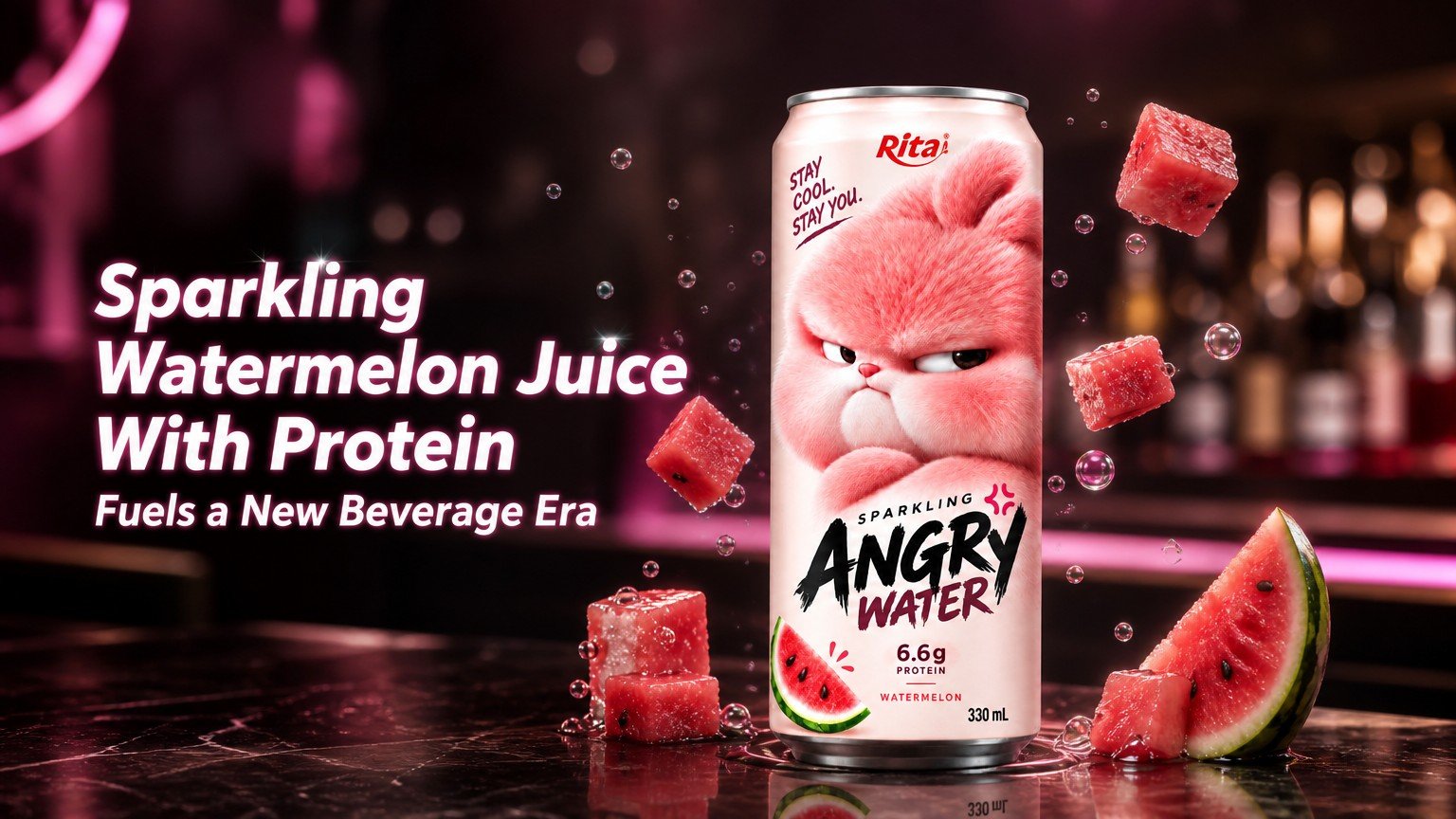
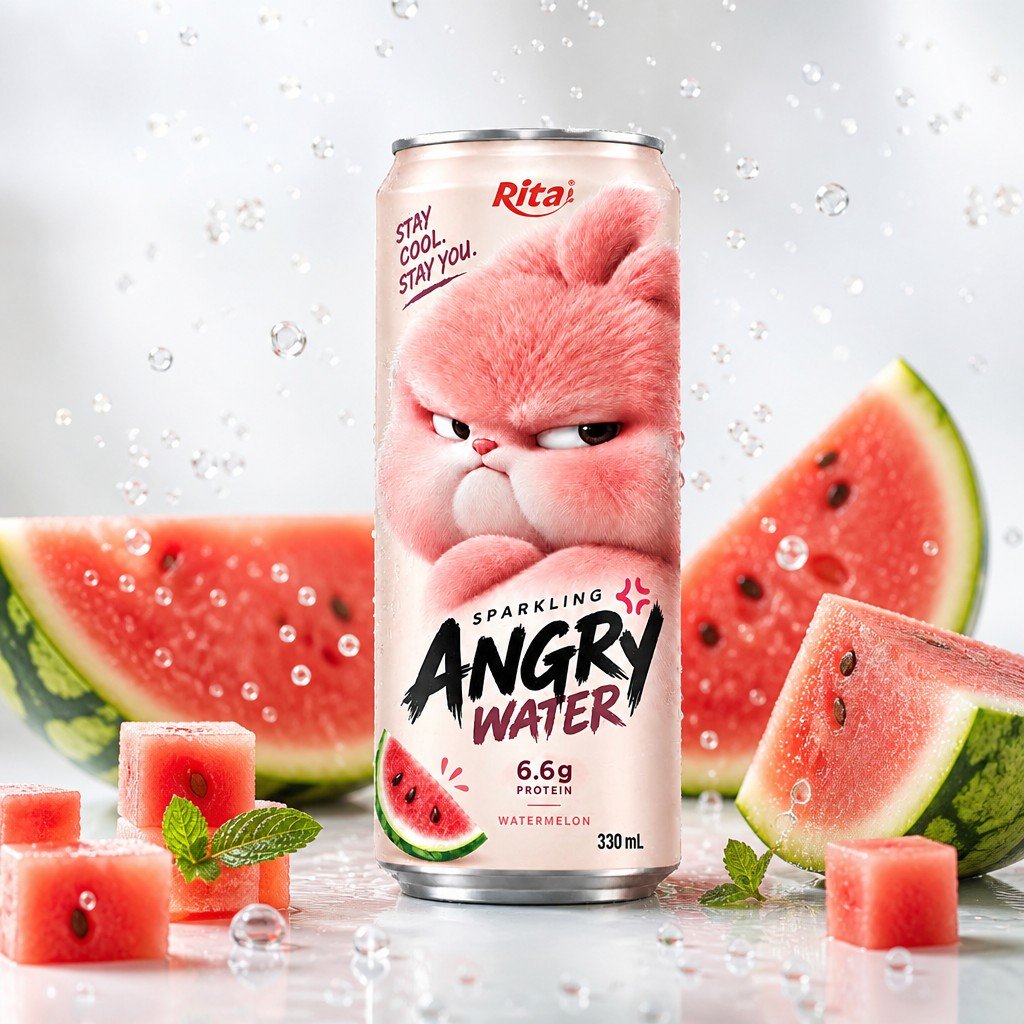
The product arrives in a sleek 330ml aluminum can adorned with a bold, irreverent design that immediately commands attention on any retail shelf. A large illustration of a fluffy, pink, angry-looking cat dominates the front panel, rendered in a playful art style that aligns with the visual language of internet culture and social media aesthetics. The brand name "ANGRY WATER" appears in striking black lettering against a light pink background, while a watermelon slice graphic reinforces the flavor profile at a glance.
The tagline "STAY COOL. STAY YOU." encapsulates the brand's positioning philosophy — a product for consumers who value individuality and aren't afraid to express it through their purchasing choices. This approach directly responds to consumer behavior research showing that younger demographics gravitate toward brands that project personality and authenticity rather than corporate polish.
With 6.6 grams of protein per 330ml can, the formulation bridges the gap between a straightforward sparkling juice and a more compositionally complex beverage. This ingredient strategy directly addresses what consumer behavior data consistently reveals: buyers increasingly favor products that feel "more than the sum of their parts." The Sparkling Watermelon Juice with Protein accomplishes this by combining a familiar, beloved fruit flavor with an ingredient that adds perceived depth to the drinking occasion.
For brands and retailers exploring private label opportunities, Angry Water serves as a compelling proof of concept. The product demonstrates that protein-infused sparkling beverages can command shelf space, attract visual engagement, and satisfy consumer curiosity — all critical factors in a marketplace where attention has become the scarcest commodity. Through RITA's comprehensive OEM beverage manufacturing capabilities, companies worldwide can replicate and customize this winning formula for their own target demographics and regional preferences.
Vietnam's Watermelon Supply Chain Supports Global Demand
Behind every successful beverage product lies a robust raw material supply chain, and watermelon sourcing is no exception. Vietnam's agricultural landscape provides an exceptional foundation for this purpose.
Vietnam's tropical climate, fertile alluvial soils, and established farming traditions produce watermelons with the sweetness and flavor intensity that juice manufacturers require. RITA Food & Drink sources its raw materials from carefully vetted agricultural regions, including the Mekong Delta's premium fruit farms, where watermelon ranks among the most widely cultivated and commercially significant crops.
This proximity between raw material supply and production facilities creates tangible advantages in freshness preservation, cost efficiency, and quality control. Unlike manufacturers who must import raw juice concentrates across vast distances, RITA benefits from direct access to harvest-fresh watermelon — a factor that directly influences the flavor integrity of the final product.
For brands evaluating OEM partners, raw material origin and supply chain transparency should rank among the top due diligence criteria. A supplier's ability to demonstrate traceable sourcing signals operational maturity and product reliability — qualities that increasingly influence B2B purchasing decisions in the beverage sector.
Certified Quality and Scalable Export Infrastructure
Consumer behavior trends carry commercial weight only when products can physically reach the markets where demand exists. RITA's export infrastructure bridges that critical gap between insight and execution.
Operating from Vietnam with Ho Chi Minh City as its primary port of dispatch, RITA Food & Drink Co., Ltd. has built a global export network spanning more than 200 countries and territories. The company ships over 1,200 twenty-foot equivalent containers monthly across its full product portfolio, encompassing tropical fruit juices, coconut products, energy drinks, and innovative formats like the sparkling watermelon juice with protein. For international buyers, this operational scale translates into reliable lead times — typically 20 to 25 days from order confirmation — and the flexibility to fulfill orders ranging from 500 cartons to full container loads.
Certifications That Build Retailer Trust
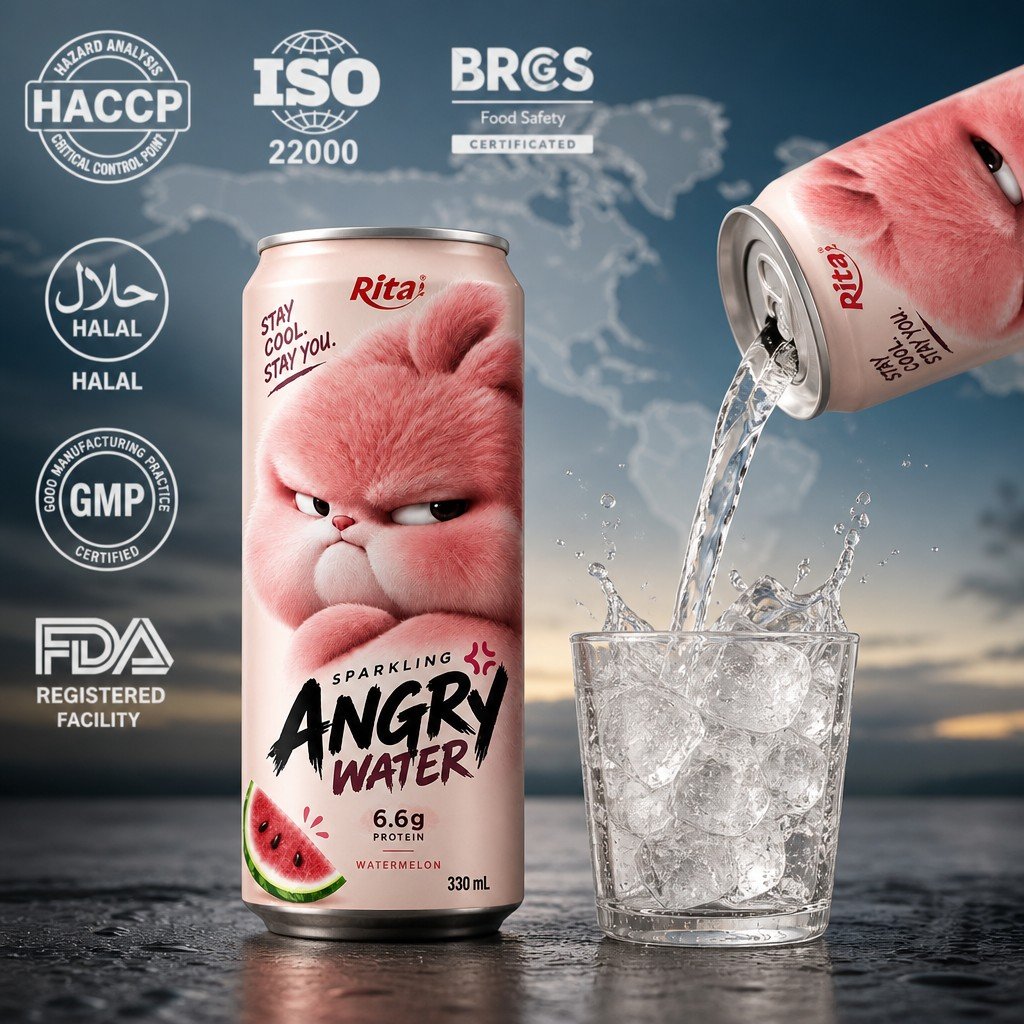
In an era where consumer trust hinges on verified quality standards, RITA's certification portfolio serves as a critical market-access differentiator. The company maintains a comprehensive roster of credentials that enable distribution across diverse regulatory environments worldwide:
- BRC (British Retail Consortium) — recognized by major European and North American retail chains
- FSSC 22000 — food safety management certification with global accreditation
- Halal (Jakim and HCA-GCC) — essential for Middle Eastern and Southeast Asian markets
- Kosher — enabling access to specialty retail channels
- ISO, GMP, HACCP, and SMETA — covering quality management, manufacturing practices, and ethical auditing
These certifications serve a dual role: they satisfy regulatory requirements at the point of import and function as consumer-facing trust signals that support purchase decisions at the shelf. The product portfolio encompasses aluminum cans, glass bottles, PET bottles, and PP bottles, giving brand partners the packaging flexibility needed to match local market preferences and channel requirements. The Angry Water line's 330ml aluminum can format aligns perfectly with convenience store and vending machine placement strategies common across urban retail environments. Brands seeking to expand their beverage lines can explore RITA's comprehensive offerings through the Fruit Drinks catalog and the Special Drink catalog, which cover formulation, packaging, and logistics coordination.
Positioning Sparkling Watermelon Juice With Protein Against the Competition
The protein beverage market is crowded and growing more competitive by the quarter. Standing out requires more than a well-formulated recipe — it demands strategic differentiation across branding, format, and channel placement.
A closer examination of the competitive landscape reveals that most protein beverages still default to conventional formats — milky shakes, thick smoothies, or unflavored supplement mixes. Sparkling formats remain comparatively underexplored, creating meaningful whitespace for brands willing to innovate. The sparkling watermelon juice with protein from Angry Water carves out a distinct position by combining the effervescence and lightness that consumers associate with soft drinks with the ingredient profile they recognize from more purpose-driven categories. This dual positioning directly responds to consumer behavior data showing that younger demographics resist rigid category boundaries.
Pricing dynamics further reinforce the opportunity. Protein-infused sparkling beverages command a measurable price premium over standard sparkling juices, yet consumer willingness-to-pay data consistently indicates that novelty, taste quality, and perceived ingredient value drive acceptance of higher price points. Products like the Angry Water Sparkling Watermelon Juice with Protein benefit from this pricing headroom, particularly in urban markets where ingredient-conscious purchasing has become a social norm rather than a niche behavior.
Looking at comparable products on international retail shelves, several patterns emerge among successful entries. The most effective launches tend to share three characteristics: bold, memorable packaging that communicates flavor and personality within seconds; clean ingredient labels that avoid artificial complexity; and distribution strategies that place the product where impulse buying is most likely — convenience stores, checkout aisles, and digital-first direct-to-consumer channels. Angry Water checks all three boxes, offering brand partners a replicable template for competitive entry in this growing niche.
For OEM buyers and brand managers evaluating entry into this space, the strategic takeaway is clear: the protein-infused sparkling segment is ripe for expansion, but competitive success depends on more than ingredient innovation. Visual identity, packaging format, distribution channel alignment, and scalable production capacity — areas where RITA's full-service OEM model excels — are equally critical to capturing consumer attention and sustaining repeat purchase behavior over time.
Frequently Asked Questions
What makes sparkling watermelon juice with protein different from standard sparkling beverages?
The key differentiator lies in the combination of carbonated watermelon juice with a meaningful protein content — 6.6 grams per 330ml can. This formulation bridges the gap between traditional sparkling fruit drinks and more compositionally complex beverages, offering consumers a product that goes beyond simple refreshment. The Angry Water line achieves this while maintaining a light, enjoyable taste profile that appeals to mainstream consumers.
What certifications does RITA hold for manufacturing this product?
RITA Food & Drink Co., Ltd. maintains an extensive certification portfolio including BRC, FSSC 22000, Halal (Jakim and HCA-GCC), Kosher, ISO, GMP, HACCP, and SMETA. These credentials enable market access across diverse regulatory environments in the Americas, Europe, Asia, the Middle East, Africa, and Oceania.
What is the minimum order quantity for Angry Water products?
The minimum order quantity is 500 cartons. RITA also offers free samples to prospective brand partners, allowing businesses to evaluate product quality and market potential before committing to larger production runs.
Can RITA customize the formulation and branding for private label orders?
Yes. RITA operates as both an OEM and ODM partner, offering end-to-end services from flavor development and ingredient customization to packaging design and private label branding. Companies can adapt the sparkling watermelon juice formula, protein content, and visual identity to suit their specific market positioning and consumer demographics.
What packaging formats are available for sparkling juice products?
RITA manufactures beverages in aluminum cans, glass bottles, PET bottles, and PP bottles. The Angry Water Sparkling Watermelon Juice is currently available in a 330ml aluminum can, which is well-suited for convenience retail, vending, and on-the-go consumption channels.
Related news items:
Older news items:
- Rita Celebrates Mid-Autumn Festival with Employees and Partners - 23/09/2026 08:07
- Rita Visits a Guava Farm in Dong Thap to Explore Fresh Fruit Sourcing - 22/09/2026 02:52
- Premium Grape Juice Drives Fresh Opportunities in Global OEM Beverage Trade - 18/09/2026 07:39
- Blackcurrant Beverages Gain Momentum as Wellness Drinks Reshape Global Soft Drink Markets - 18/09/2026 07:25
- Coconut Water Supply Chains Shift as Demand for Electrolyte-Enhanced Beverages Surges - 18/09/2026 06:56