
Rise of Coconut Water With Pineapple Juice in Global PET Markets
Coconut water with pineapple juice has moved from a niche tropical experiment to one of the fastest-tracked formats in the global PET beverage category, and the supply chain behind it is scaling to match. Retailers, importers and private label buyers in the Americas, Europe, Asia, the Middle East, Africa and Oceania are adding coconut water with pineapple juice to ambient and chilled listings, while manufacturers with certified facilities, automated lines and container-level export capacity are absorbing the volume. This article examines where the demand sits, what buyers are specifying in packaging and compliance, and how OEM partnerships are shaping the next round of product development across the tropical beverage space.
Key Takeaways
- Tropical flavor blending is moving from trial listings to core SKUs across coconut water and fruit juice categories worldwide.
- PET bottle packaging at 500 ml (16.9 fl oz) delivers a practical balance of portability, shelf presence and shipping economics for export programs.
- Export qualification now leans heavily on certification packages such as BRC, FSSC 22000, Halal, Kosher, ISO, GMP and HACCP.
- Private label demand is concentrating among manufacturers able to run 600 twenty-foot containers per month at documented minimum order levels.
- Coconut water with pineapple juice bridges coconut beverage and tropical fruit juice ranges across mainstream retail formats.
Coconut Water With Pineapple Juice Rises in Global Beverage Categories
The blend itself is the story. Coconut water has long been positioned as a clean, lightly aromatic base note, while pineapple juice brings acidity, fragrance and a recognizable tropical signature that performs well in retail photography and point-of-sale displays. Together they create a product that reads clearly on a shelf without leaning on complex flavor language, a decisive advantage when one shelf set in a discount grocer or convenience chain has to carry dozens of competing SKUs.
Market signals point in the same direction. Water and juice brands continue to commit capital to production and distribution even as shopper behavior shifts between formats. The ongoing investment debate around regional water production and premium still-water sites, for example, shows that beverages still attract long-horizon capital. In the non-alcoholic space, brand leaders are openly arguing that new drinking occasions are being created rather than simply contested, and fruit-based blends are among the formats most visible in that expansion.
For importers and distributors, the practical question is not whether the format works. It is whether a supplier can deliver it consistently, certified, at scale, and on the timing their own customers require. That is where the OEM conversation begins.
From Trial Listings to Core SKUs in Coconut Beverage Ranges
Category managers report that tropical blends are being picked up first in larger-format PET bottles and multipacks, where the price per unit stays approachable for everyday shoppers while still signaling a premium-adjacent taste experience. In coconut products ranges, pineapple variants are now appearing alongside pure coconut water, coconut drinks and coconut-based beverages, giving buyers a way to merchandise an entire block of shelf from a single supplier relationship.
The same logic applies to fruit drinks programs, where a coconut-pineapple blend can be introduced as a tropical extension without disrupting existing juice architecture. Importers building mixed-container orders often treat these variants as the bridge between high-volume staples and higher-margin specialty lines, and that framing is now visible in tender documents from both grocery and food-service channels.
Coconut Water With Pineapple Juice in PET Bottle Format and Packaging
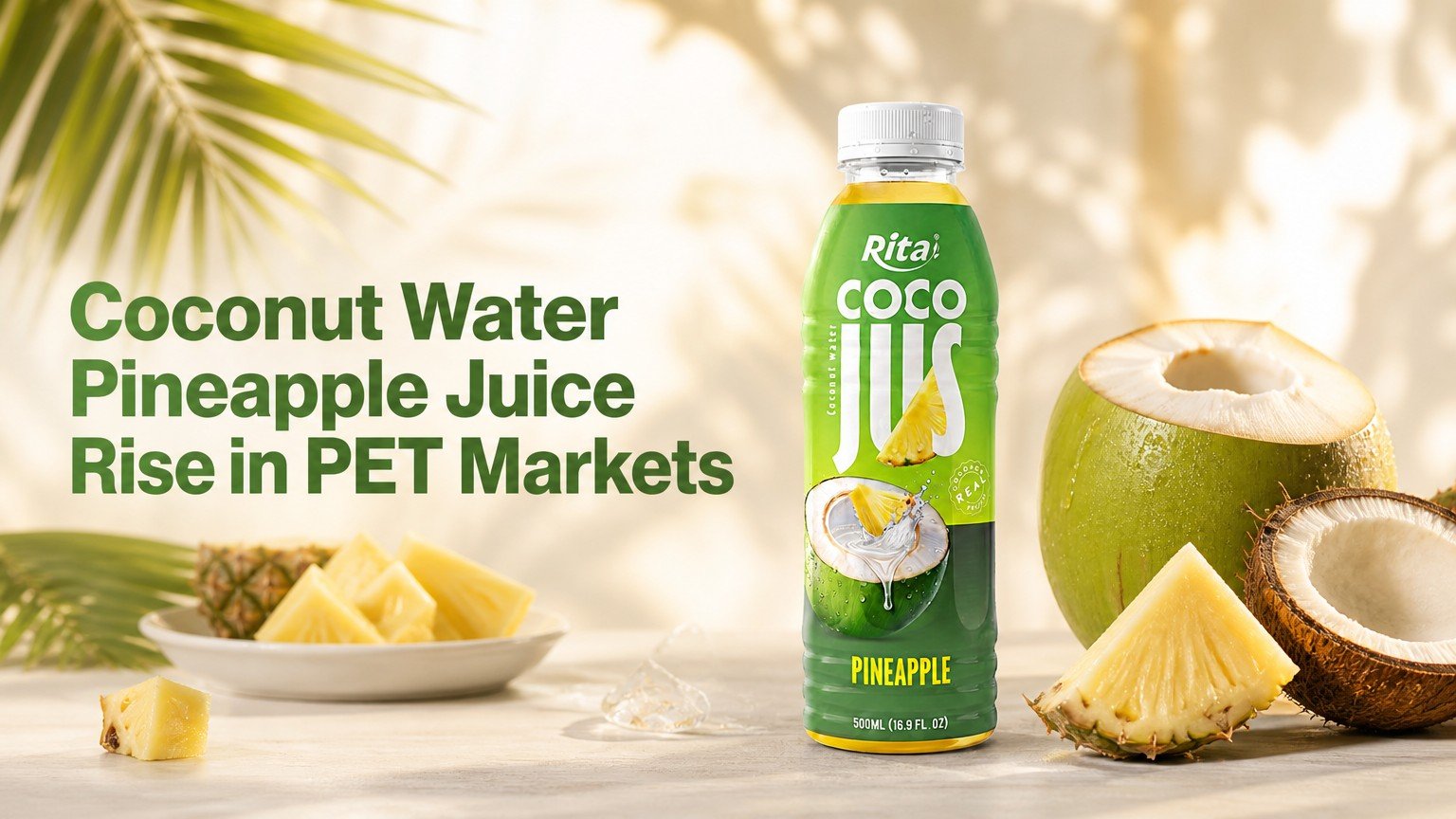
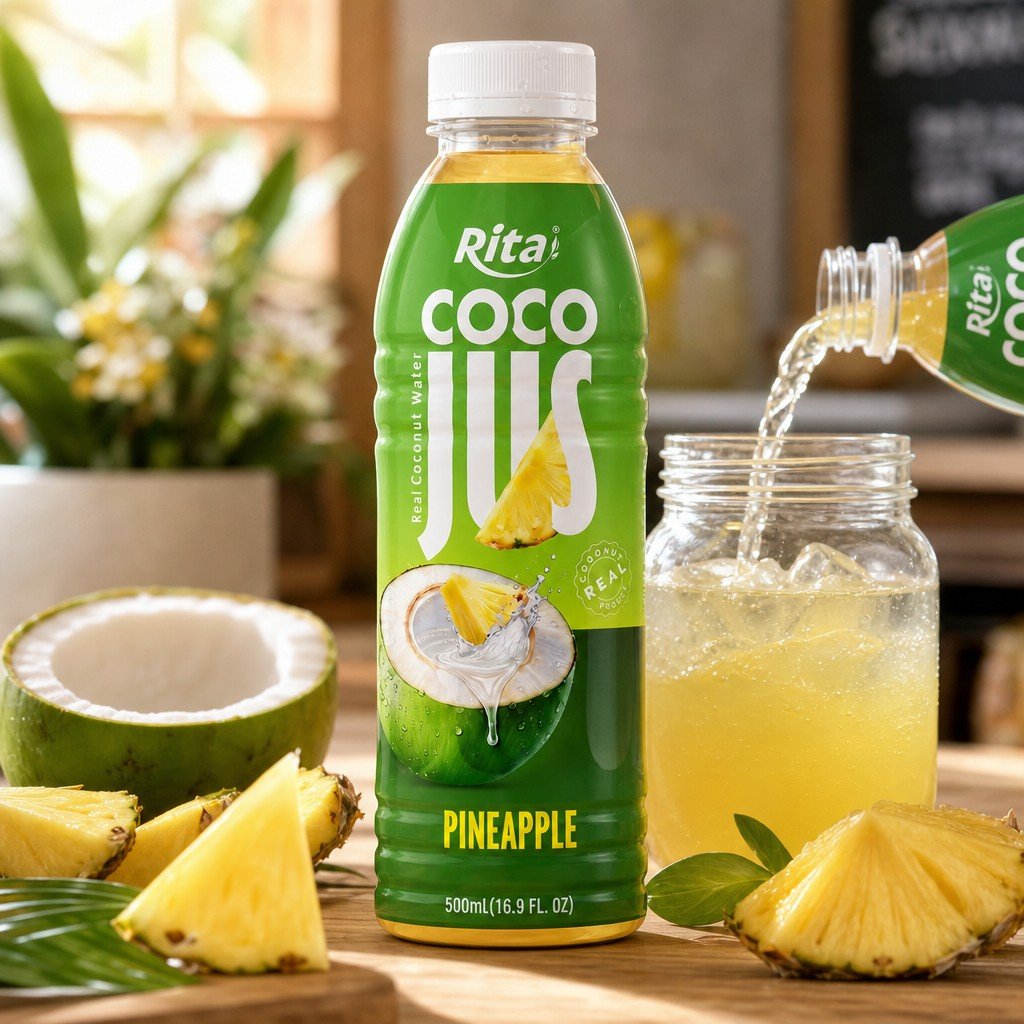
The product on export offer this cycle is COCO JUS Real Coconut Water With Pineapple Juice 500ml (16.9 fl oz), supplied by Vietnamese OEM manufacturer RITA Food and Drink Co., Ltd under its established COCO JUS beverage line. The variant is filled in a clear PET bottle with a white cap and wrapped in a green label with yellow accents, built around a bold COCO JUS wordmark with a halved coconut and pineapple slice graphic that signals the blend at a glance. Buyers can review the full specification on the COCO JUS Real Coconut Water With Pineapple Juice 500ml product page.
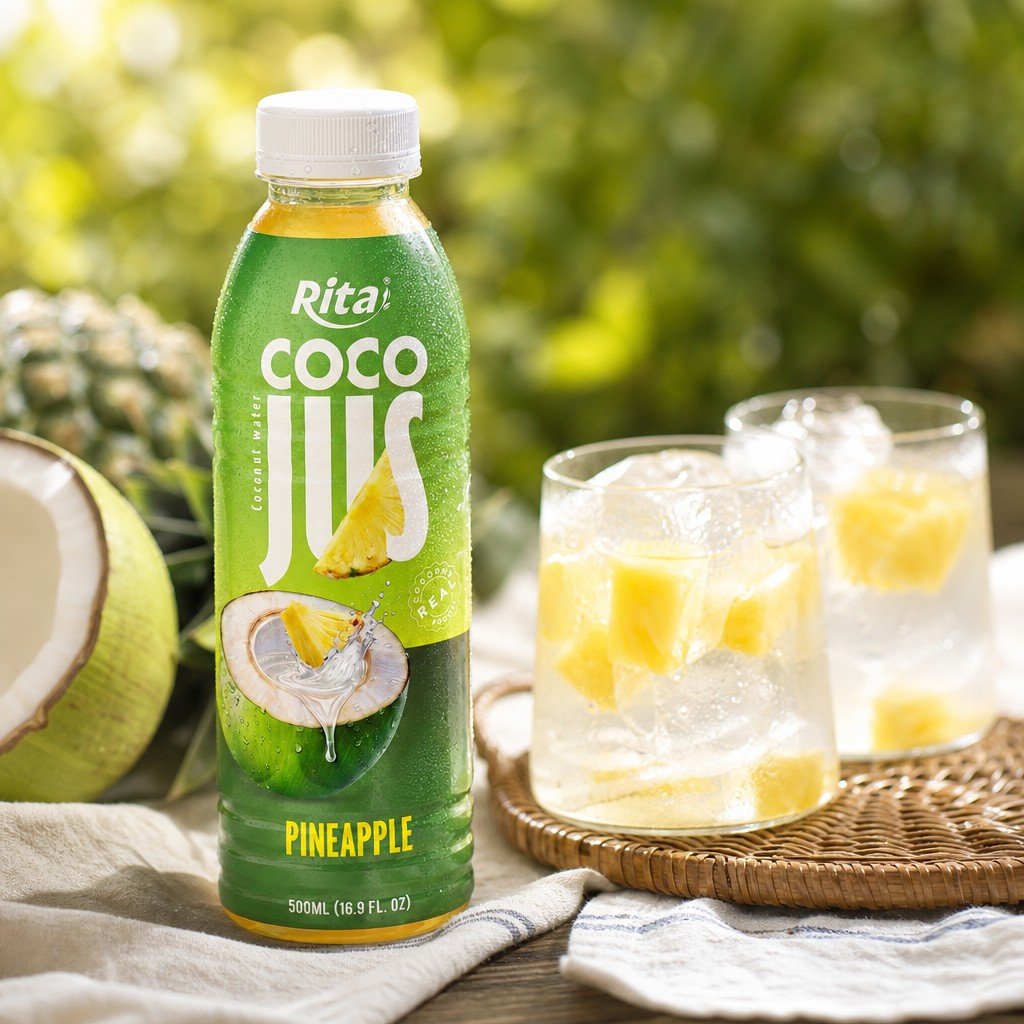
Inside, the liquid presents in a warm yellowish-orange tone that matches the label architecture and reinforces the pineapple-forward profile. The taste experience is built around a clean coconut base with pineapple aroma and a gentle sweet-tart finish, straightforward and shelf-friendly, and consistent from bottle to bottle, which is exactly what repeat purchase depends on in everyday categories.
| Specification | COCO JUS Real Coconut Water With Pineapple Juice 500ml |
|---|---|
| Packaging | PET bottle, 500 ml (16.9 fl oz), white cap |
| Label architecture | Green label with yellow accents, coconut and pineapple imagery |
| Shelf life | 18 months |
| Certifications | Halal (JAKIM, HCA-GCC), BRC, FSSC 22000, HACCP, ISO, GMP |
| Minimum order quantity | 500 cartons |
| Supply ability | 600 twenty-foot containers per month |
| Delivery time | 20 to 25 days after order confirmation |
| Port of loading | Ho Chi Minh Port, Vietnam |
Packaging, Shelf Life and Documentation That Buyers Check First
Three specifications tend to dominate early-stage buyer conversations. The first is pack format: PET bottle at 500 ml, still the most common import size in this category. The second is shelf life, 18 months under standard storage, which sits comfortably within the shipping and shelf-planning windows most importers work with. The third is documentation, where Halal certification from JAKIM and HCA-GCC, BRC, FSSC 22000, HACCP, ISO and GMP together remove a layer of friction from market entry.
Commercially, the 500 ml PET format covers several distribution needs at once. It works as a single-serve purchase for convenience and travel retail, as an affordable add-on in chilled cabinets, and as a unit within multipack and mixed-flavor programs for grocers running promotional cycles. For PET bottle fruit juice export programs specifically, that flexibility reduces the risk of dead stock when a program is tested in more than one channel.
Raw Material Sourcing in Coconut and Pineapple Supply Networks
Behind the finished product sits a raw material base that buyers increasingly want to see documented. RITA maintains inspection-level access to both its coconut and pineapple raw material areas, and that sourcing detail is becoming a standard part of qualification questionnaires from international retail and food-service buyers.
The coconut sourcing story is anchored in the Ben Tre region, where plantations feed a dedicated raw material program for the company's coconut product line. The full account of how plantation-level sourcing is turned into finished beverages is documented in RITA's Ben Tre coconut farm report, and buyers reviewing a private label program often start their diligence here rather than on the price sheet.
Pineapple sourcing follows the same logic, with harvest timing and fruit quality feeding directly into the flavor consistency a tropical blend depends on. A field-to-bottle account of the ingredient journey is captured in the RITA pineapple farm journey, which traces growing areas, harvest handling and the route from fruit to finished juice.
For distributors evaluating supplier continuity, documented raw material access is a differentiator in tenders. It moves the conversation from unit price alone to traceability, harvest cycles and the ability to hold a flavor profile steady across production batches and reorders.
A visual walkthrough of the coconut water sourcing areas is available at
RITA and the Global OEM Beverage Supply Chain
COCO JUS Real Coconut Water With Pineapple Juice is produced by RITA Food and Drink Co., Ltd, established in 2004, which today operates as a leading Vietnamese OEM/ODM beverage manufacturer and global exporter. The company runs more than 50 automated production lines across tropical fruit juices, coconut products, functional drinks and energy drinks, filling aluminium cans, glass bottles, PET and PP formats, and exports 1,200-plus containers monthly to buyers in over 200 countries and territories.
That scale is the point of interest behind searches for a reliable coconut water OEM manufacturer from importers who have outgrown trial-order suppliers. The company's export footprint already spans the Americas, Europe, Asia, the Middle East, Africa and Oceania, which means documentation routines, shipping patterns and buyer communication are handled as standard rather than treated as exceptions.
For programs targeting distribution beyond one home market, the relevant framing is beverage OEM Vietnam sourcing: consistent fill weights, repeatable label output, and certification files that match the import requirements of each destination region. RITA's own quality framework of BRC, FSSC 22000, Halal JAKIM, Halal HCA-GCC, Kosher, ISO, GMP, HACCP and SMETA covers the compliance checks most retail and food-service buyers in global beverage distributor networks run before a first order is placed.
The company also positions itself as a long-term partner rather than a transactional supplier, with service defined across the full cycle from pre-order consultation to after-sales support, and a stated focus on consistent product quality and taste across every production batch.
Private Label Pathways for Coconut Water With Pineapple Juice
For distributors building their own brand, the most relevant detail is what a supplier will do with the format. The COCO JUS Pineapple variant is available for private label programs, with artwork adaptation, language versions and carton design handled through the OEM and ODM service structure. Buyers can start with standard COCO JUS branding before moving to own-label artwork, which keeps a market test inexpensive and reversible.
Programs typically progress through three stages: free sample evaluation, a first production run at the 500-carton minimum, then container-level ordering as shelf performance is confirmed. That sequence suits market entries where placement is being tested regionally before a national launch, and it suits established brands looking to add a tropical SKU without committing a full product development cycle to flavor trial and compliance testing.
From a sourcing calendar perspective, the 20 to 25 day production-to-shipment window after order confirmation keeps replenishment tight enough for seasonal retail windows, including summer promotions, holiday gifting cycles and travel retail peaks, while leaving room for label proofing and documentation review before goods move from Ho Chi Minh Port. Commercial terms are transparent at every step: free samples on request, L/C or T/T payment, FOB Ho Chi Minh Port, and a stated 600 twenty-foot container monthly supply ability for programs that scale quickly.
What Buyers Should Specify Before Placing an Order
A short specification checklist separates serious programs from exploratory requests, and it shortens the back-and-forth that usually follows a first contact. Buyers entering a private label beverage discussion with a manufacturer of this scale are best served by aligning the five points below before artwork or logistics are finalized.
- Volume commitment, confirming whether the program starts at the 500-carton level or moves directly into container ordering.
- Artwork ownership and file rights, including what happens to the label design if the program is later transferred to another manufacturer.
- Certification coverage, matching Halal, BRC, FSSC 22000 and Kosher certificates to the import markets where goods will actually be sold.
- Logistics terms, aligning FOB Ho Chi Minh Port, payment terms and shipping documents with the importer's own compliance file.
- Taste benchmarking, using the supplied samples to set an internal reference profile for coconut pineapple juice 500ml production before the first commercial run.
Frequently Asked Questions
What follows answers the questions most frequently raised by buyers reviewing the coconut water with pineapple juice PET format for the first time, from product specification to export terms.
RITA food and drink
Related news items:
Older news items:
- Protein Water Drives Fresh Growth in the Global Beverage Sector - 29/09/2026 04:36
- Sparkling Watermelon Juice With Protein Fuels a New Beverage Era - 29/09/2026 04:19
- Rita Celebrates Mid-Autumn Festival with Employees and Partners - 23/09/2026 08:07
- Rita Visits a Guava Farm in Dong Thap to Explore Fresh Fruit Sourcing - 22/09/2026 02:52
- Premium Grape Juice Drives Fresh Opportunities in Global OEM Beverage Trade - 18/09/2026 07:39