
Sparkling Mango Juice With Protein Rides New Global Supply Chains
The global sparkling beverage aisle is being redrawn by a new generation of formulations that pair familiar fruit flavors with ingredient-led twists and eye-catching brand identities. Among the launches drawing attention from buyers and distributors this year is Sparkling Mango Juice With Protein, the 330ml Angry Water entry from RITA Food and Drink Co., Ltd, a Vietnamese OEM and ODM beverage manufacturer that has been supplying private label programmes for more than two decades. The product sits at the intersection of two forces shaping the drinks trade: consumer appetite for tropical fruit profiles, and the supply chain realities that determine whether a launch can reach shelves in 180 countries without disruption. Sparkling Mango Juice With Protein 330ml is offered through the company's global OEM platform, with buyers weighing not just formulation and packaging, but sourcing resilience, certification coverage and container throughput.
Key Takeaways
- Sparkling mango juice with protein represents a fast-moving niche where fruit flavor, sparkling texture and ingredient additions converge in a single-format can.
- RITA Food and Drink Co., Ltd operates more than 50 automated production lines and exports an average of 1,200 containers per month to over 200 countries and territories.
- Aluminium can packaging remains the dominant format for sparkling beverages, offering 24-month shelf life, portability and supply chain efficiency across long-haul export routes.
- Raw material sourcing for tropical fruit beverages is increasingly tied to farm-level traceability, seasonal planning and multi-origin hedging strategies.
- Buyers are turning to OEM and private label manufacturing to de-risk launches amid labour disputes, site closures and freight volatility across the wider drinks industry.
Product Profile, Sparkling Mango Juice With Protein by RITA
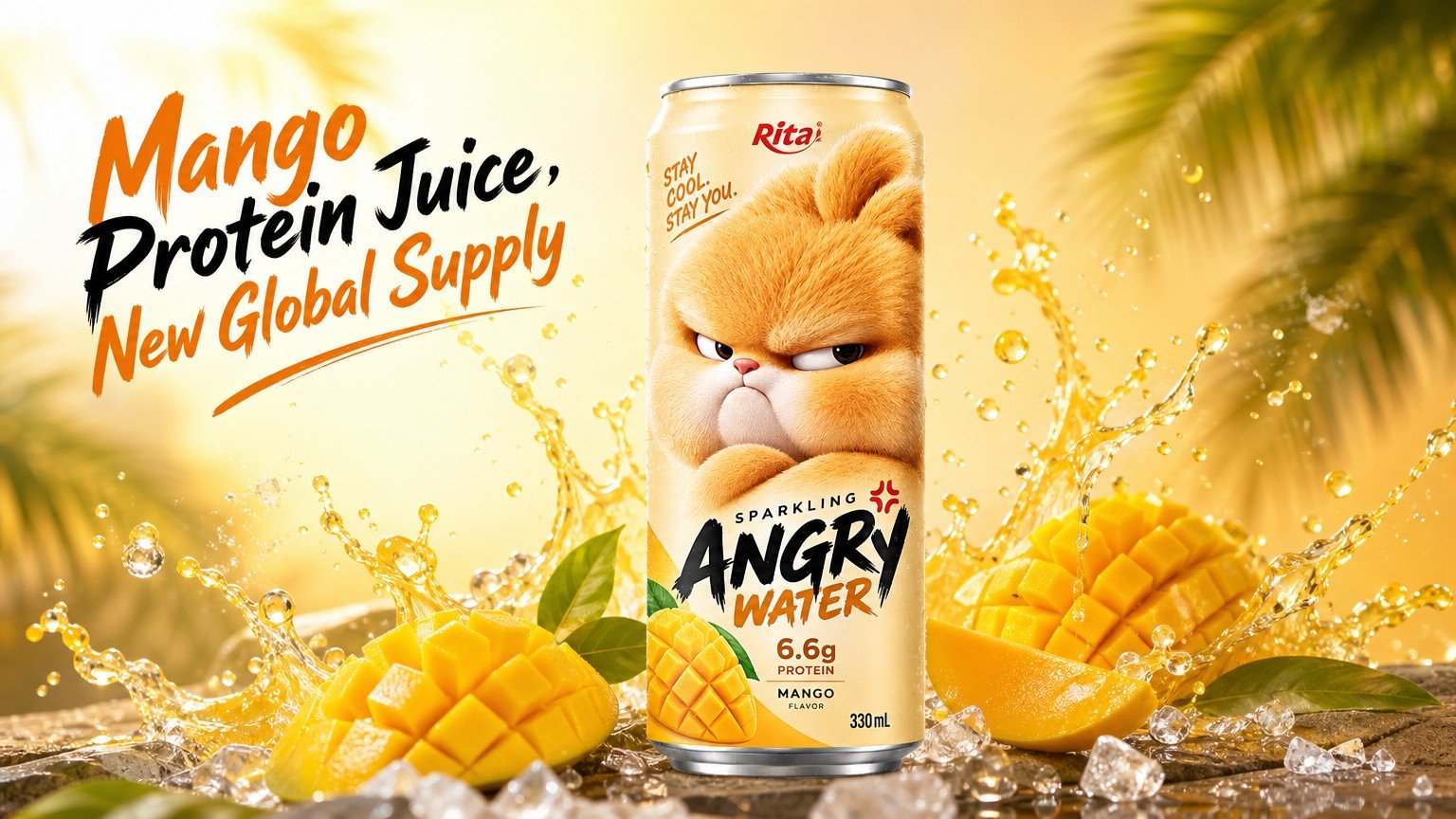
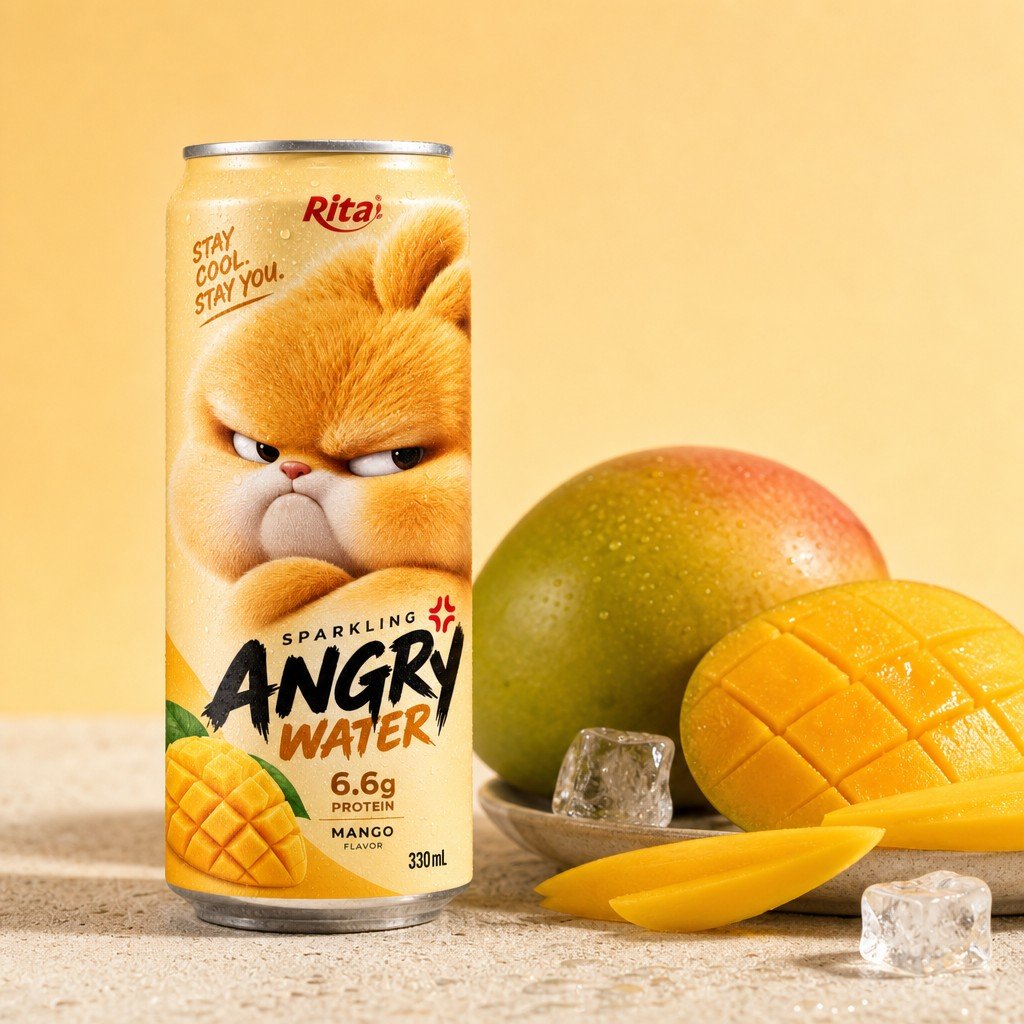
The category is defined by contrast, and Angry Water leans into it. The 330ml aluminium can carries a cream-yellow field, orange and black typography, and an oversized illustrated cat face that signals the brand's irreverent positioning. A starburst-marked "Sparkling" badge sits beside a mango illustration, while the line "Stay Cool. Stay You." anchors the shelf statement.
Behind the visuals is a formulation that adds protein content to a sparkling mango juice base — a combination that has moved from specialty shelves into mainstream retail conversation. For buyers evaluating the SKU, the appeal is as much logistical as it is sensory: a single-can, 330ml format that travels well, stacks efficiently in cartons and pallets, and supports a two-year shelf life under standard export storage conditions.
RITA describes the product as part of a wider portfolio spanning tropical fruit juices, coconut-based drinks, functional beverages and energy lines, manufactured in aluminium cans, glass bottles, PET and PP containers. The company's positioning is deliberately broad, allowing a distributor in one market to anchor a portfolio strategy that mixes sparkling fruit drinks with still juice and specialty lines, rather than sourcing each format from a separate vendor. Buyers interested in the broader category can review the manufacturer's soft drinks catalogue, where sparkling formats sit alongside carbonated fruit blends and flavored refreshments.
Supply Chain Pressures Reshaping the Beverage Industry
Sparkling mango juice with protein is a small SKU in a very large market, but it inherits the same structural pressures as the rest of the sector.
The recent turbulence in the wider drinks trade has been unusually visible. Spirits producer Diageo has faced continued labour action at its Cameronbridge distillery, while a US judge dismissed a lawsuit centred on tequila production, and the company signalled plans to close its Guinness Open Gate site in the United States. Separately, Scottish producer Holyrood paused production, and Australian Vintage moved to sell its Nepenthe cellar door and vineyard. For beverage buyers, these are not isolated headlines; they are signals that manufacturing footprints, labour availability and capital allocation remain unstable across categories.
The practical consequence for brand owners is a shift toward flexible supply bases. Where a distributor once planned launches around a single regional supplier, the current environment rewards partners who can absorb seasonal variance, hold certification across multiple markets and scale without renegotiating the entire supply arrangement. Contract manufacturing and private label sourcing have become de-risking tools rather than mere cost levers, and they are increasingly written into portfolio planning meetings months before a launch window opens.
Vietnam's Role in the Global Beverage Export Map
Vietnam has built a durable position in the beverage export economy, and the ingredients behind tropical sparkling drinks are a significant part of that story. Mango, pineapple, passion fruit and coconut sourcing networks in the Mekong Delta and Central Highlands give manufacturers access to raw material volumes that can be scaled for export programmes rather than limited to domestic demand.
RITA Food and Drink Co., Ltd has grown alongside that infrastructure. Established in 2004, the company today operates more than 50 automated production lines, moves an average of 1,200 containers per month, and reports exports to over 200 countries and territories. That scale matters when a buyer is signing a multi-market distribution agreement: container availability, documentation consistency and production scheduling are contract terms, not back-office details. The manufacturer's export profile is documented on its OEM service platform, where contract terms, packaging options and quality systems are set out for international buyers.
From Mango Orchards to the Can, Sourcing the Raw Material
Supply chain resilience begins at the farm gate.
For a sparkling mango juice program, the sourcing conversation covers ripeness windows, yield variability, pulp-to-juice conversion rates and the logistics of moving fresh fruit from growing regions to processing facilities on a predictable calendar. Buyers evaluating a new SKU often ask about farm-level oversight before they ask about shelf life, because the flavor profile of a tropical juice carries directly from harvest to finished product. RITA maintains raw material sourcing relationships documented through its mango farm sourcing programme, where orchard inspection and field-to-factory journeys are recorded for transparency with international customers.
The Mekong Delta remains the anchor region for much of Vietnam's fruit supply, and it is the reference point for many export-grade raw material agreements. The company's Mekong Delta raw materials area is cited as a core sourcing zone for juice production, supporting the volume requirements of multi-container monthly shipments. A field-to-factory account of mango sourcing in the region is available here:
For buyers running multi-SKU programmes, the practical takeaway is that orchard-level relationships determine whether a supplier can hold flavor consistency across production runs, season after season.
Packaging and Logistics, The Aluminium Can Advantage
In sparkling formats, packaging is part of the product proposition.
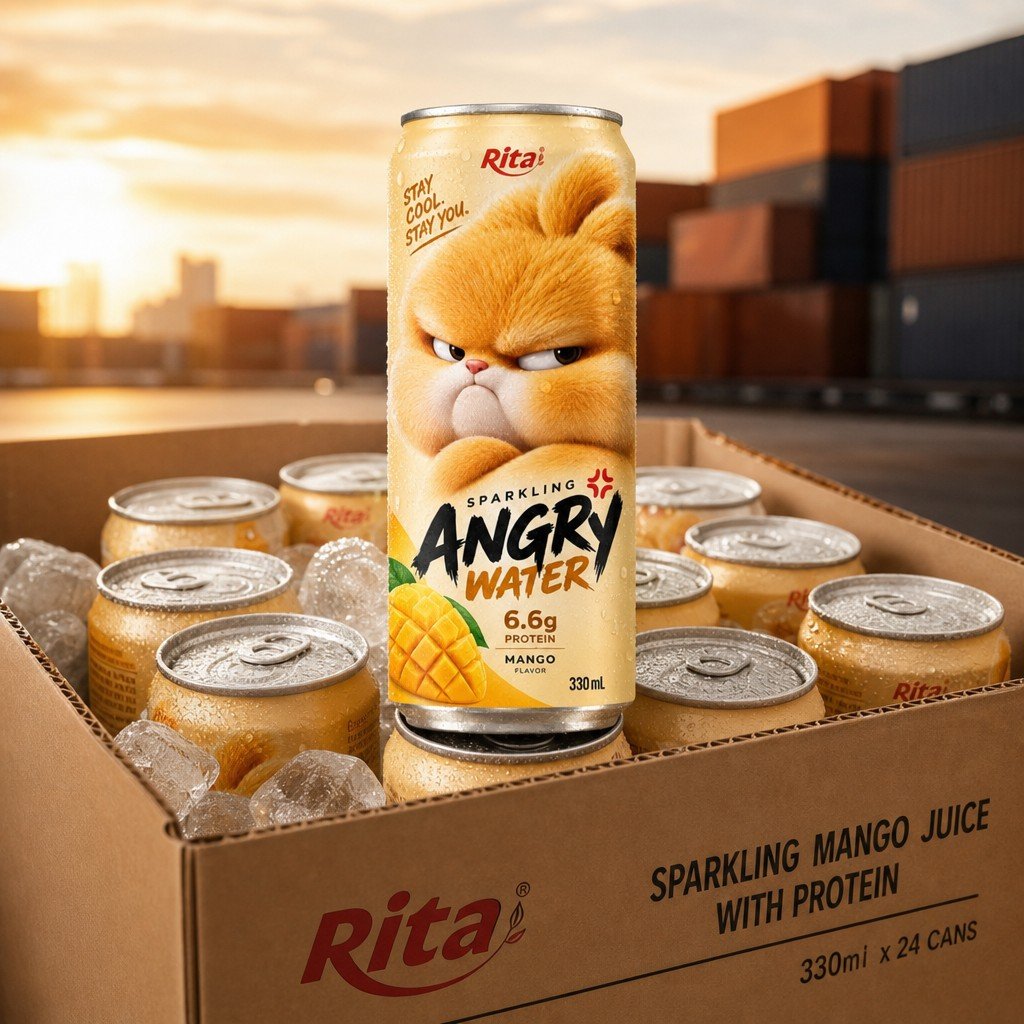
The 330ml aluminium can is a workhorse of the sparkling juice segment for reasons that extend well beyond aesthetics. It is light relative to volume, resists light ingress, tolerates pressure from carbonation, and palletizes with a density that container lines and distribution centres both reward. For the Sparkling Mango Juice With Protein SKU, RITA specifies a 24-month shelf life under standard storage, a specification that aligns with long-haul export cycles and extended distribution windows in importer-held inventory.
Packaging decisions also sit inside the regulatory picture. Aluminium cans, PET bottles and PP containers each carry different documentation requirements across markets, and certification consistency is one of the first items an importer's compliance team requests. RITA holds a portfolio of internationally recognised certifications including BRC, FSSC 22000, ISO, GMP, HACCP and SMETA, alongside Halal certification under both Jakim and HCA-GCC standards and Kosher certification, supporting shipments into Middle Eastern, Asian and North American channels. Buyers comparing packaging specifications across formats can cross-reference the manufacturer's fruit drinks catalogue to see how the same fruit base is delivered in cans, PET and glass.
| Attribute | 330ml Aluminium Can | PET Bottle | PP Bottle |
|---|---|---|---|
| Format volume | 330 ml | Multiple sizes | Multiple sizes |
| Specified shelf life | 24 months | Varies by format | Varies by format |
| Typical use | Sparkling, single-serve | Still juice, retail bulk | Premium still formats |
| Portability | High | Moderate | Moderate |
| Export documentation | Full certification set | Full certification set | Full certification set |
Specification table compiled from published RITA product and certification documentation.
OEM and Private Label Capacity for Global Buyers
Capacity is the quiet variable that decides whether a launch survives contact with a distribution calendar.
RITA reports a supply ability of approximately 600 twenty-foot containers per month, a figure that matters to buyers signing volume commitments across multiple territories. Typical commercial terms on the Sparkling Mango Juice With Protein programme include a minimum order quantity of 500 cartons, delivery from Ho Chi Minh Port, Vietnam, and a lead time of 20 to 25 days after order confirmation. Payment terms are offered on L/C and T/T arrangements, and buyers can request a free sample before committing to production — a step that protects both parties on flavor and packaging expectations.
The company also maintains a documented special drink catalogue for ingredient-added formulations, which is where buyers typically look when a project extends beyond a straightforward juice line into protein-enriched or otherwise differentiated sparkling products. Sparkling Mango Juice With Protein from Angry Water is presented within that wider contract-manufacturing framework rather than as an isolated SKU.
Private Label Opportunities in the Sparkling Segment
Private label remains one of the fastest routes from concept to shelf in sparkling beverages.
For distributors and brand owners, the appeal is structural: formulation support, packaging selection, certification coverage and container-scale logistics are handled by a single manufacturing partner, compressing the time between market validation and first shipment. The Angry Water portfolio illustrates the model, using a distinctive brand identity built on the Angry Water name while drawing on RITA's production infrastructure — more than 50 automated lines, 1,200-plus containers shipped monthly, and a service scope described by the company as covering the full arc from pre-order consultation to after-sales support.
Buyers exploring adjacent formats within the same production ecosystem can review the manufacturer's soft drinks catalogue and the fruit drinks catalogue, where sparkling mango juice sits alongside carbonated fruit drinks and still juice formats. The Sparkling Mango Juice With Protein 330ml listing carries the detailed commercial terms, from free sample availability to minimum order quantities and port of loading, giving procurement teams a single reference point during tender preparation.
Related news items:
Older news items:
- Rita Team Building 2026: Ready for Hon Rom, Phan Thiet - 07/10/2026 23:55
- Coconut Water With Pineapple Juice Faces New Regulatory Scrutiny - 06/10/2026 18:00
- From Arrival to Adventure: Rita’s Hòn Rơm Team Building Itinerary - 05/10/2026 18:55
- Yuzu Peach Electrolyte Water Drink Sees Global Export Momentum - 05/10/2026 09:05
- Rise of Coconut Water With Pineapple Juice in Global PET Markets - 01/10/2026 09:39