
Global Beverage Rules Reshape Bird's Nest Coconut Milk Exports
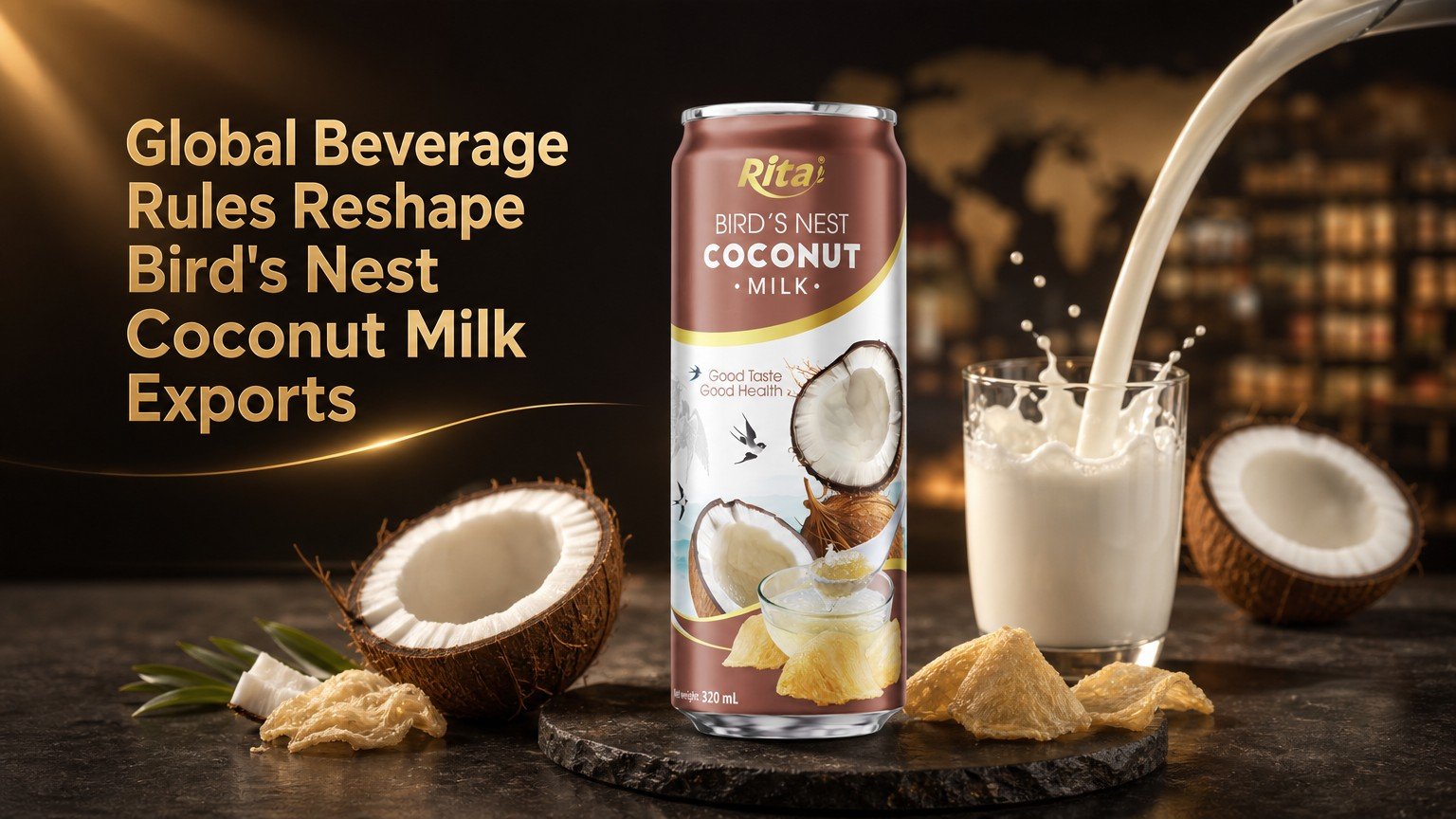
The global beverage trade is entering a period of heightened regulatory scrutiny, and Bird's Nest Coconut Milk is one of the product categories now being watched most closely by importers, distributors, and compliance officers. As food safety frameworks tighten across the Americas, Europe, Asia, the Middle East, Africa, and Oceania, manufacturers are being asked to prove documentation, traceability, and certification depth long before a single container leaves the port. The 11.18 Fl Oz (320 ml) Bird's Nest Coconut Milk supplied by RITA Food and Drink Co., Ltd, a Vietnamese OEM and ODM producer established in 2004, shows how large-scale manufacturing capacity is being repositioned around compliance rather than price alone.
Key Takeaways
- Global importers are increasingly treating certification files, traceability records, and shelf-life validation as mandatory entry conditions rather than optional marketing assets.
- Aluminum can packaging with a 24-month shelf life is gaining preference for multi-region distribution of coconut-based beverages, including bird's nest formulations.
- RITA's portfolio of certifications, including BRC, FSSC 22000, Halal Jakim, Halal HCA-GCC, Kosher, ISO, GMP, HACCP, and SMETA, addresses the widest range of buyer requirements in one production platform.
- Private label programs built around the 11.18 Fl Oz Bird's Nest Coconut Milk allow brands to enter regulated markets without building their own certified supply chain from scratch.
- Supply ability of roughly 300 twenty-foot containers per month gives distributors a reliable basis for large-volume tender and retail rollouts.
Bird's Nest Coconut Milk Faces a New Regulatory Era
Regulators are no longer judging beverages on shelf appeal alone. They are auditing supplier files, reviewing additive declarations, and cross-checking export documentation against destination-market requirements. For a category that combines two distinctive ingredients, coconut milk and bird's nest, the compliance burden is proportionally higher than for a conventional single-ingredient drink.
The 320 ml aluminum can format places the product squarely in the modern retail and food-service channel, where buyers in the Americas, Europe, Asia, the Middle East, Africa, and Oceania now run parallel compliance checklists. Each of those regions applies a different mix of food safety, labeling, religious dietary, and labor standards, which means a manufacturer must hold more than a single certificate to remain competitive across borders.
 " alt="Bird's Nest Coconut Milk aluminum can featured image about global beverage export regulations">
Why Bird's Nest Coconut Milk Fits the Regulatory Moment
Product architecture matters when compliance officers review a submission. The 11.18 Fl Oz Bird's Nest Coconut Milk pairs a stable coconut milk base with a bird's nest component, and it ships in an aluminum can that protects flavor integrity across long transit routes and warm-climate storage. Buyers evaluating this product typically begin with the specification sheet, the certification list, and the shelf-life statement before they discuss price or volume.
Regulatory Drivers Shaping Export Decisions
Several forces are reshaping the way beverage importers qualify new suppliers. Each of them favors manufacturers that can produce at scale while documenting every stage of the process.
- Stricter additive and labeling controls in mature markets, requiring full ingredient transparency on pack and in technical files.
- Expanded Halal and Kosher requirements, driven by the growth of religious dietary markets in the Middle East, Africa, and parts of Asia.
- Higher retailer expectations for internationally recognized food safety schemes such as BRC and FSSC 22000.
- Social compliance audits, including SMETA assessments, now appearing in tender documents for private label programs.
- Distribution complexity, as products move through multiple importers before reaching the final shelf.
From Our Orchards: Coconut Provenance Behind the Product
Raw material consistency remains the quiet foundation of any certified beverage program. For a coconut-based drink, the sourcing narrative matters because buyers increasingly ask where the primary ingredient originates and how it is handled before it ever reaches a production line. Transparent sourcing language also supports the traceability claims that auditors expect to see.
RITA's coconut raw material program is anchored in Vietnam's Ben Tre province, where Ben Tre coconut plantations supply a significant share of the company's coconut ingredients, giving the production platform a documented origin story that resonates with buyers in regulated markets. The company also draws on the wider Mekong Delta, an area long associated with high-quality tropical raw material supply in Vietnam.
For a closer look at how the coconut harvest moves from field to product, see the farm documentation below.
Product Specifications and Packaging Designed for Export
Spec-driven buyers tend to scan the same set of data points first: volume, packaging material, shelf life, minimum order quantity, delivery window, and port of loading. The 11.18 Fl Oz Bird's Nest Coconut Milk product page publishes those details openly, which shortens the qualification process considerably for importers running multiple tender cycles in parallel.
" alt="320 ml Bird's Nest Coconut Milk aluminum can with packaging and coconut ingredients for export">
Aluminum can packaging is a decisive factor for this category. It resists the temperature swings common to containerized shipping, supports extended shelf life, and prints cleanly with the coconut and bird's nest imagery that helps the product stand out on a crowded shelf. The following table summarizes the core commercial specifications published for the product.
| Specification | Published Detail |
|---|---|
| Product name | 11.18 Fl Oz Bird's Nest Coconut Milk |
| Volume | 320 ml (11.18 Fl Oz) |
| Packaging | Aluminum can |
| Shelf life | 24 months |
| Minimum order quantity | 500 cartons |
| Delivery time | 20 to 25 days after order confirmation |
| Supply ability | Approximately 300 twenty-foot containers per month |
| Port of loading | Ho Chi Minh Port, Vietnam |
| Payment terms | L/C, T/T |
| Certifications listed | HALAL, FSSC, HACCP, BRC, ISO, GMP |
Source: product specifications published by RITA Food and Drink Co., Ltd via oem-beverage.com.
Certification Framework Behind the 11.18 Fl Oz Bird's Nest Coconut Milk
Certifications are the front line of beverage compliance, and the breadth of approvals behind this product is unusual for a single SKU. Rather than a single scheme, the manufacturer holds a layered set of credentials that covers food safety, quality management, dietary requirements, and social responsibility.
Halal, Kosher and Food Safety Certifications
Religious dietary approvals are no longer a niche requirement in the beverage trade. Halal Jakim and Halal HCA-GCC credentials open distribution channels in the Middle East, parts of Asia, and North Africa, while Kosher certification supports retail listings in the Americas and Europe. Paired with ISO, GMP, and HACCP frameworks, the file answers the most common first-round questions raised by compliance teams during supplier qualification.
- BRC Global Standards for food safety, widely requested by European and North American retailers.
- FSSC 22000, built on ISO 22000 and recognized across global food supply chains.
- Halal Jakim and Halal HCA-GCC, covering religious dietary markets in Southeast Asia and GCC countries.
- Kosher certification, supporting mainstream retail placement in several Western markets.
- ISO, GMP, and HACCP systems governing quality management and process control.
- SMETA social compliance auditing, increasingly referenced in retailer tender documents.
RITA operates more than 50 automated production lines and exports to over 200 countries and territories, so the certification architecture is not attached to a single facility but to an integrated manufacturing platform. Buyers reviewing the full Bird's Nest Coconut Milk certification package are therefore looking at documentation that has been tested by real export volume rather than prepared for a single pilot shipment.
How Compliance Is Reshaping Buyer Decisions
Compliance has quietly become a pricing variable in beverage procurement. Buyers now weigh the administrative cost of qualifying a supplier, the risk of a rejected shipment, and the speed of market entry alongside the unit price on the invoice. Manufacturers that reduce that hidden cost tend to win tenders even when their quoted price is not the lowest in the room.
Cost Structures Behind Certified Production
Every certification carries an operating cost, from audit preparation to laboratory testing to ongoing process documentation. These costs are absorbed more efficiently by producers that run high volume across many export markets, because the fixed compliance overhead is spread across hundreds of containers per month. The following comparison illustrates how buyers typically evaluate two alternative supply scenarios for a coconut-based can beverage.
| Evaluation Criteria | Generic Coconut Can Supplier | Certified Bird's Nest Coconut Milk Platform |
|---|---|---|
| International certifications | Limited or single-scheme | BRC, FSSC 22000, Halal, Kosher, ISO, GMP, HACCP, SMETA |
| Shelf-life documentation | Often incomplete | 24-month shelf life published with specification sheet |
| Packaging standard | Varies by market | Aluminum can format designed for multi-region shipping |
| Supply continuity | Regional focus | Approximately 300 twenty-foot containers per month |
| Private label readiness | Variable | Established OEM and ODM programs with free sampling |
Source: comparison framework based on publicly published product specifications and certification scope from RITA Food and Drink Co., Ltd and oem-beverage.com.
The practical effect is that a producer with broad certification coverage can compress the buyer's qualification timeline, reduce the risk of documentation gaps at customs, and support a faster launch in a new territory. For a 320 ml aluminum can product aimed at several regions at once, that advantage compounds across every shipment.
Market Outlook for Coconut-Based Beverage Exports
Coconut beverages continue to travel well across borders, and the combination of coconut milk with a differentiated ingredient such as bird's nest gives importers a premium position within the category. The demand pattern is broad rather than concentrated: retail chains in mature markets, food-service operators in growing economies, and private label programs seeking a distinctive SKU all read the same specification sheet differently.
Volume planning is the next commercial question after compliance is settled. With a published supply ability of around 300 twenty-foot containers per month and a delivery window of 20 to 25 days after order confirmation, distributors can model annual forecasts around this product without relying on ad hoc production capacity. Free sampling, listed as part of the commercial terms, also allows buyers to complete sensory and shelf-life validation before committing to a container order.
Private Label as the Growth Path
Private label has become the fastest route for brands that want the category economics without the regulatory overhead. Working with an established OEM and ODM partner means the brand owner inherits an existing certification base, an approved specification, and a packaging format that has already cleared multiple import regimes. For the Bird's Nest Coconut Milk in 11.18 Fl Oz aluminum can, that translates into a launch-ready asset rather than a development project.
That model also explains the broader shift in the sector. Manufacturers are no longer competing purely on price per unit; they are competing on how quickly a compliant, export-ready product can move from a signed contract to a first shipment. RITA's position as a leading Vietnamese OEM and ODM exporter, supplying brands in more than 180 countries, demonstrates how certification depth and production scale combine to shorten that cycle.
Buyers exploring adjacent categories within the same certified platform can review the company's coconut products range, its milk series portfolio, and the broader special drink collection on the oem-beverage.com catalog. Each catalog entry carries the same compliance discipline, which makes it straightforward to build a multi-SKU program under a single audit relationship.
Frequently Asked Questions
What is the Bird's Nest Coconut Milk from RITA?
It is a 320 ml (11.18 Fl Oz) coconut milk beverage containing a bird's nest component, supplied by RITA Food and Drink Co., Ltd and available in aluminum can packaging with a published 24-month shelf life.
Which certifications support the export of this product?
The product is listed with HALAL, FSSC, HACCP, BRC, ISO, and GMP certifications, supported by the manufacturer's Halal Jakim, Halal HCA-GCC, Kosher, and SMETA credentials.
What are the minimum order and delivery terms?
The published minimum order quantity is 500 cartons, with a delivery time of 20 to 25 days after order confirmation and a monthly supply ability of approximately 300 twenty-foot containers.
Which packaging format is used for this beverage?
The Bird's Nest Coconut Milk is packed in a 320 ml aluminum can, a format selected for long transit routes, warm-climate storage, and extended shelf life.
Does the manufacturer offer private label production?
Yes. RITA provides OEM and ODM solutions for brands worldwide, with free sampling available and free consultation before order confirmation.
Related news items:
Older news items:
- Yuzu Peach Electrolyte Water Rides Low-Sugar Beverage Wave - 13/10/2026 18:37
- RITA Grape Prebiotic Soda Attracts Global OEM Buyers - 11/10/2026 18:27
- Sparkling Mango Juice With Protein Rides New Global Supply Chains - 08/10/2026 18:22
- Rita Team Building 2026: Ready for Hon Rom, Phan Thiet - 07/10/2026 23:55
- Coconut Water With Pineapple Juice Faces New Regulatory Scrutiny - 06/10/2026 18:00