
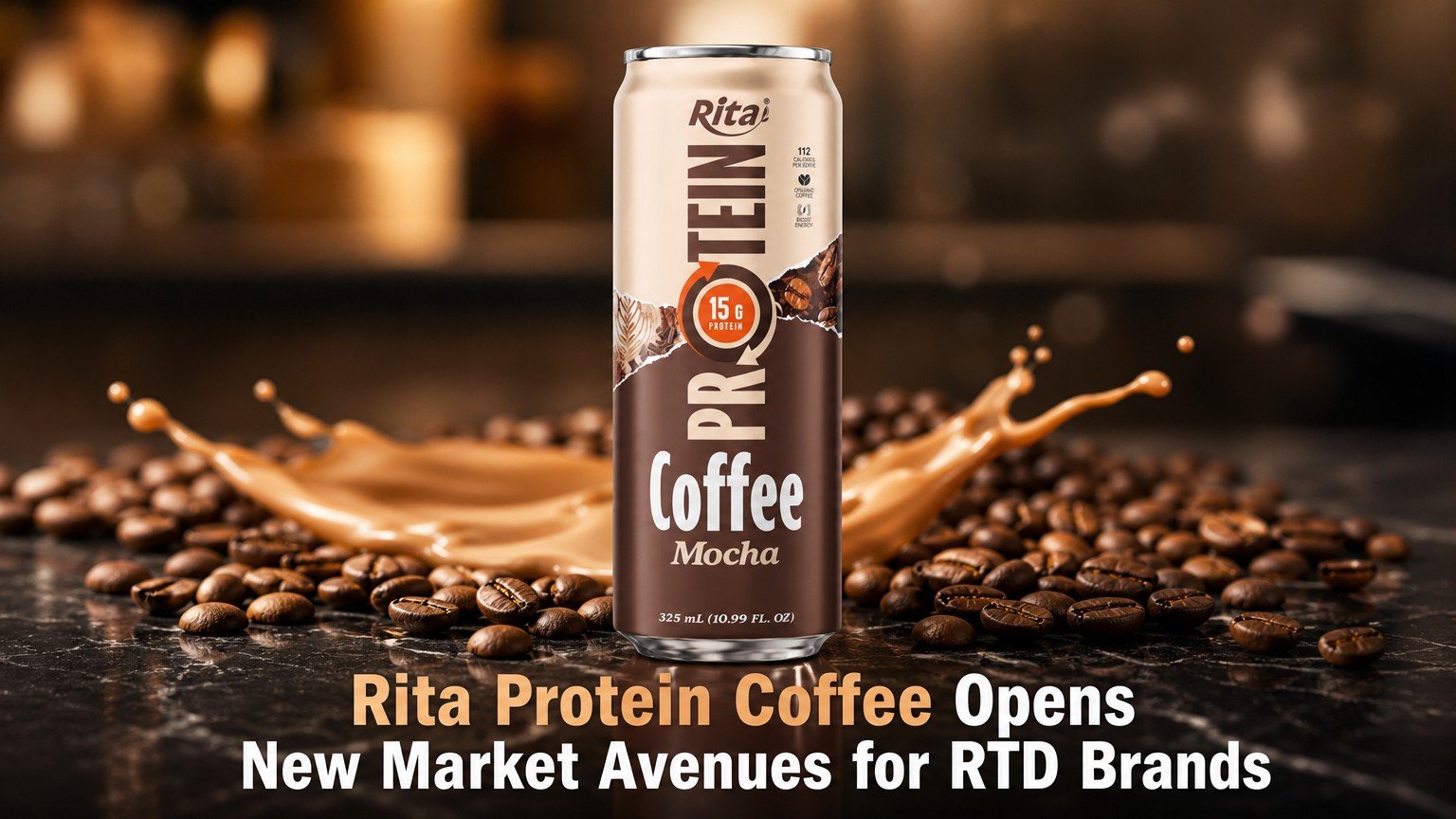
Rita Protein Coffee Opens New Market Avenues for RTD Brands
The global ready-to-drink coffee category is entering a decisive phase, and protein coffee 15g formulations are emerging as one of the most closely watched sub-segments among beverage buyers, distributors, and private label entrepreneurs. As consumers shift toward convenient, on-the-go formats that combine familiar taste profiles with added nutritional content, manufacturers capable of delivering export-ready solutions at scale are finding themselves in a strong commercial position. Against this backdrop, Vietnamese OEM/ODM manufacturer RITA Food and Drink Co., Ltd has positioned its Rita Protein Coffee 15g Ready-to-Drink Mocha 325ml Can as a compelling offering for brands seeking to enter or expand within the protein-enriched coffee segment across global markets.
Key Takeaways
- Ready-to-drink coffee with added protein is gaining traction among time-pressed consumers seeking convenient mocha-flavored options in portable formats.
- Aluminum can packaging, a 24-month shelf life, and monthly supply capacity of 600 twenty-foot containers position RITA for high-volume export contracts.
- International certifications including BRC, FSSC 22000, Halal, Kosher, ISO, GMP, and HACCP open doors across the Americas, Europe, Asia, Middle East, Africa, and Oceania.
- Private label and OEM partnerships allow brands to launch differentiated protein coffee products without heavy capital investment in production infrastructure.
- Broader beverage industry dynamics, from sugar tax debates in Germany to corporate restructuring among global brewers, underscore the value of agile manufacturing partners.
Ready-to-Drink Coffee Meets the Protein Wave
The protein coffee trend reflects a broader convergence between two of the beverage industry's strongest currents: the enduring popularity of coffee-based drinks and rising consumer interest in products with added protein content. Mocha, with its familiar blend of coffee and chocolate notes, remains one of the most widely accepted flavor profiles in international markets, making it a natural entry point for brands exploring this space.
Why Mocha Leads the Flavor Conversation
Mocha occupies a unique position in the global coffee spectrum. It appeals to consumers who find black coffee too intense and to those who want more complexity than a standard latte delivers. In ready-to-drink formats, mocha translates well across cultures, requiring little localization of taste expectations. For manufacturers, this predictability reduces formulation risk and accelerates time-to-market for new brand launches.
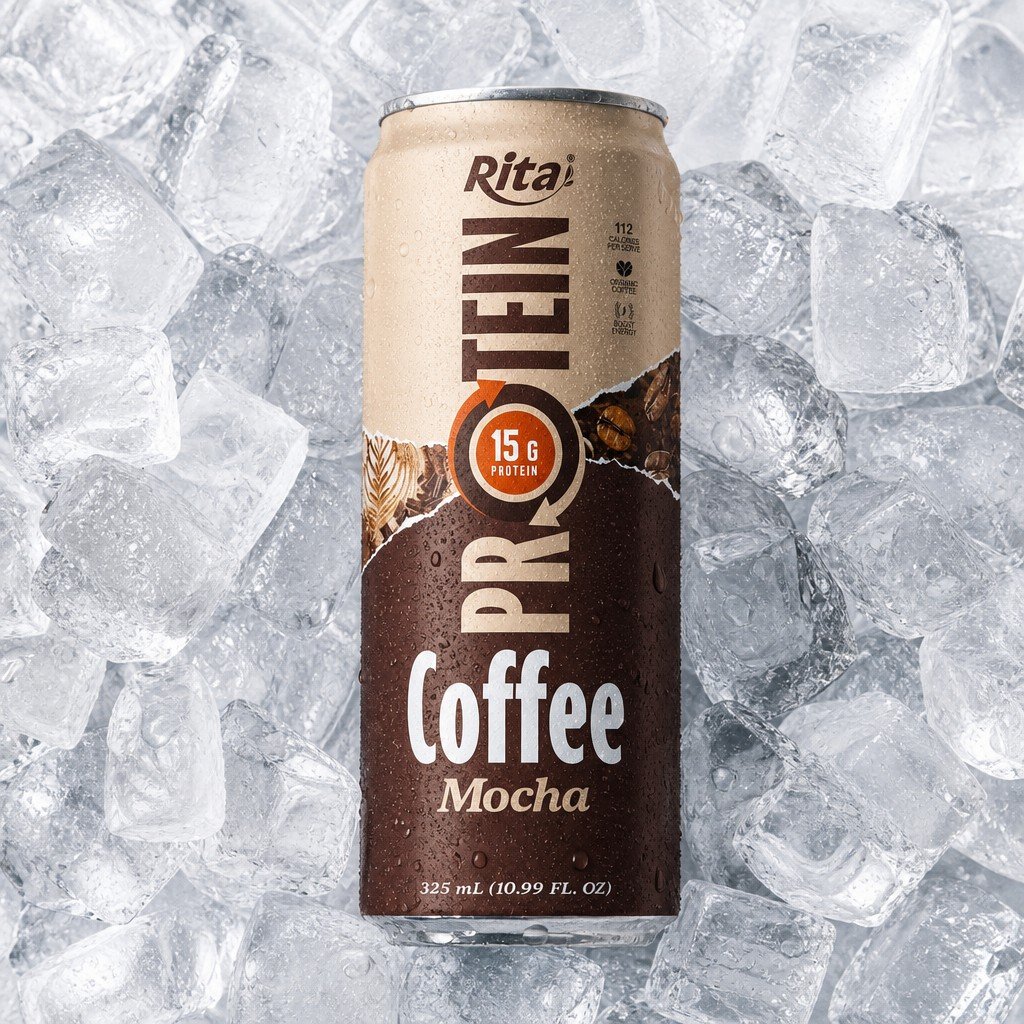
RITA's protein coffee mocha delivers 15 grams of protein per 325ml serving at 112 calories, packaged in a brown-and-beige aluminum can adorned with coffee bean graphics. The specification sheet speaks directly to what retail buyers and distributors ask for: a compact, visually distinctive format with clear on-pack nutritional communication. The product is available for private label customization, enabling brands to adapt branding while retaining a proven formulation.
Format and Packaging as Competitive Levers
The choice of a 325ml aluminum can is deliberate. Cans chill quickly, protect contents from light exposure, and are among the most recycled beverage packaging formats worldwide. For export-oriented brands, the 24-month shelf life associated with this format simplifies inventory planning across long supply chains. Payment terms of L/C or T/T, FOB pricing, and a delivery window of 20 to 25 days after order confirmation further reduce friction for international buyers.
Market Opportunity in Protein-Enriched Beverages
Demand signals for protein-enriched beverages are strengthening across both mature and emerging markets. Convenience stores, fitness-oriented retail channels, and e-commerce platforms are all expanding their chilled and ambient beverage selections, and protein coffee occupies an appealing middle ground between indulgent coffee drinks and more utilitarian nutrition products.
Regional Demand Patterns
In North America and Europe, protein-enriched ready-to-drink products have moved from niche wellness shelves into mainstream chilled aisles. In Asia-Pacific and the Middle East, rapid urbanization and expanding modern retail infrastructure are creating fresh distribution opportunities for canned coffee beverages. Africa and Oceania, while smaller in absolute volume, present attractive entry points for brands seeking differentiated offerings with less shelf competition. RITA's export footprint across more than 200 countries and territories gives it unusual visibility into these varying demand patterns.
For buyers evaluating sourcing options, the combination of competitive Vietnamese production costs, established logistics through Ho Chi Minh Port, and a minimum order quantity of 500 cartons lowers the barrier to testing new markets. The company's monthly supply ability of 600 twenty-foot containers ensures that successful pilots can scale without renegotiating capacity.
Export-Grade Certifications and Global Compliance
International buyers increasingly treat certification as a gating criterion rather than a differentiator. A product that cannot demonstrate compliance with recognized food safety and quality standards will struggle to clear retail onboarding processes, regardless of taste or price. This reality makes RITA's certification portfolio a central element of its commercial proposition.
Certifications That Open Market Doors
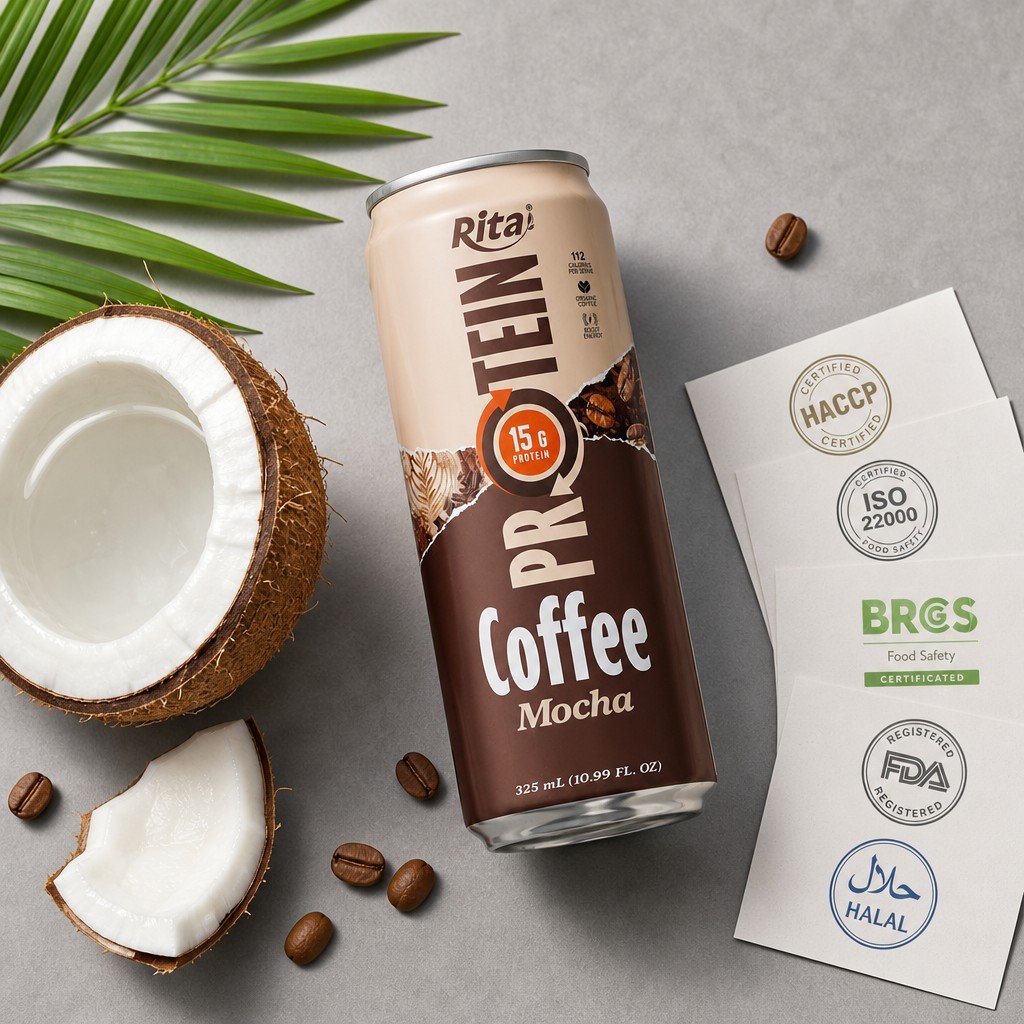
RITA holds BRC, FSSC 22000, Halal Jakim, Halal HCA-GCC, Kosher, ISO, GMP, HACCP, and SMETA certifications. Each serves a distinct market function:
- BRC and FSSC 22000 — widely required by European and North American retailers for supplier approval.
- Halal Jakim and Halal HCA-GCC — essential for distribution across Southeast Asia and the Gulf Cooperation Council states.
- Kosher — relevant for specific retail segments in North America and Europe.
- ISO, GMP, and HACCP — baseline quality and process controls expected by professional importers.
- SMETA — ethical audit compliance increasingly requested by multinational buyers.
Together, these credentials allow a single production partner to serve buyers with vastly different regulatory expectations. For brands considering multi-market launches, this reduces the need to qualify multiple factories across regions.
From Our Orchards and Highlands to the Can
Flavor authenticity in coffee beverages begins long before the canning line. The character of a mocha protein drink depends on the quality and roast profile of its coffee inputs, and Vietnam's Central Highlands have become one of the world's most significant arabica and robusta growing regions. RITA's team regularly inspects raw material areas during peak harvest season to secure consistent supply, an approach documented in the company's account of visiting Vietnam's coffee gardens in peak harvest season.
Broader raw material sourcing also draws on the Mekong Delta, one of Southeast Asia's most productive agricultural zones. The region's diversity of fruits and crops underpins RITA's wider beverage portfolio and supports cross-category innovation. Further detail on this sourcing base is available in the company's overview of the Mekong Delta as a high-quality raw ingredients area.
For buyers interested in the upstream story behind coffee sourcing, RITA has shared footage from its coffee-growing regions at
Industry Headlines Shape the Competitive Landscape
The wider beverage sector has been unusually eventful. A cyberattack on French supermarkets has prompted fresh scrutiny of supply chain cybersecurity, a reminder that digital resilience now sits alongside food safety as a procurement concern. Carlsberg, meanwhile, faces an order to shut its Indian brewery over emissions violations, highlighting how environmental compliance can disrupt production plans overnight.
Policy debates are equally active. German states have criticized proposed sugar tax plans, reigniting discussion about how health-related levies might reshape product portfolios and pricing strategies across Europe. Constellation Brands is returning to M&A activity despite a stagnant U.S. beer market, signaling that scale and portfolio breadth remain strategic priorities. Separately, Rosemount has returned to founding family ownership as The TWE group continues its divestiture program, underscoring the enduring value of brand heritage in an industry defined by long cycles.
For OEM partners and private label brands, these headlines carry a practical implication: agility matters. Manufacturers that can absorb regulatory shifts, pivot packaging or formulations quickly, and maintain reliable export logistics will be better positioned to serve clients navigating an unpredictable environment.
OEM and Private Label Pathways for Brand Builders
Launching a protein coffee line from scratch requires formulation expertise, production capacity, certification, and distribution know-how — capabilities that are expensive to build in-house. Partnering with an established OEM/ODM manufacturer converts those fixed costs into variable ones, allowing brands to focus capital on marketing and channel development.
What RITA's OEM Model Offers
RITA Food and Drink Co., Ltd, established in 2004, operates more than 50 automated production lines and exports over 1,200 containers per month. The company manufactures beverages spanning tropical fruit juices, coconut products, functional drinks, energy drinks, and coffee beverages in aluminum cans, glass bottles, PET, and PP bottles. Buyers exploring adjacent categories can review the company's ready-to-drink coffee drinks series or its broader milk-based beverage range to identify complementary SKUs for portfolio expansion.
Service coverage extends from pre-order consultation through after-sale support, with free samples available to qualified buyers. The combination of R&D capability, flexible order quantities, and globally recognized certifications makes the manufacturer a practical partner for both established distributors and first-time importers. The full specification for the mocha protein coffee can be reviewed directly at the Rita Protein Coffee 15g product page.
Considerations for Buyers Evaluating Suppliers
Procurement teams weighing protein coffee sourcing options typically assess several dimensions in parallel. A structured comparison helps clarify trade-offs:
| Criterion | What to Verify | RITA Position |
|---|---|---|
| Packaging format | Aluminum can, PET, glass, or pouch availability | 325ml aluminum can; multi-format capability across portfolio |
| Shelf life | Suitability for long-haul export | 24 months |
| Certifications | Retailer and regional market requirements | BRC, FSSC 22000, Halal, Kosher, ISO, GMP, HACCP, SMETA |
| Minimum order | Test-market feasibility | 500 cartons |
| Supply capacity | Scalability after successful launch | 600 twenty-foot containers per month |
| Lead time | Planning for seasonal campaigns | 20-25 days after order confirmation |
| Incoterms | Logistics and cost structure | FOB, Ho Chi Minh Port; L/C and T/T payment terms |
Specifications as published by RITA Food and Drink Co., Ltd for the Rita Protein Coffee 15g 325ml can.
Looking Ahead
The intersection of convenient coffee formats, added protein content, and export-ready manufacturing creates a genuine market opportunity for brands prepared to move decisively. As retail channels continue to broaden their beverage selections and consumers show sustained interest in mocha-flavored ready-to-drink options, the window for differentiation remains open — but it will not stay open indefinitely.
For distributors and brand owners evaluating their next product launch, the practical starting point is a sample request and a conversation about target markets, labeling requirements, and volume projections. With the right manufacturing partner, a protein coffee line can move from concept to container in a matter of weeks.
Frequently Asked Questions
What is Rita Protein Coffee 15g?
Rita Protein Coffee 15g is a ready-to-drink mocha-flavored coffee beverage supplied in a 325ml aluminum can. Each serving contains 15 grams of protein and 112 calories, and the product carries a 24-month shelf life suitable for export distribution.
What certifications does the product hold?
The product is manufactured under BRC, FSSC 22000, Halal Jakim, Halal HCA-GCC, Kosher, ISO, GMP, HACCP, and SMETA certifications, supporting compliance across European, North American, Middle Eastern, and Asian retail channels.
What is the minimum order quantity?
The minimum order quantity is 500 cartons. Free samples are available for qualified buyers, and delivery is typically completed 20 to 25 days after order confirmation, shipped FOB from Ho Chi Minh Port, Vietnam.
Can the product be customized under a private label?
Yes. RITA offers OEM and ODM services, allowing brands to adapt branding and packaging while working from an established formulation. Additional details are available through the company's OEM service program.
What is the monthly supply capacity?
RITA can supply up to 600 twenty-foot containers per month, providing sufficient capacity for brands scaling from initial market tests to full regional distribution.
Newer news items:
Older news items:
- Rita Beverage Team Building 2026: A Journey of Connection, Joy and Togetherness - 19/10/2026 06:31
- Global Beverage Rules Reshape Bird's Nest Coconut Milk Exports - 15/10/2026 18:00
- Yuzu Peach Electrolyte Water Rides Low-Sugar Beverage Wave - 13/10/2026 18:37
- RITA Grape Prebiotic Soda Attracts Global OEM Buyers - 11/10/2026 18:27
- Sparkling Mango Juice With Protein Rides New Global Supply Chains - 08/10/2026 18:22