
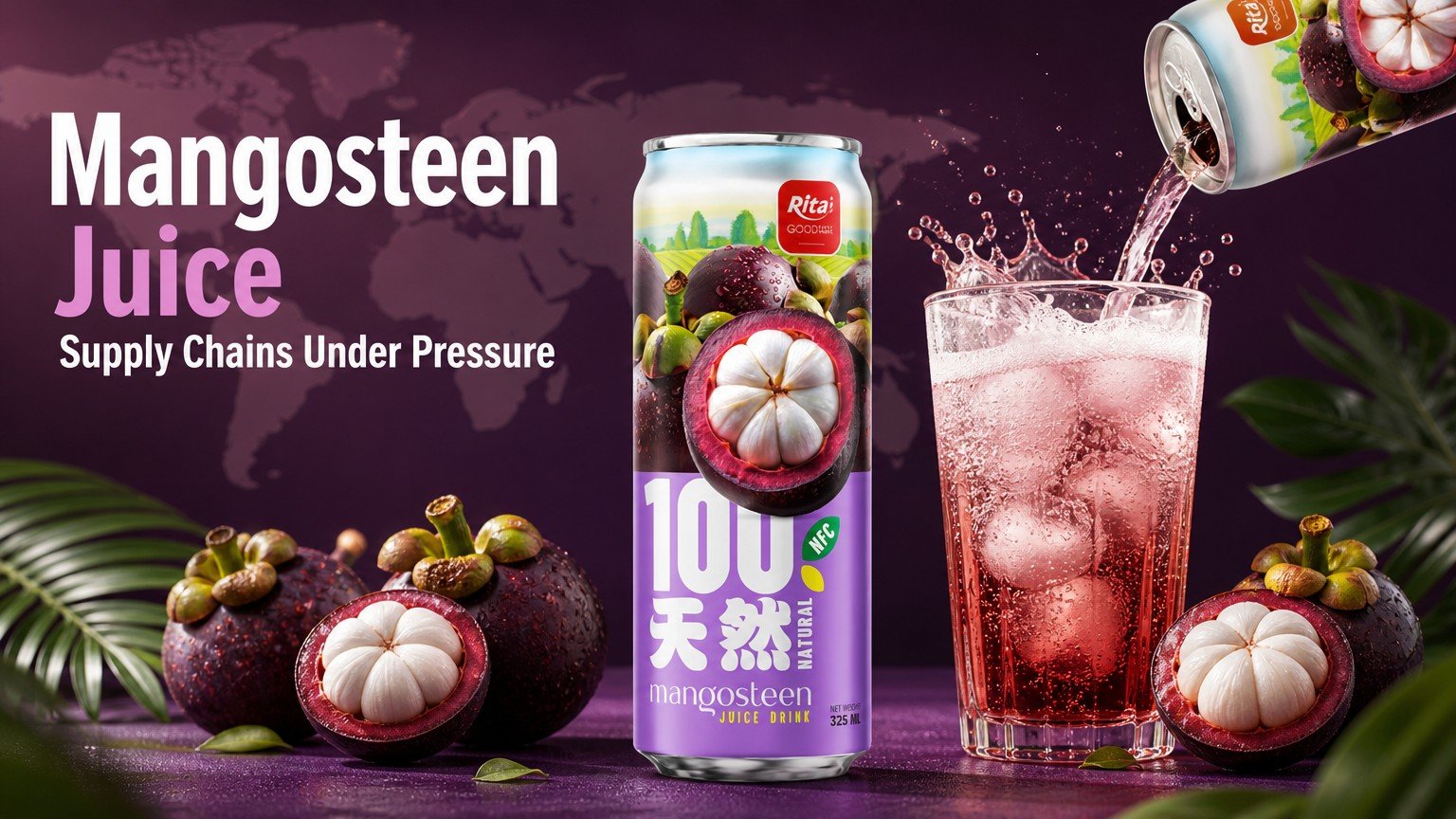
Mangosteen Juice Drink Supply Chains Under Pressure as Demand Expands
The global beverage trade is being reshaped by supply chain disruption, regulatory pressure and shifting retail preferences, and tropical fruit categories sit right at the centre of that shift. Within this landscape, the 100% natural mangosteen juice drink has emerged as a genuinely distinctive proposition for importers and private label buyers looking for something beyond the mainstream apple, orange and mango profiles. Vietnamese manufacturer RITA Food and Drink Co., Ltd has taken the format into a 325ml sleek can built for international retail shelves, from the Americas and Europe to Asia, the Middle East, Africa and Oceania. This article examines the supply chain dynamics behind the category, the sourcing practices that support it, and the export infrastructure required to deliver it at scale.
Key Takeaways
- Retail and logistics disruption across Europe and South Asia is pushing beverage buyers to prioritise proven, certified supply partners over the lowest headline price.
- Mangosteen offers a sweet-tart, aromatic flavour profile that gives retailers a credible point of difference in a crowded tropical juice set.
- The 325ml sleek can remains one of the most export-efficient single-serve formats for fruit beverages, combining light weight with strong barrier protection and a 24-month shelf life.
- RITA operates more than 50 automated production lines and ships over 1,200 containers monthly to 200+ countries and territories, giving buyers genuine volume depth.
- Certifications including BRC, FSSC 22000, Halal Jakim, Halal HCA-GCC, Kosher, ISO, GMP, HACCP and SMETA underpin access to the most regulated import markets.
Global Beverage Supply Chains Face a Stress Test
Supply reliability has become the defining question for beverage buyers in this cycle.
Recent months have offered a compressed case study in how quickly conditions can move. A cyberattack disrupted operations across French supermarket networks, forcing major retailers to manage stock and replenishment under degraded digital systems while suppliers waited on order visibility. In India, Carlsberg was ordered to close a brewery over emissions violations, a reminder that environmental enforcement can remove capacity from an export market almost overnight. In Germany, several states have voiced opposition to proposed sugar tax plans, underlining how fiscal policy remains an unpredictable variable for soft drink and juice portfolios alike.
Strategic activity tells a similar story of repositioning. Constellation Brands is re-entering merger and acquisition territory despite a stagnant U.S. beer market, while Rosemount has returned to founding family ownership as Treasury Wine Estates continues its portfolio disposals. Across categories, the message from boardrooms is consistent: control your supply base, or someone else will price you out of it.
For buyers sourcing fruit beverages, the practical implication is straightforward. Supplier depth, traceability and contractual reliability now carry more weight than headline pricing, and buyers are increasingly auditing the full chain from raw material area through to container loading.
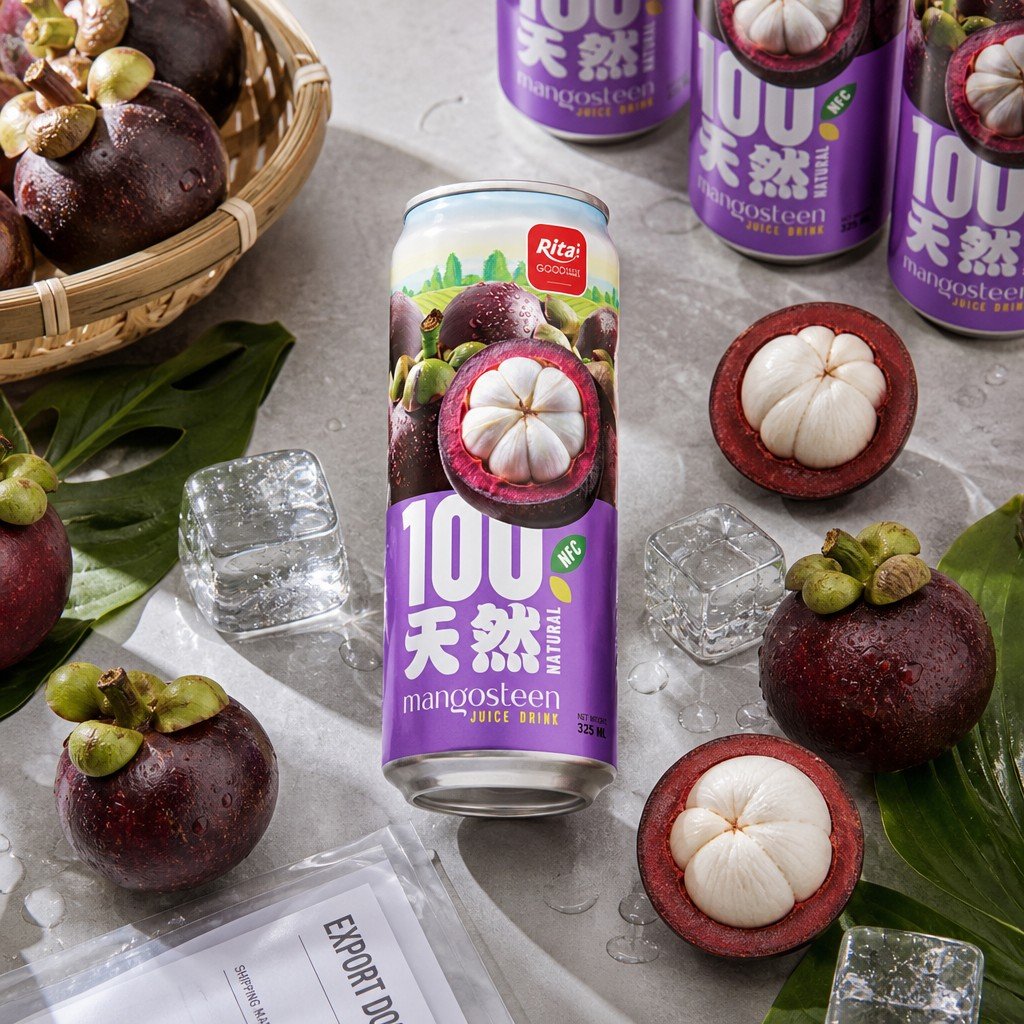
Resilient supply chains in this category tend to share the same architecture. Raw material is contracted across multiple growing regions rather than a single estate. Production runs across parallel lines so that a technical stoppage on one does not halt an entire shipment programme. Export documentation is prepared in advance, and buffer stock is held close to the port of loading. Each of these elements adds cost in the short term but removes far larger costs in the form of missed listings and penalty clauses.
Reliable Sourcing as a Competitive Advantage
Vertical integration has quietly become one of the strongest differentiators available to beverage manufacturers. When a producer controls or closely audits its raw material area, it can plan harvest windows against production schedules rather than the reverse. That matters enormously for a fruit as seasonal as mangosteen, where the window between tree-ripe quality and over-maturity is narrow.
Buyers have responded accordingly. Tender documents in the Gulf, North Africa and Southeast Asia increasingly request evidence of farm-level supplier management, residue testing protocols and batch traceability back to the harvest date. Manufacturers that can present those records move through qualification faster, and that speed is itself a commercial advantage in a market where shelf slots are allocated months in advance.
The Rise of Mangosteen Juice Drink in Global Retail
Mangosteen occupies an unusual position in the fruit beverage trade — highly prized, rarely commoditised, and still under-represented on shelf relative to demand signals.
The fruit itself explains much of that tension. Known for its thick deep-purple rind and snow-white segments, mangosteen delivers a sweet-tart balance with delicate floral and citrus-adjacent notes that consumers describe as unlike anything else in the tropical set. Historically, however, its commercial reach was capped by biology: the fruit bruises easily, oxidises quickly once opened, and has a harvest window measured in weeks rather than months. Fresh mangosteen could never scale into a global retail proposition on its own.
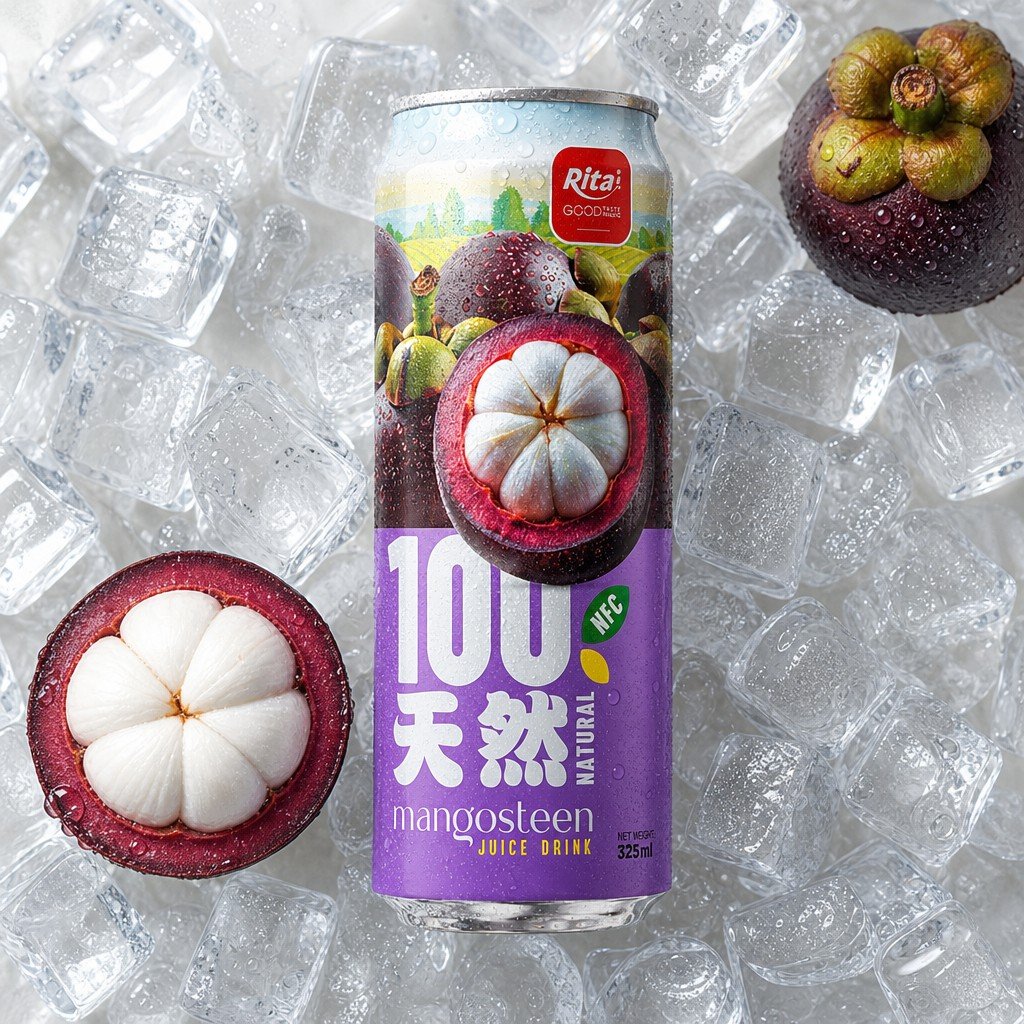
Canning resolves almost every one of those constraints. Thermal processing stabilises the flavour profile, the aluminium hermetic seal eliminates light and oxygen ingress, and the resulting mangosteen juice drink in a 325ml sleek can carries a 24-month shelf life at ambient temperature. For a category buyer, that converts a perishable seasonal fruit into a year-round listing with predictable inventory turns — one of the quiet structural reasons tropical can beverages have gained ground in import markets over the past decade.
Flavour positioning matters too. Retailers building a tropical juice wall need anchors that shoppers recognise and discoveries that stop them. Mangosteen sits firmly in the second category, and it pairs naturally with established lines such as guava, passion fruit, soursop and lychee without cannibalising them.
Why the 325ml Sleek Can Format Keeps Winning
Format choice is a supply chain decision as much as a marketing one, and the sleek can has proven remarkably durable on both fronts.
- Logistics efficiency — slim cans cube tightly in standard export cartons, improving pallet density and reducing per-unit freight cost on long ocean routes.
- Barrier performance — aluminium delivers near-total protection against light and oxygen, protecting colour and aroma across the full 24-month shelf life.
- Portion control — 325ml sits inside the preferred single-serve range for convenience, food service and travel retail channels.
- Shelf economics — vertical can facings maximise linear space in chilled cabinets and ambient displays alike.
- Material recovery — aluminium's established recycling infrastructure remains a positive talking point for European and Australasian buyers.
Together, these attributes explain why the format continues to win listings even as alternative packaging enters the conversation. For an export-led programme, the maths rarely changes.
From Our Orchards - Sourcing Mangosteen in Southern Vietnam
Raw material quality for a premium mangosteen beverage begins long before the canning line, and Vietnam's southern growing belt remains one of the most reliable sourcing bases for the fruit in Asia.
The tropical monsoon climate of the Mekong Delta region and surrounding provinces delivers the consistent heat and rainfall pattern mangosteen requires, while deep alluvial soils support the long maturation cycle of the tree. Fruit is typically harvested by hand at controlled maturity, sorted on site, and moved into processing quickly to preserve the delicate aromatic top notes that differentiate a quality beverage from a generic one. RITA documents this chain of custody through its mangosteen garden inspection programme, which covers orchard condition, harvest practice and raw material grading before fruit is released to production planning teams.
A visual walkthrough of the garden, including harvesting and on-site handling, is available at
Export-Ready Manufacturing and Private Label Solutions
Capacity is where ambition meets reality, and RITA Food and Drink Co., Ltd has spent two decades building for exactly this moment. Established in 2004, the company operates as a Vietnamese OEM and ODM beverage manufacturer with more than 50 automated production lines and ships over 1,200 containers per month to buyers in 200+ countries and territories.
For the mangosteen juice drink programme specifically, the commercial framework is designed around international buyer requirements. The product is filled in 325ml aluminium cans with a 24-month ambient shelf life, a minimum order quantity of 500 cartons and a supply ability of around 300 twenty-foot containers per month. Confirmed orders typically move from confirmation to dispatch in 20 to 25 days, loading at Ho Chi Minh Port, with L/C and T/T payment terms supported. Buyers interested in the full specification sheet can review the product listing on oem-beverage.com or request a complimentary sample through the export desk.
The wider portfolio context matters as well. Mangosteen rarely travels alone in a buyer's assortment, and the group's fruit drinks catalogue covers complementary tropical lines including guava, soursop, passion fruit, pineapple, papaya and mixed fruit formulations, allowing consolidators to build multi-SKU containers from a single supplier.
Certifications That Open Doors in Regulated Markets
Certification is no longer a differentiator; it is an entry ticket. RITA's mangosteen programme is produced and audited against a stack that covers the major regulatory environments buyers operate in:
- BRC and FSSC 22000 — the reference schemes for British and continental European retail listing.
- Halal Jakim and Halal HCA-GCC — dual Halal coverage spanning Southeast Asian and Gulf Cooperation Council requirements.
- Kosher — supporting access to specialised distribution channels in North America and Israel.
- ISO, GMP and HACCP — the foundational manufacturing and food safety frameworks expected by importers globally.
- SMETA — an ethical audit standard increasingly requested by European retail groups and their buying committees.
That combination means an OEM beverage manufacturer relationship with RITA can serve a single import market or a multi-region distribution network without re-qualifying production for each territory.
Market and Export Outlook
Demand signals for tropical fruit beverages remain constructive, but the winners will be defined by supply chain execution rather than trend timing.
Three structural forces are likely to shape the category through the next planning cycle. First, private label expansion in Gulf and African retail continues to outpace branded growth, creating steady volume for manufacturers able to offer both standard and bespoke formulations. Second, single-serve can formats keep gaining share in convenience and food service channels where portion control and ambient stability are non-negotiable. Third, buyers exposed to European and North American regulatory regimes are consolidating their supplier bases toward partners who can evidence certification, traceability and ethical compliance in one package.
For a fruit juice drink wholesale programme, that consolidation trend rewards scale. A producer that can hold 24-month inventory, load 300 containers a month and answer an audit request with current paperwork is simply easier to buy from than a smaller counterpart, regardless of unit price. RITA's position as a fruit juice products specialist with a documented export record across 200+ markets gives procurement teams a single point of accountability for tropical can programmes.
The mangosteen category will not become the next orange juice. It does not need to. What it offers instead is a defensible, shelf-ready proposition backed by real sourcing infrastructure and export discipline — and in a supply chain environment where reliability has become the scarcest commodity of all, that may be the more valuable position to hold.
Frequently Asked Questions
What is the shelf life of RITA's mangosteen juice drink in cans?
The 100% natural mangosteen juice drink is filled in 325ml aluminium cans with a shelf life of 24 months at ambient temperature, supported by controlled thermal processing and a hermetic aluminium seal.
What is the minimum order quantity and typical lead time?
The minimum order quantity is 500 cartons. After order confirmation, production and dispatch typically take 20 to 25 days, with loading at Ho Chi Minh Port in Vietnam.
Which certifications does the product programme carry?
The programme is produced under BRC, FSSC 22000, Halal Jakim, Halal HCA-GCC, Kosher, ISO, GMP, HACCP and SMETA frameworks, covering retail listing requirements across Europe, the Gulf, Southeast Asia and North America.
Can the product be supplied under a private label?
Yes. RITA offers OEM and ODM private label solutions, including artwork development, formulation adjustment and custom can decoration, alongside its standard export range.
What are the available payment and shipping terms?
Payment terms are available on L/C or T/T basis, with FOB pricing quoted against current market conditions and freight schedules from Ho Chi Minh Port.
Related news items:
Newer news items:
Older news items:
- Rita Protein Coffee Opens New Market Avenues for RTD Brands - 20/10/2026 04:43
- Rita Beverage Team Building 2026: A Journey of Connection, Joy and Togetherness - 19/10/2026 06:31
- Global Beverage Rules Reshape Bird's Nest Coconut Milk Exports - 15/10/2026 18:00
- Yuzu Peach Electrolyte Water Rides Low-Sugar Beverage Wave - 13/10/2026 18:37
- RITA Grape Prebiotic Soda Attracts Global OEM Buyers - 11/10/2026 18:27