
Sparkling Kombucha Peach Flavour Gains Ground in Global Retail
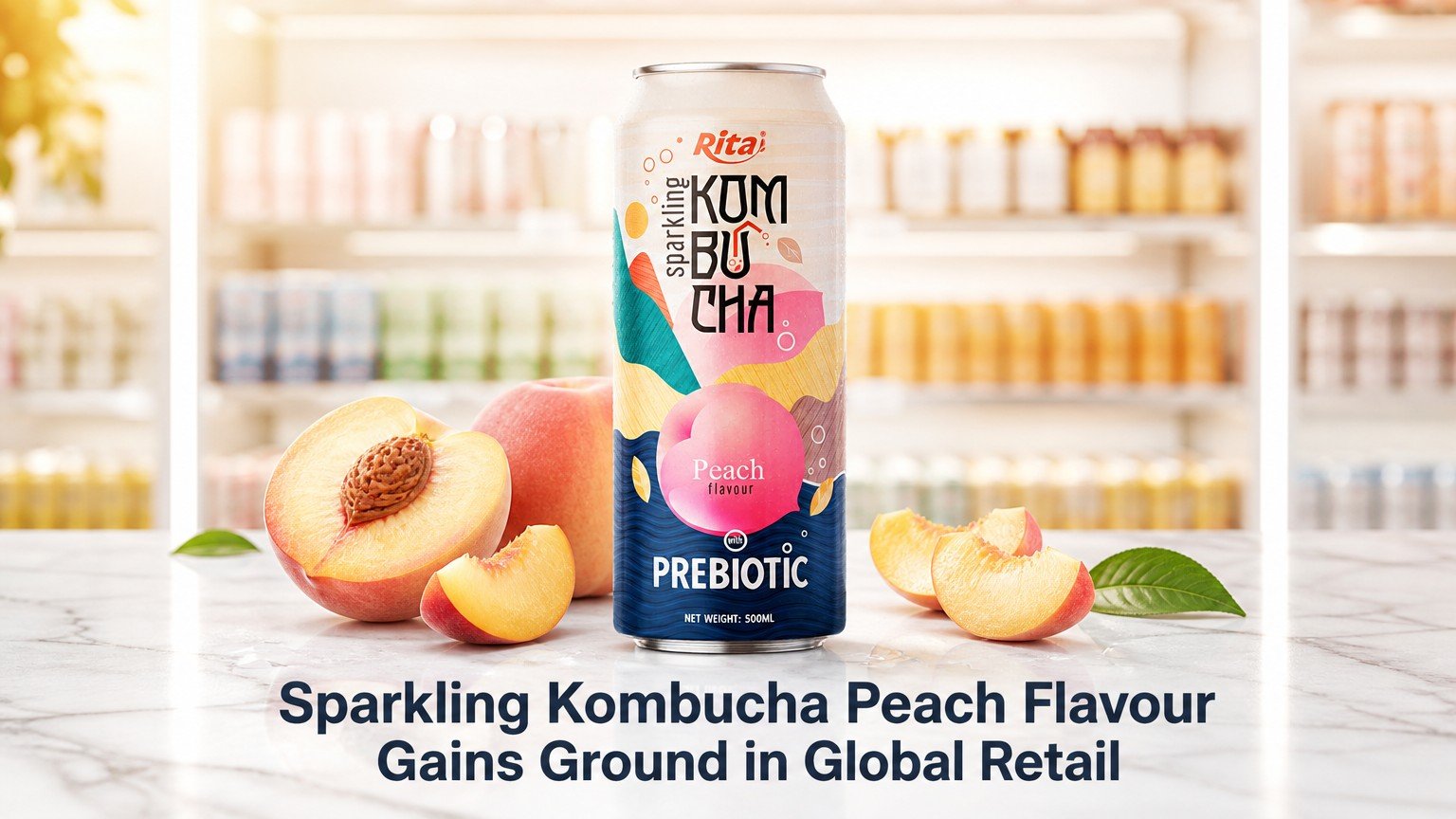
Wellness-oriented beverage categories continue to redraw the global retail map, and sparkling kombucha peach flavour has become one of the more closely watched formats among importers, private label developers and category managers. A 500ml aluminum can, a light sparkling texture and a prebiotic label cue place the drink at the intersection of two narratives that buyers across the Americas, Europe, Asia, the Middle East, Africa and Oceania are tracking this season: rising interest in fermented formats and fibre-associated ingredient stories printed directly on the pack.
Retailers are not extending these facings for sentiment alone. The format answers a practical brief: single-serve, chilled, visually distinct and long-dated enough to survive ocean freight.
Key Takeaways
- Sparkling kombucha peach flavour occupies a fermented-and-fizzy niche that retailers are still granting incremental shelf space across several regions.
- Prebiotic callouts have shifted from novelty to standard label vocabulary and now appear routinely in private label tender documents.
- RITA Food and Drink Co., Ltd runs 50+ automated production lines and moves more than 1,200 containers per month to 200+ countries and territories.
- Certifications spanning BRC, FSSC 22000, Halal Jakim, Halal HCA-GCC, Kosher, ISO, GMP, HACCP and SMETA underpin listings in regulated markets.
- Trade headlines stay busy, with Scotch import scrutiny in India, an administration filing in the UK and a canned wine acquisition in South Africa.
Sparkling Kombucha Peach Flavour Meets a Wellness-Driven Shopper
Buyers describe the fermented drinks aisle as one of the few corners of the shelf still adding facings rather than losing them.
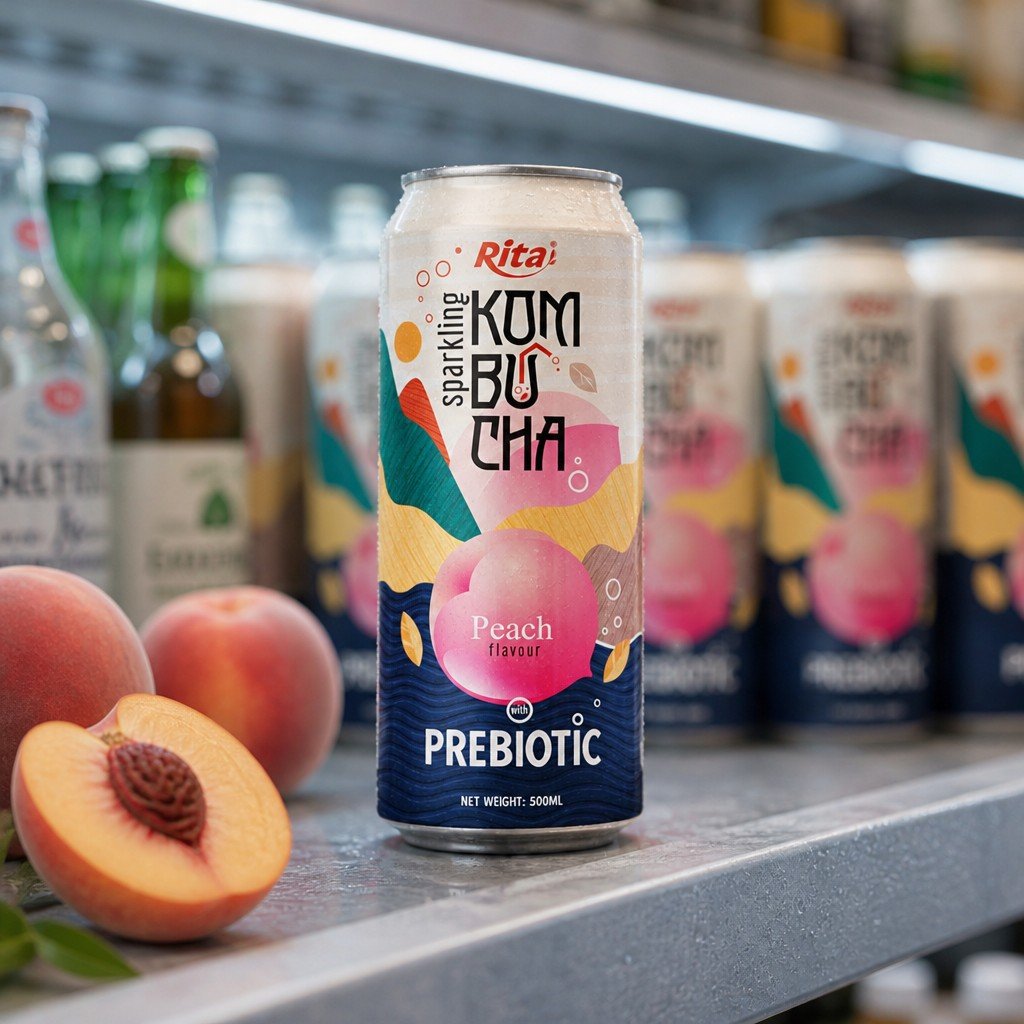
That momentum is not evenly spread. In the Americas, kombucha-style drinks have moved from specialist retail into mainstream grocery, where single-serve cans are preferred for portability and chilled-shelf presence. European importers tend to evaluate the same format against stricter label scrutiny and a crowded private label environment. Across Asia, the Middle East, Africa and Oceania, conversations usually start with certification and shelf life before they ever reach flavour. The common thread is a shopper who reads the can before buying it, and a buyer who expects the paperwork to be ready on the first request.
Fermented and Sparkling Formats Keep Earning Space
Sparkling variants of fermented teas give retailers a familiar carbonated mouthfeel with a different ingredient story behind it. That combination proves useful in ranges where cola and lemon-lime facings have plateaued and buyers want something that stands out inside a crowded chilled cabinet.
Peach, as a flavour direction, adds a soft stone-fruit sweetness that sits comfortably against the slight tartness typical of fermented tea bases. Category teams report that peach remains one of the more broadly recognised fruit cues on export labels, which reduces the amount of explanatory copy a pack has to carry. For distributors launching in several markets at once, that familiarity shortens the conversation at the point of sale and limits the need for in-store education material.
Label Cues That Now Shape Buyer Briefs
The prebiotic declaration has quietly become a line item in tender documents for prebiotic sparkling drink ranges.
Buyers now ask whether a formulation can carry the cue without destabilising carbonation or shortening shelf life, and whether the claim language will survive local labelling review. For manufacturers, that means formulation work starts at the beginning of the discussion rather than at artwork approval. Solubility, sweetness balance and the interaction between fibre ingredients and carbonation all need resolving early, which is why briefs sent to a kombucha OEM manufacturer now include compliance questions alongside flavour targets and cost parameters.
Artwork timing follows the same logic. Once label language is agreed, print-ready files move quickly, and the 24-month shelf life allows buyers to schedule a launch window without racing the production calendar.
Inside the 500ml Can, Sparkling Kombucha Peach Flavour and Its Prebiotic Cue
The product at the centre of this discussion is the Rita Sparkling Kombucha Peach Flavour With Prebiotic 500ml Can, a slim aluminum can carrying a peach illustration, a 'Peach flavour' callout and a 'with PREBIOTIC' band across the base of the pack.
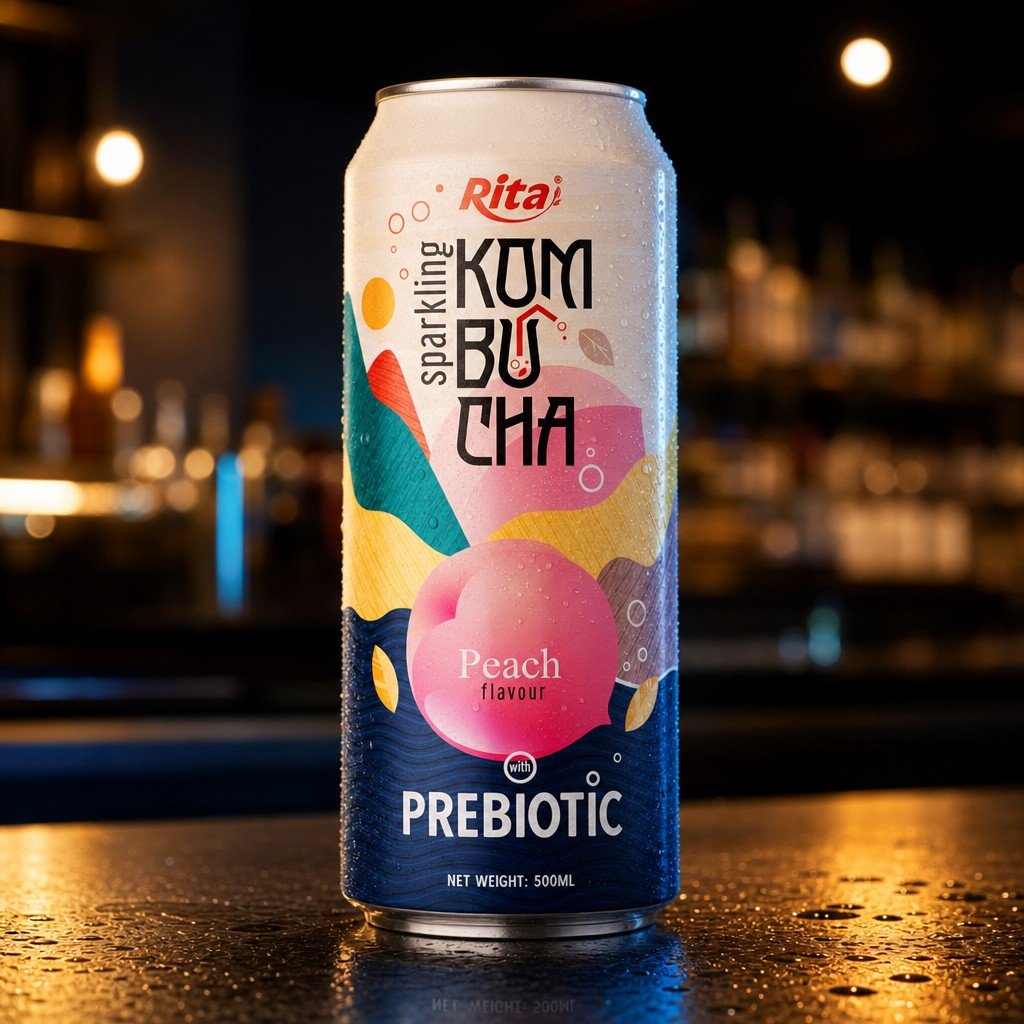
At 500ml the can sits between the 330ml single-serve standard and larger sharing formats, a size importers often favour for chilled convenience channels and foodservice trays. A 24-month shelf life gives distributors room to plan consolidated shipments, which matters when freight schedules and container availability dictate order timing. The pack also supports straightforward pallet stacking, helping buyers keep logistics costs predictable across long routes and multi-stop distribution plans.
Why Peach Reads Well on Export Labels
Peach occupies a comfortable middle ground in flavour portfolios. It is sweet enough for mainstream palates, gentle enough not to clash with a fermented tea base, and visually simple to render across alphabets and languages.
That visual simplicity is a practical advantage for private label kombucha programmes. Artwork can be localised quickly, and the same peach illustration carries across market variants without redesigning the core composition. Buyers building a wellness beverage trends deck often cite flavour recognisability as a deciding factor when shortlisting suppliers, because it lowers the risk of a slow first listing and reduces the volume of promotional support a new SKU needs.
Aluminium Can Economics for Distributors
The 500ml aluminum can beverage format also simplifies distribution planning for first-time importers.
- 500ml volume sized for chilled single-serve occasions and foodservice placement.
- 24-month shelf life supporting long-haul ocean freight and warehouse rotation.
- Aluminum can body offering high print quality and straightforward pallet stacking.
- Minimum order quantity of 500 cartons, suited to trial listings and regional launches.
Buyers scanning the soft drinks catalogue will find the sparkling kombucha peach flavour SKU positioned alongside other carbonated offerings, while those assembling a wider fermented range usually group it with tea-based drinks and specialty formats.
From Our Orchards, Raw Material Sourcing Behind the Recipe
Flavour consistency at export volume starts long before a can is filled, and it begins in the field.
For fruit-derived inputs, RITA works with established growing areas in southern Vietnam and documents its sourcing through programmes such as the Mekong Delta raw material area, where supplier relationships and harvest scheduling are reviewed ahead of each production cycle.
The peach component of the flavour system is handled as a standardised input so that sweetness, colour and aromatic profile stay aligned across batches bound for different markets. That consistency matters for distributors running multi-country listings, where a noticeable variation between two shipments can trigger complaints from retail quality teams and delay replenishment. Batch records and retained samples accompany each run, giving buyers a reference point if a question arises after delivery.
A closer look at the sourcing regions can be seen in the company's field footage:
Manufacturing Scale, Certification and Export Logistics
RITA Food and Drink Co., Ltd, established in 2004, built its export business around volume reliability rather than small-batch production.
The company operates more than 50 automated production lines, ships over 1,200 containers per month and supplies brands in more than 200 countries and territories. For a buyer evaluating the sparkling kombucha with prebiotic in a 500ml can, that scale translates into predictable lead times and the ability to grow an initial listing into a multi-market programme without changing partners. Beverage export manufacturer capacity of this size also simplifies documentation, since repeat orders follow an established compliance file rather than starting from zero.
Certification Stack for Regulated Markets
Certification coverage is usually the first filter an importer applies. The portfolio below spans food safety, religious dietary requirements and social compliance, which allows the same SKU to be presented to different retail formats without re-auditing the supply base.
- BRC and FSSC 22000 food safety schemes.
- Halal Jakim and Halal HCA-GCC for Middle East and GCC-facing programmes.
- Kosher certification for designated retail accounts.
- ISO, GMP and HACCP process controls.
- SMETA social compliance audit.
Export Programmes Built Around Sparkling Kombucha Peach Flavour
Order terms are published up front, which shortens the first exchange with a new buyer.
| Parameter | Specification |
|---|---|
| Volume | 500 ml |
| Packaging | Aluminum can |
| Shelf life | 24 months |
| Minimum order quantity | 500 cartons |
| Delivery time | 20-25 days after order confirmation |
| Supply ability | 600 twenty-foot containers per month |
| Loading port | Ho Chi Minh Port, Vietnam |
| Payment terms | L/C, T/T |
| Sample | Free sample available |
Beyond this SKU, the same platform supports a broader special drink range and a tea, honey and fruit drinks line, so a buyer can consolidate several categories into one shipment. Samples are provided free of charge and payment is accepted by L/C or T/T, terms that most regional importers already operate with. Lead times of 20 to 25 days after confirmation align well with typical promotional calendars.
Industry Backdrop and Recent Trade Moves
The wider beverage trade has kept category teams busy. Diageo and Pernod are facing an investigation into Scotch imports in India, a reminder that spirits groups remain exposed to shifting trade policy. In the UK, Amber Beverage UK has entered administration, while Diageo is also under investigation over a toxic spill in Scotland. Canned Wine Group has acquired the South African brand New Theory, and Pernod, Suntory and De Kuyper are set to appear at the upcoming Just Drinks spirits conference.
For non-alcoholic manufacturers, these headlines matter because capital, attention and shelf space are finite. When a spirits distributor retrenches or a policy review delays an import channel, buyers often redirect open listings toward formats that clear customs predictably and carry a long shelf life.
That redirection is where a sparkling kombucha peach flavour listing can convert curiosity into a first purchase order, particularly when certification and sample support are already in place.
Frequently Asked Questions
What is the Rita Sparkling Kombucha Peach Flavour With Prebiotic 500ml Can?
It is a 500ml aluminum can drink built on a sparkling fermented tea base, finished with peach flavour and a prebiotic ingredient declaration on the label. The pack carries a 24-month shelf life and ships in export cartons. The full product specification page lists packaging, certification and ordering details.
What are the minimum order quantity and delivery terms?
The minimum order quantity is 500 cartons, with delivery 20 to 25 days after order confirmation. Loading takes place at Ho Chi Minh Port, Vietnam, and payment is accepted by L/C or T/T. Free samples are available for evaluation before an order is placed.
Which certifications support export of this drink?
The manufacturing base holds BRC, FSSC 22000, Halal Jakim, Halal HCA-GCC, Kosher, ISO, GMP, HACCP and SMETA, covering food safety, dietary requirements and social compliance for buyers in different regions.
Can the product be supplied under a private label programme?
Yes. RITA operates OEM and ODM programmes across more than 50 automated production lines, with artwork localisation and formulation support for private label kombucha projects aimed at retail and foodservice channels.
What is the monthly supply ability?
Supply ability stands at 600 twenty-foot containers per month, supported by more than 1,200 containers exported monthly across the wider product portfolio.
Older news items:
- Regulation Tightens as Sparkling Kiwi Soda Water Gains Global Ground - 26/10/2026 05:12
- Rita at SIAL Paris 2026: Vietnamese Beverage Innovation on the International Stage - 23/10/2026 00:20
- Honoring the Women of Rita Beverage on Vietnamese Women's Day 2026 - 21/10/2026 06:55
- Mangosteen Juice Drink Supply Chains Under Pressure as Demand Expands - 21/10/2026 04:50
- Rita Protein Coffee Opens New Market Avenues for RTD Brands - 20/10/2026 04:43