
Red Grape Juice Cans Gain Ground in Global Export Trade
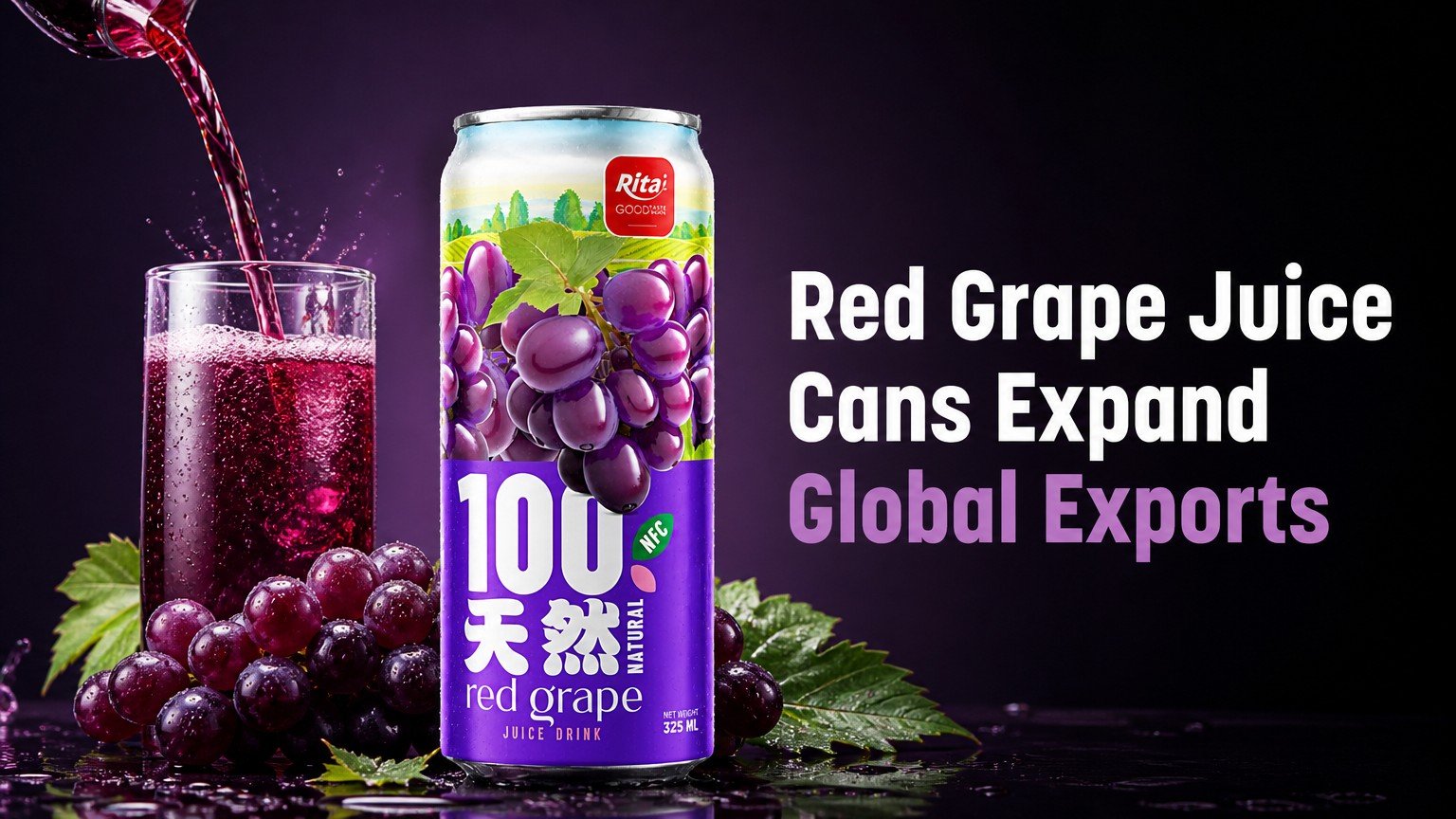
The global beverage trade is seeing a quiet shift on the juice shelf, and red grape juice drink products are at the center of it. Importers across the Americas, Europe, Asia, the Middle East, Africa and Oceania are ordering more single-serve canned fruit juice as convenience retail, travel retail and e-commerce bundles expand their ambient sets. The format that keeps winning tenders is the 325 ml sleek can, compact enough for vending machines, slim enough for premium shelf presence and sturdy enough for long ocean freight.
Key Takeaways
- Canned grape juice demand is spread across every major buying region rather than concentrated in a single market.
- The 325 ml sleek can suits convenience retail, travel retail and single-serve online bundles.
- RITA operates 50+ automated production lines and ships more than 1,200 containers per month to 200+ countries and territories.
- Export documentation is backed by BRC, FSSC 22000, Halal Jakim, Halal HCA-GCC, Kosher, ISO, GMP, HACCP and SMETA.
- Standard trade terms include a 500-carton minimum order, 24-month shelf life and a 20 to 25 day lead time.
Where Red Grape Juice Drink Demand Is Coming From
The category is broad rather than concentrated, which makes canned grape juice a comparatively steady line item on an exporter order book.
 " alt="Red grape juice drink 325 ml sleek can on a convenience retail shelf">
In the Americas, single-serve cans move quickly through c-store chilled doors and stadium concessions, where a deep purple pour and a familiar grape profile make the shelf decision easy. European importers usually specify long ambient shelf life and full batch traceability so stock can sit in central distribution before it reaches independent retailers. Buyers in the Middle East and parts of Asia frequently treat halal certification as a gatekeeping requirement, while importers in Africa and Oceania often weigh carton durability and pallet efficiency because inland legs after discharge tend to be longer.
RITA fruit juice product catalogue shows how the grape drink sits alongside tropical options such as mango, passion fruit and pineapple, which lets a buyer assemble a mixed container from one supplier. Consolidation like that matters when freight rates move and landed cost has to stay predictable for a wholesale fruit juice program.
Assortment planning is the second half of the conversation. A distributor covering multiple channels rarely wants a single flavour in isolation, so grape is typically ordered as an anchor line beside citrus and tropical profiles that carry different shopper occasions. That pattern is visible in reorder data across regions: grape holds its position while the surrounding assortment rotates with season and promotion.
The Slim Can Advantage in Convenience Retail
A 325 ml sleek can solves several retail problems at once. Its diameter fits standard cooler rails and vending spirals without re-tooling, its height leaves headroom for a second row on a crowded shelf, and its full-body print gives designers a continuous canvas for grape imagery and scenic label artwork. Aluminum chills quickly, which matters in grab-and-go locations where product is pulled straight from a cold cabinet. For trade buyers, the format stacks efficiently on pallets and survives the vibration of multi-modal transport better than slender glass.
The same can works across channels. Retailers buy it for single-serve placement, caterers order it for event service, and online sellers bundle six or twelve units into a shipper designed for parcel networks. That versatility reduces the number of SKUs a distributor has to carry to cover different occasions.
Reading the Liquid, Not Just the Label
Tastewise, the drink presents a deep ruby-purple color in the glass, a ripe grape aroma on opening and a sweet entry that finishes with a light tart edge. The profile is familiar enough to travel across cultures, which is a practical advantage for a product distributed in more than 200 countries and territories. Full sensory and technical detail for the 100% natural red grape juice drink in a 325 ml sleek can is published on the OEM Beverage product page, alongside packaging, payment and logistics data that sourcing teams typically request at first contact.
From Our Vineyards: Raw Material Sourcing
Raw material decides the flavor ceiling long before any line runs.
The grape sourcing journey is documented in the RITA grape story, from sun-kissed vineyards to refreshing juice creations, which follows fruit selection, harvest timing and the route from field to press that shapes the juice eventually sealed into a can.
For buyers, traceability at this stage is a commercial issue as much as a quality one. Lot records, incoming fruit assessment and batch coding determine whether a statement printed on a can can be substantiated months later, when a container is already on the water and an importer auditor asks for paperwork. Consistent incoming fruit also protects color and sweetness balance between production runs, which is what keeps a private label tasting the same in shipment twenty as it did in shipment one.
A short film from the vineyard program is available at
What Export Buyers Check Before Confirming an Order
Most first-time importers run the same short checklist before they release a purchase order.
" alt="Export documentation and 325 ml red grape juice sleek can for trade buyers">
Certification coverage usually comes first, because it decides whether a shipment clears customs and retail onboarding without rework. RITA holds BRC, FSSC 22000, Halal Jakim, Halal HCA-GCC, Kosher, ISO, GMP, HACCP and SMETA, which covers the requirements most buyers raise in the Middle East, Europe and North America. Second comes production capacity: more than 50 automated lines and a supply ability of 300 twenty-foot containers per month mean a trial order can scale into a rolling program without changing supplier mid-year.
| Trade Parameter | Specification |
|---|---|
| Product | 100% Natural Red Grape Juice Drink |
| Volume | 325 ml |
| Packaging | Aluminum sleek can |
| Shelf life | 24 months |
| Minimum order | 500 cartons |
| Lead time | 20 to 25 days after order confirmation |
| Supply ability | 300 twenty-foot containers per month |
| Payment terms | L/C, T/T |
| Loading port | Ho Chi Minh Port |
| Sample policy | Free sample available |
The red grape juice drink product page also lists sample policy, payment terms and loading port, which is usually the page a sourcing manager forwards to the logistics team before a first booking is discussed.
What Makes a Red Grape Juice Drink Export-Ready
Four attributes tend to decide whether a canned juice survives the journey and then the shelf, and they are worth reviewing line by line before a contract is signed.
- Packaging integrity, with seamed aluminum and a protective inner coating suited to a 24-month shelf life.
- Documentation that matches the destination market acceptance list, including halal and food safety schemes.
- Capacity headroom, so a promotional spike does not force an unplanned supplier change.
- Batch consistency in color, sweetness balance and fill level across successive production runs.
Industry Headlines Reshaping Beverage Trade
Regulatory and corporate moves in the wider drinks trade are keeping compliance teams busy this quarter.
Diageo and Pernod Ricard are facing import investigations in India, a reminder that market access can shift quickly when authorities review duty and origin documentation. In Scotland, a toxic spill probe has added environmental scrutiny to manufacturing operations. Meanwhile Amber Beverage UK has entered administration, underlining how distributor fragility can leave brands scrambling for a new route to shelf.
Ownership is moving too. Canned Wine Group acquired the South African brand New Theory, a deal that puts canned formats in the headlines and signals continued investor interest in portability. Pernod, Suntory and De Kuyper are also set to feature at the upcoming Just Drinks spirits conference, where sourcing resilience and supply-chain planning are expected to dominate the agenda.
For a grape juice export program, the practical read is that buyers are scrutinising supplier paperwork and distributor stability more closely than they did two years ago. A beverage exporter that can produce current certificates, confirm capacity in writing and name its loading port up front shortens the approval cycle considerably.
Private Label Pathways for Grape Juice Programs
Private label is where a standard recipe becomes a customer own brand asset.
RITA Food and Drink Co., Ltd, established in 2004, operates as an OEM beverage manufacturer and ODM partner for brands in more than 180 countries, covering formula adjustment, can artwork, case coding and pallet configuration under one schedule. Buyers can start from the complete can specification for the red grape juice drink or browse the wider fruit drinks range to build a mixed program across juice and soft drink shelves in the same account.
Typical onboarding runs in a predictable sequence, which helps a buyer forecast the calendar rather than guess at it.
- Brief and sample review, with free samples shipped for sensory and packaging assessment.
- Artwork approval plus barcode, nutrition panel and market-specific declaration checks.
- Production slot confirmed, with a 20 to 25 day lead time after order confirmation.
- Booking under FOB terms at Ho Chi Minh Port, with L/C or T/T settlement.
- After-sale support covering document follow-up, reorders and promotional runs.
The soft drinks listing on the same platform gives buyers a reference point when they compare grape juice against carbonated or tea-based alternatives inside the same purchasing account.
Frequently Asked Questions
What is the minimum order quantity for the 325 ml red grape juice sleek can
The minimum order quantity is 500 cartons, and free samples are available before a first order is placed.
What are the shelf life and lead time
Shelf life is 24 months from production, and delivery is scheduled 20 to 25 days after the order is confirmed.
Which certifications support export documentation
The product is produced under BRC, FSSC 22000, Halal Jakim, Halal HCA-GCC, Kosher, ISO, GMP, HACCP and SMETA schemes.
Can the drink be supplied under a private label
Yes. RITA offers OEM and ODM services covering artwork, case coding, mixed-flavour loading and market-specific declarations for brands worldwide.
What are the payment and shipping terms
Payment is accepted by L/C or T/T on FOB terms, with loading at Ho Chi Minh Port and a supply ability of 300 twenty-foot containers per month.
Related news items:
Newer news items:
Older news items:
- Rita Beverage Halloween 2026: Tricks, Treats, and Team Spirit in the Office - 31/10/2026 03:47
- Vanilla Protein Milkshake in a Sleek Can Opens Global OEM Doors - 29/10/2026 22:11
- Sparkling Kombucha Peach Flavour Gains Ground in Global Retail - 27/10/2026 22:04
- Regulation Tightens as Sparkling Kiwi Soda Water Gains Global Ground - 26/10/2026 05:12
- Rita at SIAL Paris 2026: Vietnamese Beverage Innovation on the International Stage - 23/10/2026 00:20