
Consumer Shifts Fueling the Rise of Less Sugar Turmeric Drinks
Across retail aisles and digital storefronts, shopper decisions are increasingly shaped by three things — how much sugar is in the can, how interesting the flavor feels, and how convenient the format is to carry. The less sugar turmeric passion fruit drink category sits at exactly that intersection, and it is drawing attention from buyers, distributors, and private label teams scanning for the next dependable performer. As consumers recalibrate their baskets, beverage makers are responding with reformulated recipes, slimmer cans, and tropical pairings that travel well across borders.
Key Takeaways
- Sugar reduction has moved from a niche preference to a mainstream purchase driver across developed and emerging beverage markets alike.
- Turmeric and passion fruit pair a familiar botanical with a recognizable tropical fruit, giving brands a flavor story that is easy to explain on shelf.
- The 250ml slim can aligns with portion expectations and performs well in chilled displays, vending machines, and foodservice trays.
- Export-ready OEM partners with internationally recognized certifications shorten the path from concept to container.
- Capacity, lead time, and documentation quality increasingly decide which supplier a brand books for a launch window.
Consumer Behavior Reshaping the Global Beverage Aisle
Purchase decisions are being made earlier than ever — on front labels, on shelf tags, and in screenshots shared between friends. For beverage brands, that means the can has to answer questions the shopper is already asking before it ever reaches a hand.

That pattern repeats across every region a global exporter serves. In the Americas, reduced-sugar claims now sit beside flavor and price in the everyday purchase conversation. Across Europe, label scrutiny is intense and ingredient lists are read line by line. In Asia and the Middle East, on-the-go formats dominate convenience and transit channels. Throughout Africa and Oceania, import-ready packaging and a long shelf life carry real weight for distributors holding inventory far from the point of production. In each case the shopper is comparing more than taste — they are comparing sugar levels, can size, and whether the brand behind the product looks capable of delivering the next shipment on time.
What has changed is the speed at which these preferences travel. A format that tests well in one market now reaches buyers on the other side of the world within a single season, and distributors are quicker than ever to request samples of anything that looks like it could anchor a private label range. Consumer beverage trends that once took years to cross borders now move with a trade show calendar and a handful of social posts.
Sugar Reduction Moves From Niche to Norm
Reduced sugar is no longer a special request. It is a default expectation in many categories, and it now shapes the brief that brand owners hand to their manufacturing partners. Recipes are being rebalanced so that fruit character and spice notes carry the profile rather than sweetness alone. In a drink built around passion fruit and turmeric, the tartness of the fruit and the warm, peppery edge of the spice do much of the work, which makes a lower sugar level easier to present as a deliberate recipe choice instead of a compromise.
The commercial logic is straightforward. Products that can state a reduced sugar level without losing flavor complexity give buyers a cleaner story to tell at shelf, in online listings, and in trade presentations. That story travels well across categories, from chilled single-serve cans to multipacks destined for grocery.
- Label literacy — shoppers read sugar per serving before they read the brand name.
- Format expectations — smaller volumes are read as a measured portion rather than a sacrifice.
- Flavor credibility — tart and spice-led profiles hold up when sweetness is dialed back.
- Listing requirements — retailers and e-commerce platforms increasingly filter ranges by sugar thresholds.
Flavor Adventurousness Meets Familiar Ground
Consumers say they want novelty, but they buy what they can describe. Turmeric brings a warm, earthy note and a vivid golden color; passion fruit brings acidity, aroma, and an instantly recognizable tropical identity. Together they give a shopper a sentence they can repeat to a friend — and repetition is what turns first trial into repeat purchase.
That balance matters for anyone planning a global beverage export program. An unfamiliar single-note botanical can stall in a new market, while an all-too-common flavor competes on price alone. A pairing like this sits in the middle: distinctive enough to stand out in a crowded chilled cabinet, familiar enough to be picked up without explanation. For brand owners building a range, it also leaves room for adjacent variants — the same base format carrying a different fruit lead while the can design and volume stay constant.
Where the Fruit Comes From and How It Is Sourced
Buyers ask where the fruit comes from, and the best answers come with photographs attached.
RITA documents its sourcing trips so procurement teams can follow raw material from field to can. Its field report on passion fruit gardens in Vietnam's Central Highlands walks through planting cycles, harvest timing, and how the fruit moves into processing within a short window — a detail that shows up later as consistency of flavor from one production run to the next.
Turmeric follows a similar path, with root quality, drying, and grinding handled to a specification agreed with the buyer. For a private label beverage project, that specification is part of the brief, and it is what allows a recipe developed for one market to be reproduced in another container without drift.
For a closer look at the growing environment, the company's field footage is available at
— a short walkthrough of the passion fruit gardens behind the raw material supply.The Less Sugar Turmeric Passion Fruit Drink on Shelf
On shelf, the less sugar turmeric passion fruit drink has roughly three seconds to make its case.

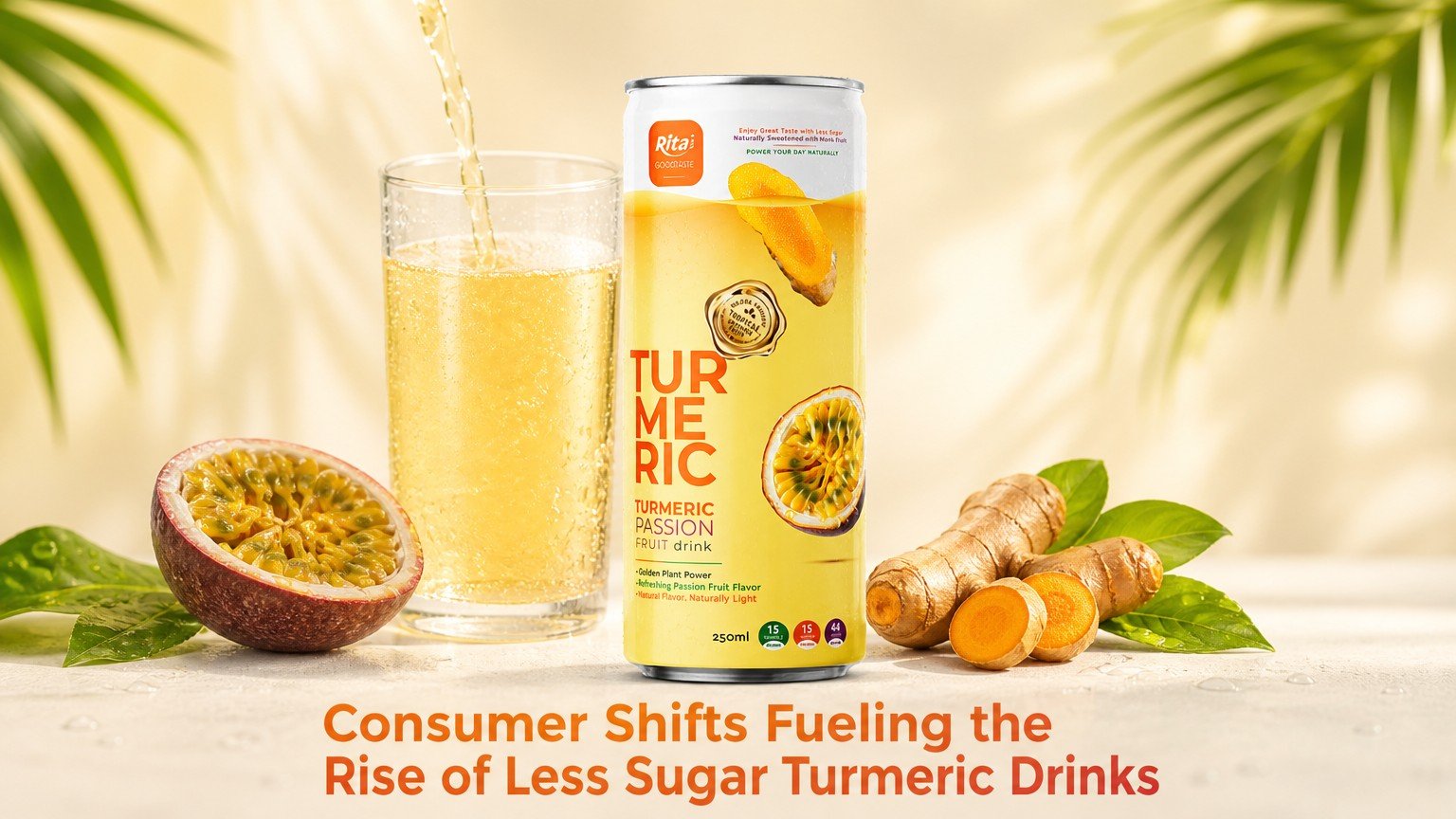
The RITA Less Sugar Turmeric Passion Fruit Drink 250ml slim can answers that moment with a bright yellow body, red and green accents, and illustrated turmeric root and passion fruit that make the recipe legible at a glance. The light golden liquid inside matches what the label promises, which is a small but real point of trust for a first-time buyer. Packaging is aluminum, shelf life is 24 months, and the minimum order quantity starts at 500 cartons — figures that matter when a distributor is testing a new listing before committing to volume.
Why the Less Sugar Turmeric Passion Fruit Drink Suits the Slim Can
The slim can has become a signal in itself. Its silhouette reads as measured and modern, it fits cup holders, lunch bags, and chilled racks without demanding extra space, and it photographs well for online listings. For a single-serve drink positioned around a lower sugar level, the format and the message reinforce each other rather than compete.
| Format | Typical volume | Best suited for | Shelf presence |
|---|---|---|---|
| 250ml slim can | 250 ml | Chilled single-serve, vending, foodservice | Tall and narrow, high facing density |
| Standard can | 330 ml | Everyday grocery, multipacks | Familiar, price-competitive |
| PET bottle | 350–500 ml | Take-home and on-the-go retail | Large label area, resealable |
| Glass bottle | 250–300 ml | Premium placement, hospitality | Weight and clarity cue a premium tier |
Volume is only part of the decision. The 250ml slim can product listing also sets out a delivery time of 20 to 25 days after order confirmation, payment terms of L/C or T/T, FOB pricing on request, and loading from Ho Chi Minh Port — the detail a buyer needs before a launch date can be agreed with a customer. Supply ability of 600 twenty-foot containers per month means an initial trial order and its first replenishment can sit under the same supplier agreement.
OEM Capacity and Export Readiness
Behind every shelf-ready can is a manufacturing decision. RITA Food and Drink Co., Ltd, established in 2004, operates as an OEM and ODM beverage manufacturer and exporter working with brands in more than 180 countries. The company runs over 50 automated production lines and ships more than 1,200 containers a month across tropical fruit juices, coconut products, functional drinks, energy drinks, and canned, glass, PET, and PP formats. For a brand weighing suppliers, that combination of breadth and throughput is usually the first filter applied.
Range matters when a buyer wants to build a family of SKUs under one agreement. The fruit drinks catalog shows how a tropical base can be extended across flavors and sweetening levels while the can size and decoration stay consistent — useful when a passion fruit drink supplier is asked to add a second and third variant mid-season.
Some buyers prefer to anchor a range in a broader soft drink proposition rather than a single fruit line, and the soft drinks catalog covers that ground, from still blends to carbonated formats packed in cans, glass, PET, and PP. Either route keeps artwork, volume, and pallet configuration aligned across the range.
For teams that need formulation support as well as filling, the OEM service program covers brief development, sampling, and production scheduling. The less sugar turmeric passion fruit drink is a working example of that process — a defined recipe, a defined can, and a defined route to port.
Documentation That Travels With the Container
Certifications rarely close a deal on their own, but their absence can end one quickly. Buyers screening an OEM beverage manufacturer for retail or foodservice listings ask for a current set before a first order is placed, and the paperwork has to match the product being shipped.
- BRC and FSSC 22000 for food safety management systems
- Halal Jakim and Halal HCA-GCC for markets requiring halal certification
- Kosher certification for specified retail channels
- ISO, GMP, and HACCP for process control and traceability
- SMETA for ethical audit requirements in supply chains
Industry Signals Worth Watching
Recent moves across the sector point in a consistent direction. Shepherd Neame has refocused its new brewery on developing and producing its own brands, a reminder that ownership of the recipe is increasingly treated as the asset rather than the contract volume behind it. Varun Beverages announced plans to build another factory in India to expand capacity, underscoring that demand forecasts are being met with capital investment instead of spillover production.
Packaging innovation is attracting equal attention. Innocent Drinks is piloting edible seaweed pods as a novel, sustainable packaging solution, while Sazerac drew public criticism over a controversial ice-cream van promotional stunt — evidence that consumers are as attentive to how a product is presented as to what sits inside it. Meanwhile, India's duty-free sugar quota is expected to provide only limited relief for sugar producers, keeping input costs tight and reformulation firmly on the agenda.
| Recent signal | What it suggests for beverage brands |
|---|---|
| Own-brand refocus at Shepherd Neame | Recipe ownership and margin control are prioritized over pure volume. |
| Capacity expansion at Varun Beverages | Growth plans are being backed by new plants, not only faster lines. |
| Limited relief from India's duty-free sugar quota | Sugar economics stay pressured, keeping reduced sugar formulations relevant. |
| Alternative packaging pilot at Innocent Drinks | Pack format is becoming part of the brand proposition itself. |
Compiled from recent industry trade press coverage.
The practical takeaway for a brand planning a reduced-sugar tropical launch is straightforward: pair a recipe that reads clearly on a label with a format shoppers already accept, and secure a manufacturer whose capacity and paperwork can keep pace with the order. The less sugar turmeric passion fruit drink in a 250ml slim can is one example of that combination reaching the market today, and the same logic will apply to whatever variant comes next in the range.
Frequently Asked Questions
What is the RITA Less Sugar Turmeric Passion Fruit Drink 250ml slim can?
It is a 250ml aluminum slim can beverage combining passion fruit with turmeric at a reduced sugar level, produced by RITA Food and Drink Co., Ltd for retail, foodservice, and private label distribution. The can has a 24-month shelf life and ships in 500-carton minimum quantities.
What are the order terms and lead time?
Standard terms are L/C or T/T payment, FOB pricing on request, and delivery of 20 to 25 days after order confirmation, with loading from Ho Chi Minh Port, Vietnam. Stated supply ability is 600 twenty-foot containers per month.
Which certifications support the product?
The manufacturing program is backed by BRC, FSSC 22000, Halal Jakim, Halal HCA-GCC, Kosher, ISO, GMP, HACCP, and SMETA, covering food safety, halal and kosher requirements, process control, and ethical audit expectations.
Why is the slim can format gaining ground with buyers?
The slim silhouette supports high facing density on shelf, fits standard cup holders and chilled racks, and reinforces the portion message that reduced sugar drinkers already look for. It also ships efficiently in cartons and pallets.
Can the recipe and label be customized for a private label brand?
Yes. As an OEM and ODM beverage manufacturer, RITA works from a buyer brief covering recipe, sweetness level, can artwork, volume, and carton specification, with sampling and production scheduling handled through its OEM service program.
Related news items:
Newer news items:
Older news items:
- Beyond the Workplace: How Rita Beverage Builds a Stronger Team Through Shared Experiences - 04/11/2026 22:50
- Protein Coconut Water Gains Ground in Global Beverage Markets - 03/11/2026 22:46
- Ready for Takeoff: Rita Beverage Prepares for the 2026 Employee Appreciation Trip to China - 02/11/2026 21:49
- Red Grape Juice Cans Gain Ground in Global Export Trade - 01/11/2026 20:17
- Rita Beverage Halloween 2026: Tricks, Treats, and Team Spirit in the Office - 31/10/2026 03:47