
Cucumber Lime Electrolyte Drink Gains Global Export Momentum
The cucumber lime electrolyte drink has moved well beyond the sports-aisle niche and now appears on buyer evaluation sheets alongside mainstream juice and soft drink lines. RITA Food and Drink Co., Ltd, a Vietnamese OEM beverage manufacturer established in 2004, has built the 490ml Cucumber and Lime Electrolyte Juice Drink in Aluminum Can into an export-facing special drink offering for distributors, private label beverage export programs and foodservice operators serving the Americas, Europe, Asia, the Middle East, Africa and Oceania.
Key Takeaways
- 490ml aluminum can with a 24-month shelf life, specified for long-haul shipping and multi-climate distribution.
- Cucumber and lime pairing reflects buyer demand for crisp, restrained flavor profiles in canned beverage categories.
- RITA exports to more than 200 countries and territories, with a stated supply ability of 600 twenty-foot containers per month.
- Certification stack spans BRC, FSSC 22000, Halal Jakim, Halal HCA-GCC, Kosher, ISO, GMP, HACCP and SMETA.
- Minimum order quantity of 500 cartons, 20 to 25 days after order confirmation, shipment from Ho Chi Minh Port.
Why the Cucumber Lime Electrolyte Drink Is Drawing Export Interest
Buyers are no longer shopping on sweetness alone; restraint and clarity now decide which cans earn a second order.
The wider beverage trade is pointing in the same direction. Founders behind the canned cocktail brand Nütrl have committed capital to a nootropic drink startup, while AB InBev is reinvesting in Cutwater Spirits production capacity to expand canned cocktail output. Two different categories, one shared conclusion: canned, convenience-led formats with a defined story are where growth capital is concentrating.
That matters to exporters because format and positioning travel together. A 490ml aluminum can beverage format communicates portion certainty, chills quickly and stacks cleanly in mixed pallets. When the liquid inside is a cucumber and lime electrolyte juice drink rather than another cola variant, a distributor gains a talking point when it presents the range to retail category managers. Retailers across several regions have spent two years tightening assortment, so a new SKU now has to justify itself against an existing line rather than simply fill a gap.
Flavor profiles replacing sweetness as the deciding factor
Cucumber has become a reference flavor across premium water, tonic and canned cocktail ranges, while lime remains one of the most widely recognized citrus cues printed on a label.
Combined, the two read as crisp rather than sugary, which is the description buyers repeat most often when they brief a manufacturer on a low-sweetness line for warm-climate distribution. It is also a pairing that photographs well on shelf and translates cleanly into secondary packaging, an underrated consideration for brands running social campaigns behind a launch.
For private label programs specifically, the pairing offers an advantage in differentiation. A cucumber lime profile does not compete directly with the lemon-lime cola segment that dominates most convenience channels, so a retailer can position the can as a distinct tier within its own range rather than as a discount alternative. Buyers across the Middle East and parts of Asia have been notably receptive to vegetable-forward citrus blends, while European importers tend to evaluate the same profile against the mixer and adult soft drink categories.
Why the canned format keeps winning shelf space
Aluminum remains the format of choice for chilled distribution and for export routes where breakage risk and weight decide landed cost.
The material also aligns with the sustainability reporting that large retailers are now pushing down their supply chains. Tesco recently joined a platform designed to collect supplier emissions data, accelerating Scope 3 tracking across its vendor base. For a manufacturer, that shift means packaging choices are increasingly scrutinized as data points rather than as marketing claims, and aluminum's established recycling infrastructure gives importers a straightforward answer when the question is raised in a category review.
Inside the 490ml Cucumber Lime Electrolyte Drink Product Profile
The specification sheet is deliberately simple, which is what high-volume buyers ask for first.
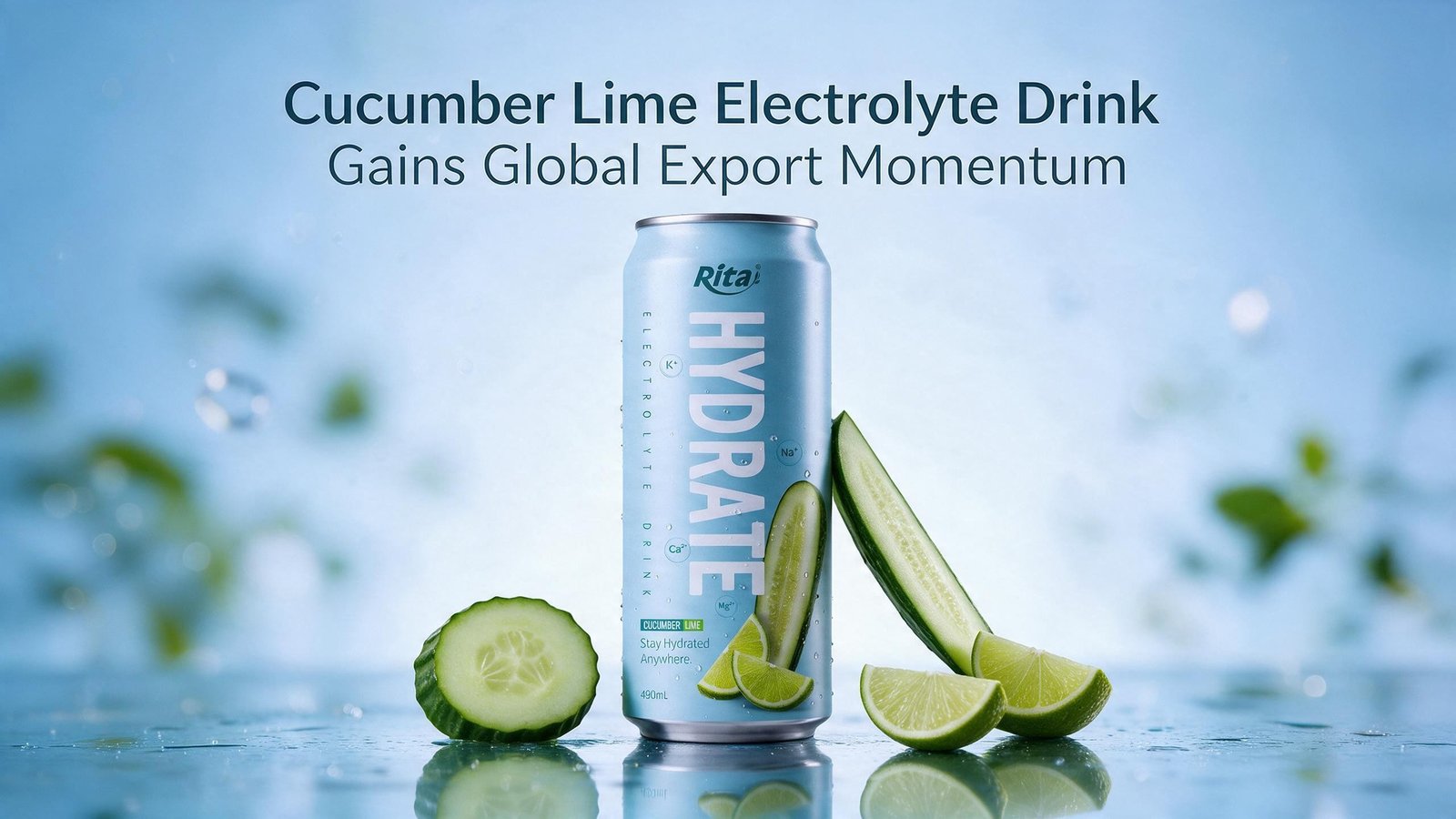
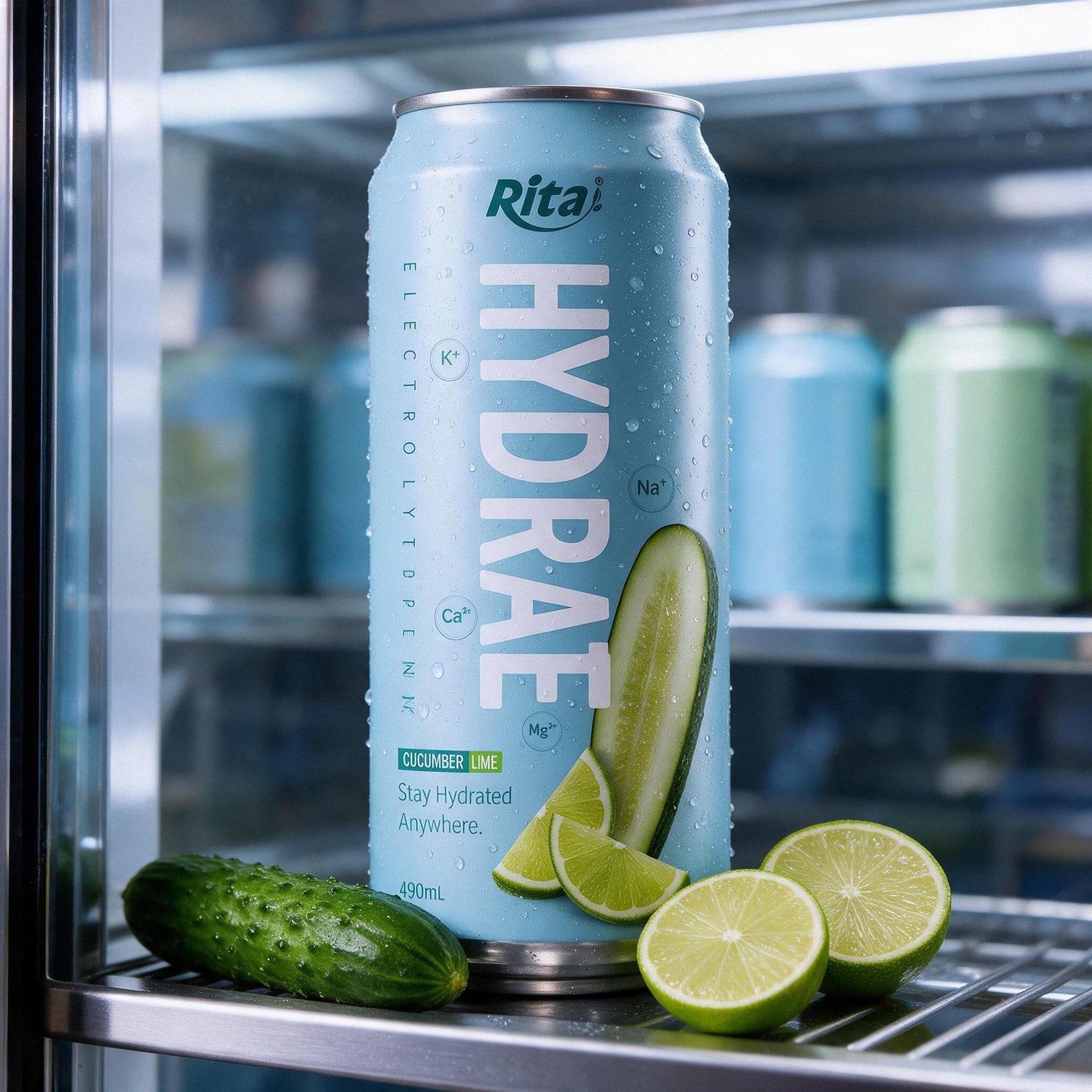
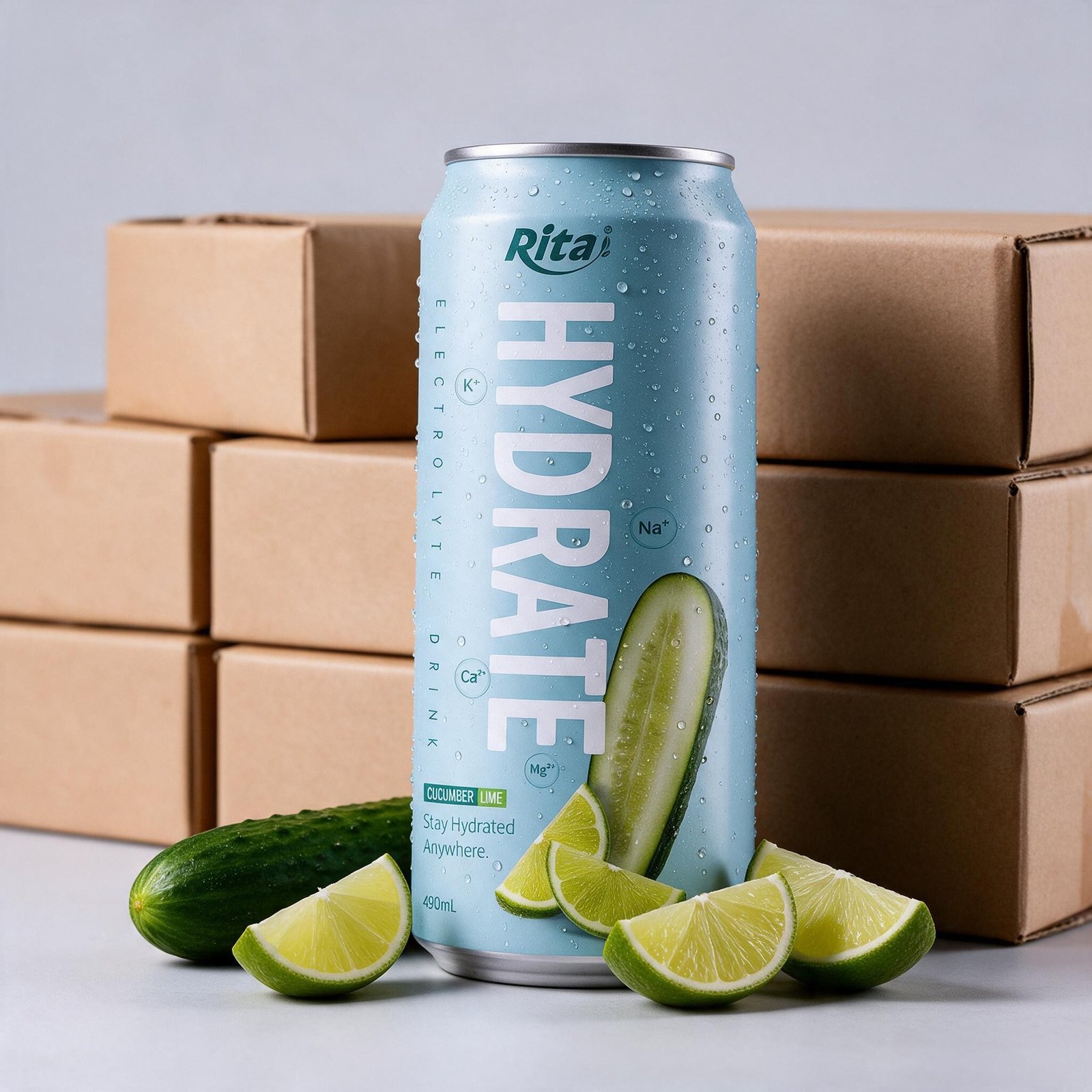
The cucumber lime electrolyte drink is supplied in a 490ml aluminum can with a 24-month shelf life under standard storage conditions. The can design uses a light blue body with silver rims, dark green RITA branding near the top, large vertical HYDRATE lettering and a smaller ELECTROLYTE DRINK subline. Mineral markers for potassium, sodium, calcium and magnesium sit in small circular icons, while a green CUCUMBER LIME label anchors the base above the printed line "Stay Hydrated Anywhere." Sliced cucumber and lime wedges complete the visual, and a droplet texture across the surface reads as cold in a chiller cabinet.
| Specification | Detail |
|---|---|
| Volume | 490 ml |
| Packaging | Aluminum can |
| Flavor | Cucumber and lime |
| Shelf life | 24 months |
| Minimum order quantity | 500 cartons |
| Delivery time | 20 - 25 days after order confirmation |
| Payment terms | L/C, T/T |
| Port of loading | Ho Chi Minh Port, Vietnam |
| Supply ability | 600 Twenty-Foot Container / month |
The full technical listing, including payment terms of L/C or T/T and current FOB pricing, is published on the 490ml cucumber and lime electrolyte juice drink product page, where buyers can also request a free sample before committing to a production slot.
Packaging, Shelf Life and Export Logistics
Twenty-four months of shelf life changes what a distributor can plan for across a full calendar year.
A two-year window allows buyers to consolidate shipments, hold buffer stock through a season and route containers through transshipment hubs without racing a date code. Combined with delivery 20 to 25 days after order confirmation and loading at Ho Chi Minh Port, the schedule fits the ordering rhythm of importers who plan in quarterly cycles rather than monthly replenishment.
Supply capacity is the other half of the equation. RITA operates more than 50 automated production lines and reports monthly exports above 1,200 containers, with a stated supply ability of 600 twenty-foot containers per month for this category. That scale matters when a retail group approves a listing across several markets simultaneously, because the opening order is rarely the difficult one; predictable reorders in year two determine whether a listing survives its first review cycle. Buyers who have been caught by a supplier hitting a capacity ceiling mid-program tend to ask for throughput figures before they ask for price.
The 490ml cucumber and lime electrolyte juice drink in aluminum can is packed for a minimum order quantity of 500 cartons, a threshold low enough for market testing yet compatible with full container loading once a program scales.
Sourcing Cucumber and Lime for Consistent Batches
Flavor consistency starts long before the filling line, and it is decided at the field stage.
RITA's raw material base sits in the Mekong Delta, recognized as the high-quality raw ingredients area of RITA, where cucumber and lime are grown through a climate that supports continuous harvests. Proximity between field and factory shortens the window between picking and processing, which is the variable most responsible for batch-to-batch similarity in a cucumber-forward formulation.
Field footage from the sourcing region is available here:
For lime specifically, the sourcing logic follows the same pattern. Domestic citrus supply reduces reliance on imported concentrate and gives the R&D team room to adjust acidity between production runs without renegotiating a contract mid-year. Buyers who request a flavor revision after an initial sample round usually find that local raw material access is what makes the revised timeline realistic.
Export Market Signals for Canned Electrolyte Drinks
The trade data behind canned beverage categories has been moving in one direction for several years now.
Premiumisation is the other thread running through the category. Tequila brand Volcan de mi Tierra has been highlighting sustained craft opportunities at the premium end, a reminder that buyers at every price tier reward products with a clear origin story and a deliberate flavor choice. A cucumber lime electrolyte drink carries that logic into a canned non-alcoholic format, where the story is told through ingredient pairing rather than distillation heritage.
Meanwhile, EU wine production is forecast to fall around 4% by 2026 according to agricultural lobby groups, tightening supply in one of the traditional beverage import categories. Importers who have historically built portfolios around wine and spirits are therefore exploring adjacent canned formats to keep shelf productivity intact, which widens the buyer pool for any global beverage supplier able to deliver at container scale with consistent repeat quality. That shift is already visible in tender documents, where canned soft drinks and juice formats increasingly appear alongside the traditional wine and spirits lines.
Certification Stack for Cross-Border Beverage Trade
Certifications are the gate rather than the garnish of an export program, and buyers check them before they check price.
RITA audits its portfolio against a stack that covers food safety management, religious dietary requirements and social compliance. Each certificate answers a specific question a category buyer will ask during qualification, and the breadth of coverage is what allows a single supplier to serve regions with different regulatory expectations under one agreement.
- BRC and FSSC 22000 for food safety management systems
- HACCP and GMP for process control and good manufacturing practice
- Halal Jakim and Halal HCA-GCC for Middle East and GCC market access
- Kosher certification for retail programs that require it
- ISO and SMETA for management systems and ethical audit reporting
The Halal credentials open doors across the Middle East and parts of Southeast Asia and Africa, where a missing certificate can end a conversation before price is discussed. Buyers reviewing the special drink catalog typically shortlist suppliers on certification coverage first, then move to flavor, format and minimum order terms.
Commercial Terms and the OEM Partnership Pathway
The commercial framework is published in full, which shortens the negotiation cycle for first-time importers.
Terms are set out on the 490ml cucumber and lime electrolyte juice drink listing: free samples on request, payment by L/C or T/T, FOB pricing on application, delivery 20 to 25 days after confirmation and a 500-carton minimum.
Behind the listing sits a manufacturer that has operated since 2004 and now supplies brands in more than 180 countries, with private label and full ODM development available through its OEM service program. That combination of established infrastructure, documented certifications and flexible order sizing is what lets a buyer move from a sample request to a first container without building a new supplier qualification process from scratch, while the adjacent soft drinks catalog shows how the same can specification translates across neighboring categories.
Repeat orders, not first orders, decide whether a retail listing survives its second year, and the cucumber lime electrolyte drink is specified for exactly that continuity.
Frequently Asked Questions
What packaging and shelf life does the 490ml cucumber and lime electrolyte juice drink use?
It is filled in a 490ml aluminum can with a 24-month shelf life under standard storage conditions and shipped in cartons, with a minimum order quantity of 500 cartons per order.
What are the standard export terms and lead times?
Payment is accepted by L/C or T/T, FOB pricing is provided on application, delivery runs 20 to 25 days after order confirmation, and shipments are loaded at Ho Chi Minh Port, Vietnam.
Which certifications does the product carry?
The portfolio is certified to BRC, FSSC 22000, Halal Jakim, Halal HCA-GCC, Kosher, ISO, GMP, HACCP and SMETA standards, covering food safety, dietary requirements and social compliance audits.
Can the drink be supplied under a private label program?
Yes. RITA supports OEM and ODM private label development, from formula and can artwork adjustment through to scheduled repeat production, with free samples available before an order is confirmed.
What is the monthly supply capacity for this category?
Stated supply ability is 600 twenty-foot containers per month for this line, supported by more than 50 automated production lines and overall monthly exports above 1,200 containers.
Related news items:
Newer news items:
Older news items:
- International Men's Day November 19: Celebrating Strength, Responsibility and the Men Behind Rita Food & Drink - 19/11/2026 04:49
- Supply Chains Rethink Grape Drinks as Nata De Coco Cans Gain Ground - 17/11/2026 22:40
- Rita at PLMA Chicago 2026: Exploring the U.S. Private Label Beverage Market - 17/11/2026 01:00
- Sustainability Reshapes Coconut Water Blends in Global Beverage Trade - 16/11/2026 06:21
- Peach Tea Innovation Reshapes the Global Ready-to-Drink Beverage Market - 12/11/2026 21:41