
Consumer Shifts Fuel Demand for Coconut Water With Watermelon Juice
Consumer behavior in the non-alcoholic beverage aisle is being rewritten by shoppers who read labels, compare formats and switch brands faster than ever. Within that churn, coconut water with watermelon juice has emerged as a blend that answers two purchase drivers at once, the light and quietly sweet profile of coconut water and the instantly recognizable character of watermelon. For importers, distributors and private label owners, understanding why this combination resonates is now a commercial question rather than a curiosity.
Key Takeaways
- Flavor familiarity now outranks brand heritage in first-purchase decisions across many beverage categories.
- The 325ml aluminum can aligns with single-serve, on-the-go occasions that dominate convenience and travel retail.
- Traceable sourcing and internationally recognized certifications are screening criteria in tender and private label evaluations.
- Scalable OEM capacity, not recipe novelty alone, determines whether a brand can hold shelf position in several countries at once.
- RITA Food and Drink Co., Ltd supplies more than 200 countries and territories, giving buyers a single route into blended coconut beverages.
How Consumer Behavior Is Reshaping the Beverage Aisle
Chilled shelf decisions are made in seconds, and brand loyalty rarely survives a new flavor sitting on the adjacent hook.
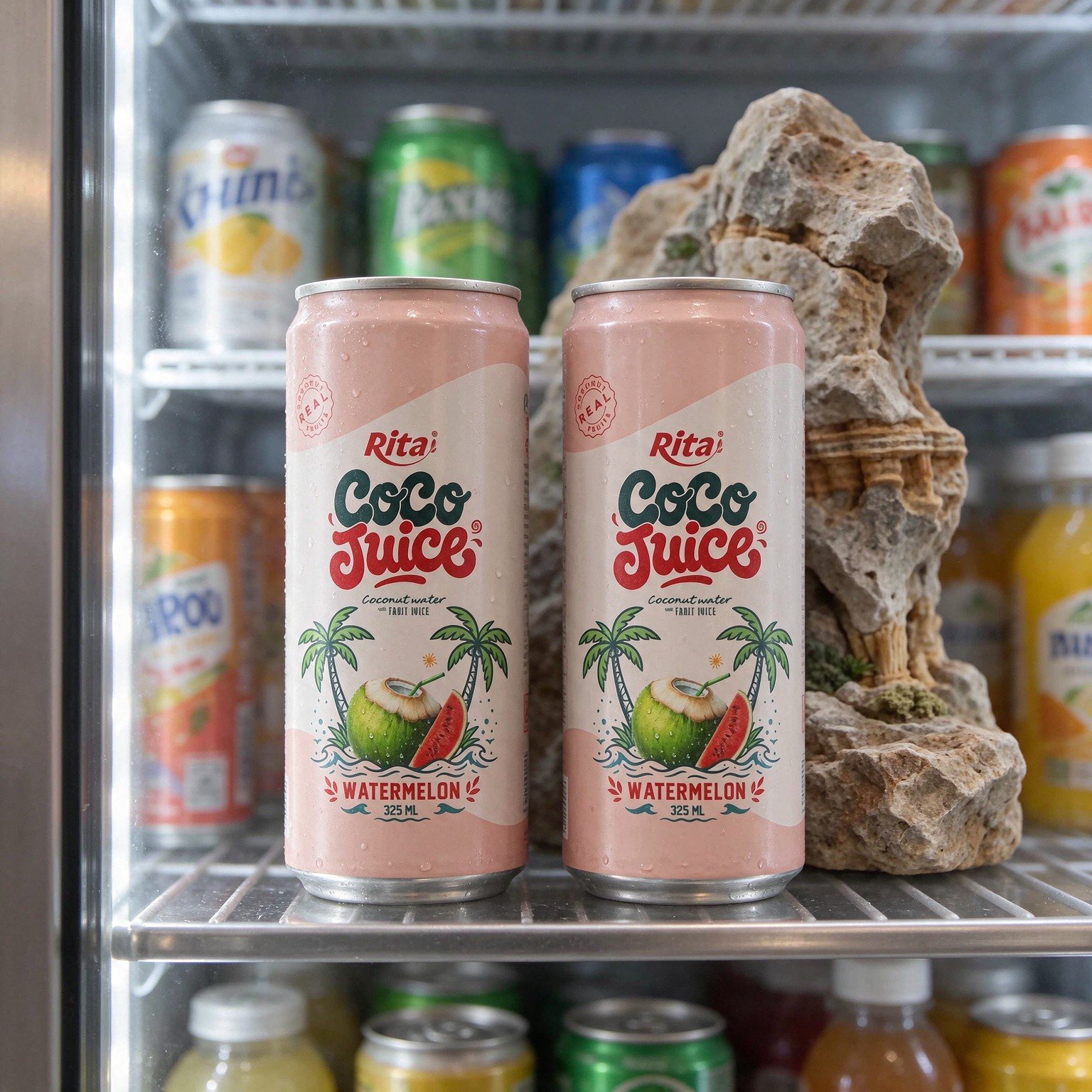
Across markets from the Gulf to Western Europe, Latin America and North America, the pattern repeats. Shoppers arrive with a shortlist built on taste cues rather than heritage. Watermelon reads as summery and uncomplicated without requiring any explanation, while coconut carries a premium-adjacent image assembled through a decade of category marketing. When both appear on a single label, the shopper receives both signals in one glance. That compression of the decision is exactly what a crowded fixture rewards, and it is why blended formats are steadily taking facings from single-ingredient incumbents.
The consequence for buyers is straightforward. Products that communicate flavor and format without effort need less shelf talker support, fewer promotional interventions and a shorter path from trial to repeat. Retailers notice the difference within weeks, and category managers respond by allocating space to items that move without hand-holding.
Novelty Chasing Meets Flavor Familiarity
Consumers say they want something new, but their baskets say they want something recognizable. The market compromise is a familiar fruit layered over a base that feels contemporary. Coconut water has spent ten years travelling from niche shelves to mainstream coolers, and watermelon is one of the most universally understood fruit flavors across age groups and regions. Together they create a proposition that feels adventurous without asking anyone to decode an unfamiliar ingredient, which lowers the risk attached to that first purchase.
Portion Size and Occasion Shape the Purchase
Occasion matters as much as flavor. A 325ml can fits a lunch bag, a gym locker, a hotel minibar tray or a seat pocket on a short-haul flight, which makes it attractive to retailers serving commuters and travelers. Smaller formats also reduce the perceived commitment of a first trial, a factor that counts when a shopper is standing between three labels they have never opened before.
- Convenience and forecourt coolers, where single-serve cans occupy the front row
- Travel retail and airline catering, where portion control and stackability are practical requirements
- Hotel and hospitality minibars that need recognizable flavors for international guests
- Office and campus vending, where a sealed can format simplifies handling
Why Coconut Water With Watermelon Juice Appeals to Modern Shoppers
The blend works because it removes the two objections shoppers usually raise about coconut drinks, heaviness and sameness.
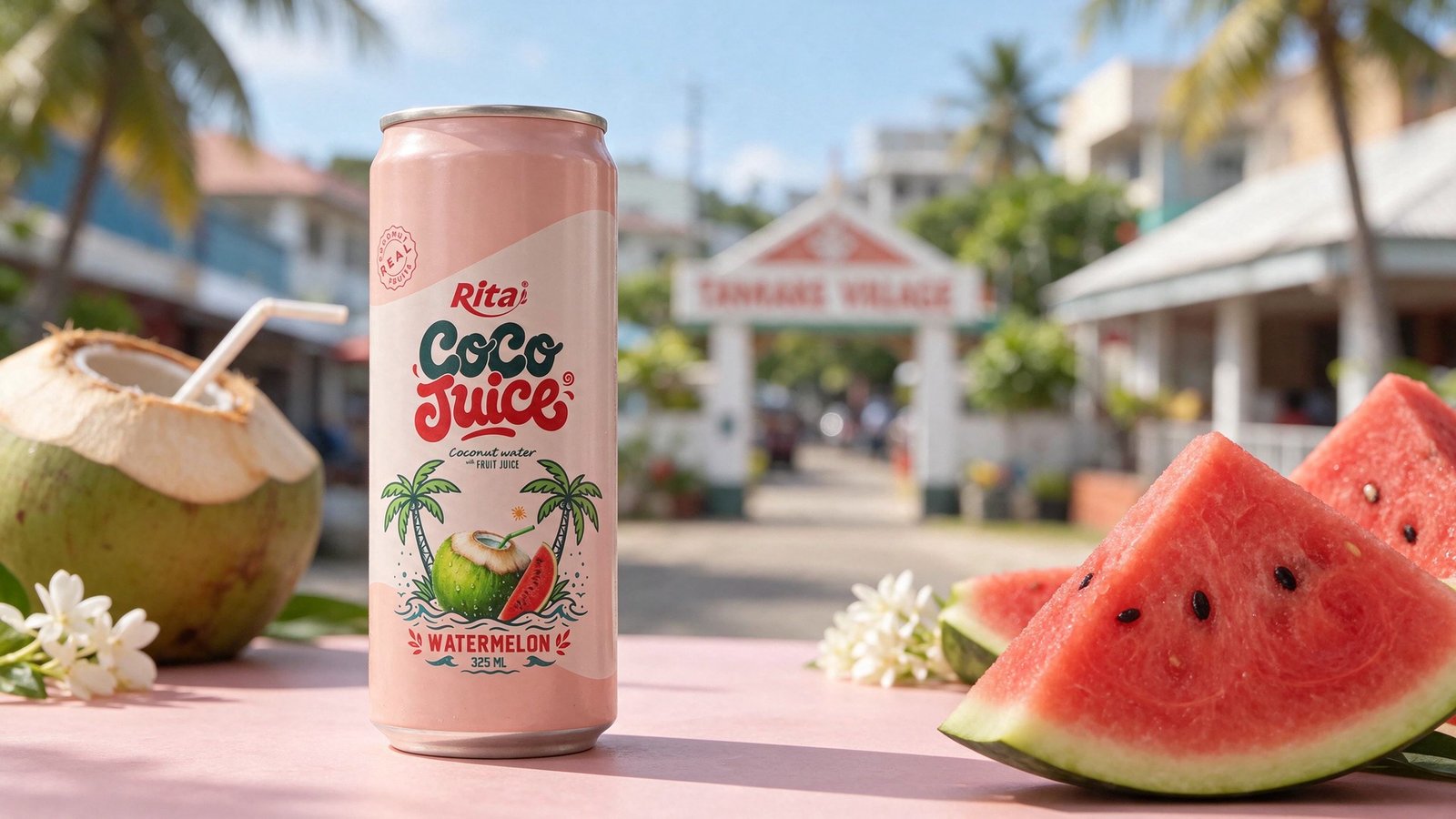
Coconut water brings a clean, mildly sweet base with a thin, easy finish, while watermelon juice contributes a rounded summery top note and a soft pink tone that shows well through label graphics. Neither component overwhelms the other, so the drink stays light from the first sip to the last. That balance matters commercially, because a flavor that fatigues halfway through a can does not earn a second purchase, and repeat consumption is where margin actually sits.
It also travels across cultures without translation. Watermelon is a familiar flavor in the Middle East, South Asia, Southeast Asia, Africa and the Americas alike, so a brand does not need a different story for every market it enters. For exporters, that reduces localization cost and shortens the distance between a first shipment and a repeat order.
Label Literacy Changes the Buying Script
Today's shopper reads the back of the can as carefully as the front. Short ingredient lists, plain language and clear format declarations all reduce hesitation at the point of sale. A straightforward statement such as coconut water with fruit juice, watermelon, in a 325ml can gives a buyer everything needed to decide without assistance, and it survives translation into any retail language without losing meaning. The published specification for the RITA Coco Juice coconut water with watermelon juice 325ml can follows that same principle, presenting facts before persuasion.
Visual Identity and Shelf Presence
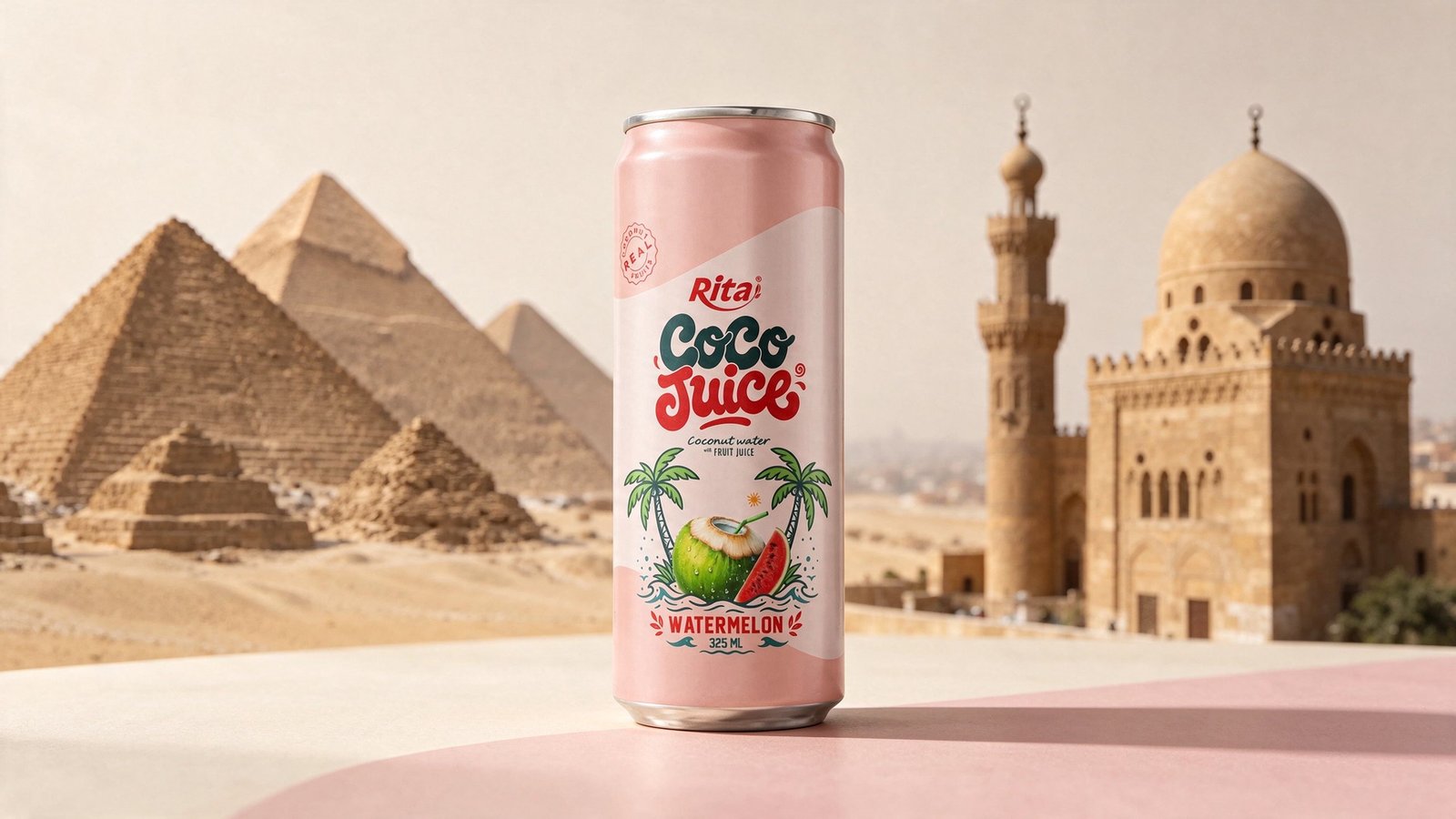
Design carries real weight in this category. Pastel pink and cream panels, palm motifs, a wave graphic and a visible fruit cue help a can stand apart in a cooler crowded with neon energy formats and dark coffee labels. The Coco Juice artwork pairs a circular coconut badge with a red watermelon slice and teal wave lines, so the blend registers before the text is read. Buyers commissioning private label work routinely underestimate how much of the conversion happens at three feet, in a chilled cabinet, in under two seconds.
From Our Orchards: Raw Material Sourcing and Farm Traceability
Sourcing has become part of the product rather than a footnote on a corporate page.
Raw material quality sets the ceiling for what a blend can taste like, and the coconut supply behind this drink is anchored in established growing regions. The manufacturer documents its coconut intake through a Ben Tre coconut farm program, where plantation conditions and intake standards are reviewed from field to finished product.
Fruit inputs for the watermelon component and the wider juice portfolio draw on the Mekong Delta raw material region, an area the company identifies as a high-quality sourcing base for its beverage lines.
A closer look at the growing environment is available in this short farm visit:
Market and Export Outlook for Blended Coconut Beverages
Export demand for blended coconut drinks is broadening well beyond tropical markets into mainstream retail channels.
Market & Export Overview
Annual Trend
| Year | Transactions (lô) | Total Value (USD) | Total Weight (kg) | Total Quantity (đv) | YoY |
|---|---|---|---|---|---|
| 2025 | 30,736 | 587,357,440 | 521,062,036 | 288,325,563 | N/A |
| 2026 | 40,525 | 566,028,847 | 862,715,925 | 339,922,262 | +31.8% transactions; -3.6% value; +65.6% weight; +17.9% quantity |
Data source: Tradesparq Trade Data (tradesparq.com)
Coverage note: figures reflect the AI TradeSeek window Aug 2025–Aug 2025 reporting period as supplied by the source; the two periods are unequal partial-year windows and are shown as reported, not as a like-for-like full-year comparison.
Top Destination Countries
| Destination | Transactions (lô) | Total Value (USD) | Weight (kg) | Market Share % | Avg. Price (USD/đv) |
|---|---|---|---|---|---|
| United States | 33,501 | 376,251,733 | 1,118,492,507 | 47.3% | 1.51 |
| Australia | 3,262 | 54,453,356 | 438,020 | 4.6% | 2.46 |
| Vietnam | 3,175 | 40,383,813 | 8,023,765 | 4.5% | 1.37 |
| Singapore | 3,122 | 89,723,882 | 9,651,955 | 4.4% | 0.79 |
| Netherlands | 2,347 | 108,766,617 | 30,248,792 | 3.3% | 4.05 |
| Peru | 1,766 | 7,125,398 | 1,247,942 | 2.5% | 3.73 |
| United Kingdom | 1,604 | 40,931,218 | 37,707,131 | 2.3% | 5.54 |
| Mexico | 1,399 | 11,812,236 | 10,699,694 | 2.0% | 2.40 |
| Costa Rica | 1,242 | 60,704,775 | 948,396 | 1.8% | 113.25 |
| Canada | 1,167 | 37,373,105 | 17,070,499 | 1.6% | 3.28 |
Data source: Tradesparq Trade Data (tradesparq.com)
Top Origin Countries
| Origin | Transactions (lô) | Total Value (USD) | Weight (kg) | Market Share % | Avg. Price (USD/đv) |
|---|---|---|---|---|---|
| N/A — origin-country breakdown not provided in this source extract | N/A | N/A | N/A | N/A | N/A |
Data source: Tradesparq Trade Data (tradesparq.com)
HS Code Breakdown
| HS Code | Transactions (lô) | Total Value (USD) | Weight (kg) | Market Share % | Avg. Price (USD/đv) |
|---|---|---|---|---|---|
| HS 200989 | 24,208 | 466,501,000 | 487,667,981 | 34.4% | 1.49 |
| HS 220299 | 9,126 | 77,862,232 | 70,227,940 | 12.9% | 3.41 |
| HS 200939 | 3,259 | 167,206,615 | 16,600,794 | 4.6% | 3.83 |
| HS 330300 | 2,029 | 2,761,138 | 527,788 | 2.9% | 14.48 |
| HS 210690 | 1,949 | 18,397,993 | 37,784,144 | 2.8% | 0.82 |
| HS 200990 | 1,916 | 11,640,495 | 11,953,665 | 2.7% | 3.00 |
| HS 220210 | 1,833 | 1,855,697 | 7,119,711 | 2.6% | 1.63 |
| HS 200969 | 1,616 | 111,500,040 | 34,905,877 | 2.3% | 2.04 |
| HS 481190 | 1,294 | 13,713,003 | 0 kg | 1.8% | 1.86 |
| HS 200819 | 839 | 38,164,473 | 42,311,897 | 1.2% | 26.41 |
Data source: Tradesparq Trade Data (tradesparq.com)
The reported figures show transaction activity rising from 30,736 lô to 40,525 lô while total value moves from USD 587,357,440 to USD 566,028,847, with weight increasing from 521,062,036 kg to 862,715,925 kg and quantity from 288,325,563 đv to 339,922,262 đv; the source reports YoY changes of +31.8% transactions, -3.6% value, +65.6% weight and +17.9% quantity. On the destination side, the United States accounts for 47.3% of transactions (33,501 lô, USD 376,251,733, 1,118,492,507 kg, average 1.51 USD/đv), followed by Australia at 4.6%, Vietnam at 4.5%, Singapore at 4.4% and the Netherlands at 3.3%, with average prices ranging from 0.79 USD/đv (Singapore) to 113.25 USD/đv (Costa Rica).
By HS code, HS 200989 leads with a 34.4% share (24,208 lô, USD 466,501,000, average 1.49 USD/đv), while HS 220299 holds 12.9% at an average 3.41 USD/đv and HS 200939 holds 4.6% at 3.83 USD/đv. Monthly figures in the source range from 7,855 lô (09/2025) and 7,110 lô (05/2026) down to 748 lô (08/2026), and the 08/2026 value field is reported as 0 — a zero reported value is not evidence of zero actual trade value.
What the movement means for buyers is a longer shelf window for blended SKUs and a shorter one for undifferentiated single-ingredient offerings. Retailers in mature markets are refreshing beverage lineups more frequently, and suppliers who can present a proven blend with documentation attached tend to advance further in the evaluation process.
Where Coconut Water With Watermelon Juice Lands in Retail and Foodservice
Format is part of that documentation. Aluminum cans travel well over long lead times, stack efficiently in mixed pallets and chill quickly in-store, all of which matter when a container leaves Ho Chi Minh Port and arrives weeks later in a different climate zone. In foodservice, the same can moves from a hotel breakfast counter to a beach club cooler without a change in presentation, which keeps service teams from building separate routines for each channel.
Buyers watching coconut water beverage trends will also notice that blended SKUs tend to hold price better than commodity still water during promotional periods, because shoppers perceive them as a distinct choice rather than a substitute. That pricing resilience is a quiet argument for listing a coconut juice drink alongside, rather than instead of, the core range.
OEM Capacity Behind the RITA Coco Juice Can
Buyers evaluating the category can review the full specification of the RITA Coco Juice coconut water with watermelon juice 325ml can, covering packaging, shelf life, order terms and logistics.
The commercial terms are built for importers running structured replenishment. The product ships in an aluminum can with a 24-month shelf life, a minimum order quantity of 500 cartons, and delivery within 20 to 25 days after order confirmation. Payment is accepted by L/C or T/T on FOB terms from Ho Chi Minh Port, Vietnam, with a supply ability of 600 twenty-foot containers per month. Free samples are available before any volume commitment, which lets a buyer validate taste and packaging against local competition at no cost.
| Specification | Detail |
|---|---|
| Packaging | 325ml aluminum can |
| Shelf life | 24 months |
| Minimum order quantity | 500 cartons |
| Delivery time | 20 to 25 days after order confirmation |
| Supply ability | 600 twenty-foot containers per month |
| Port of loading | Ho Chi Minh Port, Vietnam |
| Payment terms | L/C, T/T, FOB |
Behind the can sits an OEM beverage manufacturer built for scale. RITA Food and Drink Co., Ltd, established in 2004, operates more than 50 automated production lines and ships over 1,200 containers a month to buyers in 180-plus countries, with a portfolio spanning tropical fruit juices, coconut products, functional drinks and energy formats in cans, glass, PET and PP. Certifications include BRC, FSSC 22000, Halal Jakim, Halal HCA-GCC, Kosher, ISO, GMP, HACCP and SMETA, a combination that covers most import requirements in the GCC, Europe and Asia-Pacific inside a single documentation file.
The blend sits alongside a broader coconut products catalog and a separate fruit drinks range, so a buyer who proves one SKU can extend the line without changing suppliers. Additional coconut formulations are also listed in the manufacturer's coconut beverage collection.
For teams that prefer to taste before they plan, a free sample of the 325ml coconut water with watermelon juice can can be requested ahead of any volume discussion, with service coverage running from pre-order consultation through after-sale support.
Frequently Asked Questions
What is coconut water with watermelon juice?
It is a blended drink combining coconut water with watermelon juice, produced by RITA under the Coco Juice label in a 325ml aluminum can. The profile is light and mildly sweet, with watermelon providing the top note and coconut water carrying the base.
What is the shelf life of the RITA Coco Juice 325ml can?
The product carries a 24-month shelf life in its aluminum can format, which suits long transit routes and staggered retail rotations across multiple countries.
What is the minimum order quantity for private label buyers?
The minimum order quantity is 500 cartons, with delivery 20 to 25 days after order confirmation, free samples available before commitment, and payment by L/C or T/T on FOB terms.
Which certifications support export of this coconut water can?
Production is covered by BRC, FSSC 22000, Halal Jakim, Halal HCA-GCC, Kosher, ISO, GMP, HACCP and SMETA. Full specifications for the RITA Coco Juice coconut water with watermelon juice 325ml can are published on the product page.
Related news items:
Older news items:
- Gratitude in Every Lesson: Rita Beverage Honors Vietnamese Teachers’ Day, November 20, 2026 - 20/11/2026 04:48
- Cucumber Lime Electrolyte Drink Gains Global Export Momentum - 19/11/2026 22:06
- International Men's Day November 19: Celebrating Strength, Responsibility and the Men Behind Rita Food & Drink - 19/11/2026 04:49
- Supply Chains Rethink Grape Drinks as Nata De Coco Cans Gain Ground - 17/11/2026 22:40
- Rita at PLMA Chicago 2026: Exploring the U.S. Private Label Beverage Market - 17/11/2026 01:00